Verse 21833aatme;N aave
G13
1
like (a) shadow the cypress and pine would wander {together / with [you]}
2
if/when you with that heart-attracting stature would come into the garden
'The pine-tree, fir, any cone-bearing tree'.
is an archaic form of ( GRAMMAR )
| References | |
|---|---|
| Arshi, Imtiyaz Ali | Ghazal# 206 |
| Raza, Kalidas Gupta | 383 |
| Hamid Ali Khan | Open Image |
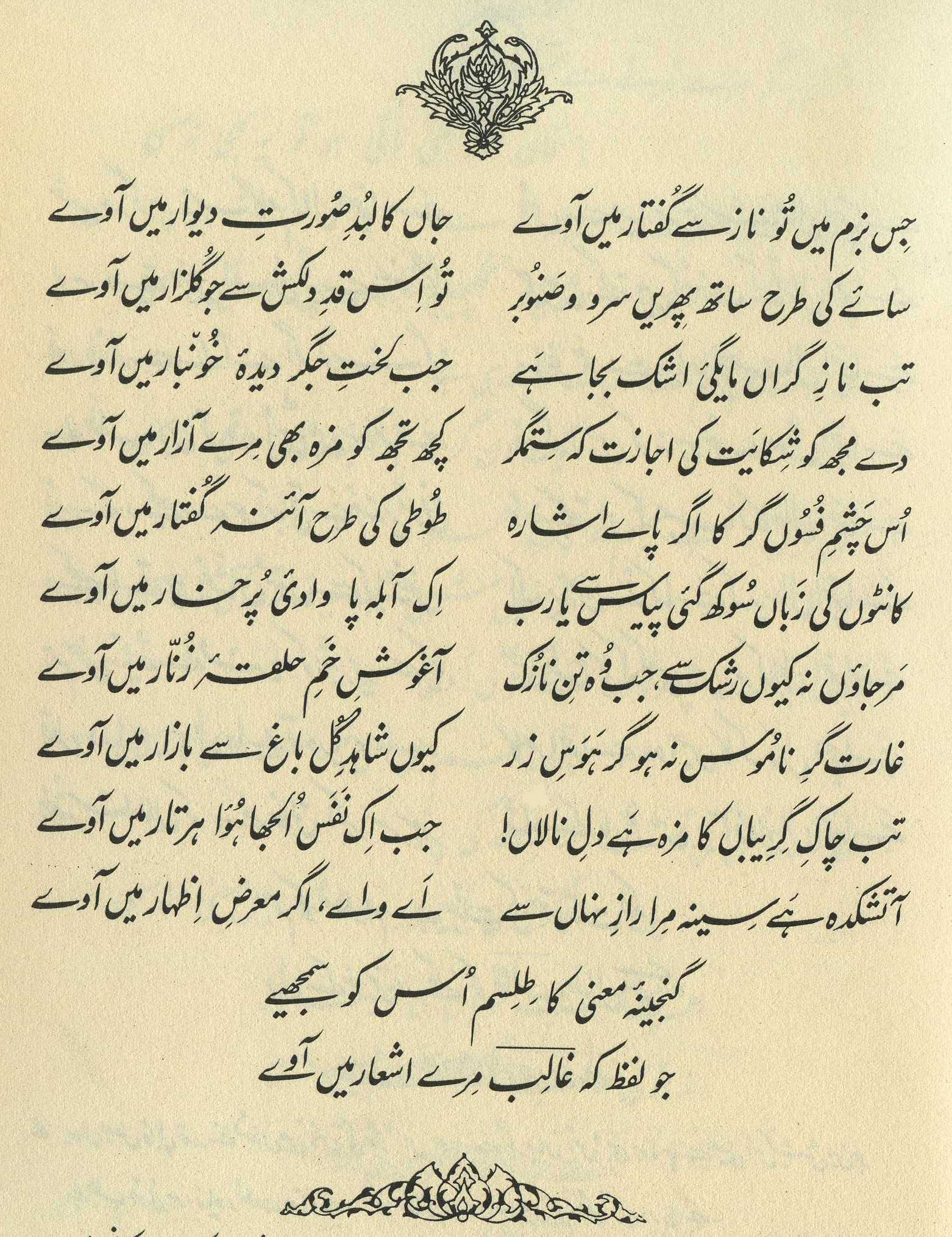
In this verse the word possesses an extraordinary pleasure/refinement, and it's an extremely idiomatic word. And the author is the first person who has used in this situation. All the other poets always versify it in this way: . (193)
== Nazm page 193

He says, 'The cypress and pine would wander together with you like a shadow, they would no longer remain rooted in the garden, if you with your heart-attracting stature would come even one time into the garden.' Here the meaning of is 'with' or 'together with'. The connoisseurs of language [] often use it idiomatically in this way. This verse of Mirza's is the ' high point of the ghazal '. (249)
The heart-attractingness of the beloved's stature has had an extremely powerful effect on the lover's heart, and he considers that there's no one on whom it wouldn't have such an effect. (338)
[See his comments on Mir's M 111,3 .]
The first line is cleverly arranged so that we can read it as a single thought: can easily mean that the two trees would wander together around the garden. They would be like a 'shadow' because if they were close together they'd both, being tall, dark, and slender, look like each other's shadows, and also because they'd then 'shadow' each other, or follow each other closely (in a way similar to the idiomatic usage in English). So we're thinking that the second line might give us a reason why the two would want to wander so closely together in this way. And under mushairah performance conditions, of course, we have to wait for further information.
Then when we finally get to hear the second line, we realize that we need to go back and reinterpret the word to mean not 'with each other' but 'with you'. The beloved's tall slender stature, which of course is traditionally compared to that of the cypress, would so captivate the cypress and pine that they would wander around behind her like her shadow. On the beloved's tall stature, see 38,4 .
The innovative use of that the commentators discuss is one that elides the difference between 'accompanied by' and 'by means of', both of which are part of the normal range of meaning of that versatile little postposition. Fortunately some of the effect can be captured in English by 'with', which can also have both senses ('with a friend' and 'with a hammer').
Note for grammar fans: For the beloved's stature, should we read , or ? Both make plausible meanings. Arshi doesn't commit himself, and Hamid recommends . I've followed my usual rule: when at all in doubt, go for . 'This' applies to the area of time and space immediately around the speaker, while 'that' applies to all the other time and space in the universe. Obviously, there's a lot more 'that' in the universe than 'this', so 'that' is a kind of linguistically 'less marked' form, which is appropriate when we have to remain in some doubt as to which form to use. But often, as here, it doesn't really matter much.
graphics/cypress.jpg