Verse 41833aatme;N aave
G13
1
give me permission for complaint-- {since / so that}, tyrant
2
there would come to you even/also some relish/amusement in my affliction
'Taste savour, smack, relish; delight, pleasure, enjoyment; anything agreeable to the palate or to the mind, &c.; a delicacy, a tidbit; a bon-mot; jest, joke, fun, sport, amusement'.
'Sickness, disorder, disease, infirmity; trouble, affliction; injury, outrage'.
is an archaic form of ( GRAMMAR )
| References | |
|---|---|
| Arshi, Imtiyaz Ali | Ghazal# 206 |
| Raza, Kalidas Gupta | 383 |
| Hamid Ali Khan | Open Image |
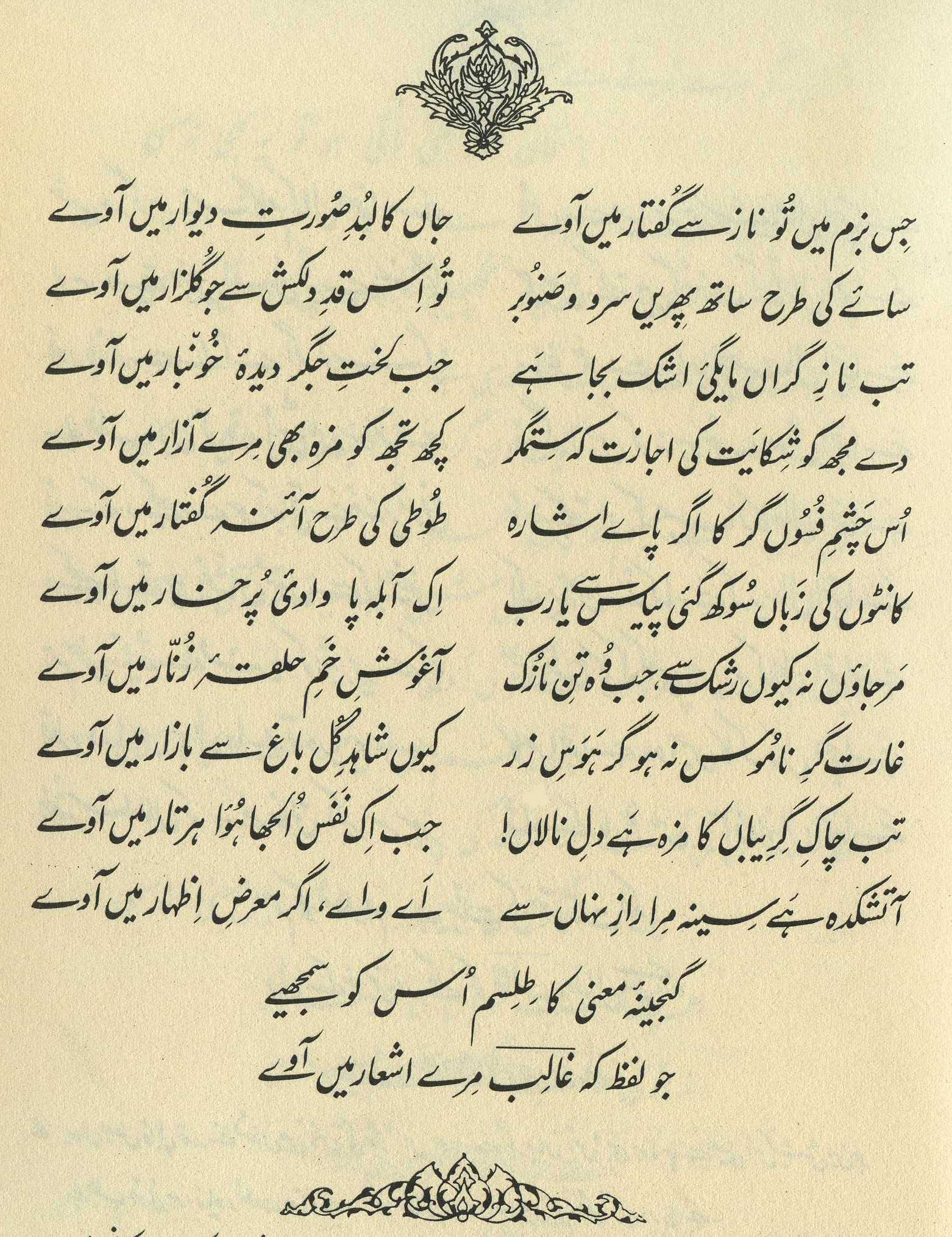
That is, I will do the lamentation and complaint, you'll have the pleasure and find enjoyment. The ' high point of this ground ' [] has come in this verse. (193)
== Nazm page 193

This other verse too [in addition to 173,2 ] is the ' high point of this ground ' []-- when is it vouchsafed to anybody to compose such valuable verses in such limp [] ground s? He says, if you want to experience the relish/amusement of your tyranny, then give me permission to complain. If I endure your tyranny and cruelty with patience and silence, then how will you know which of your cruelties is the most effective and which subtle injustice gave the worst wound? (249)
I am not silent because your tyranny has no effect upon me, but rather because I consider it impermissible to lament without your permission.
I don't ask permission to lament in order to defame you, or because I lack fortitude. Rather, my purpose in this is that you would receive relish/amusement in tormenting me. (338)
It's the position of that that perplexes me. The question is, what exactly does it apply to? From its position, it ought strictly to apply to 'relish/amusement' []. But surely the beloved already gets some such feeling out of tormenting the lover. (Otherwise, why would she do it?) So why this suggestion? Would she get pleasure only from his complaining aloud, and not from his reproachful looks? Or only from his complaining, not from his suffering without complaint?
If were differently positioned, other possibilities would emerge-- ('I already get pleasure from my suffering; let's arrange things so that you do too'); and ('You already get other kinds of pleasure from having me as your faithful lover; you might as well get pleasure from my suffering too'). But I don't see why we would reposition what Ghalib has so clearly positioned.
Instead, we can invoke the idiomatic usage of that renders it almost invisible, just a kind of emphasizer and sentence-balancer: , and other such phrases. Probably that's how we can best read it here. Still, I don't see the special excellence in this verse that Nazm and Bekhud Dihlavi praise. Maybe there's something idiomatic going on that I just don't get.
graphics/blakebookofjob.jpg