Verse 91833aatme;N aave
G13
1
then the relish/pleasure of tearing the collar exists/'is', oh lamenting heart
2
when a single/particular/unique/excellent breath, entangled, would come in every thread
'Groaning, lamenting, complaining;—lamentable'.
'Breath, respiration; --the voice or sound from the breast; --a moment, an instant'.
is an archaic form of ( GRAMMAR )
| References | |
|---|---|
| Arshi, Imtiyaz Ali | Ghazal# 206 |
| Raza, Kalidas Gupta | 383 |
| Hamid Ali Khan | Open Image |
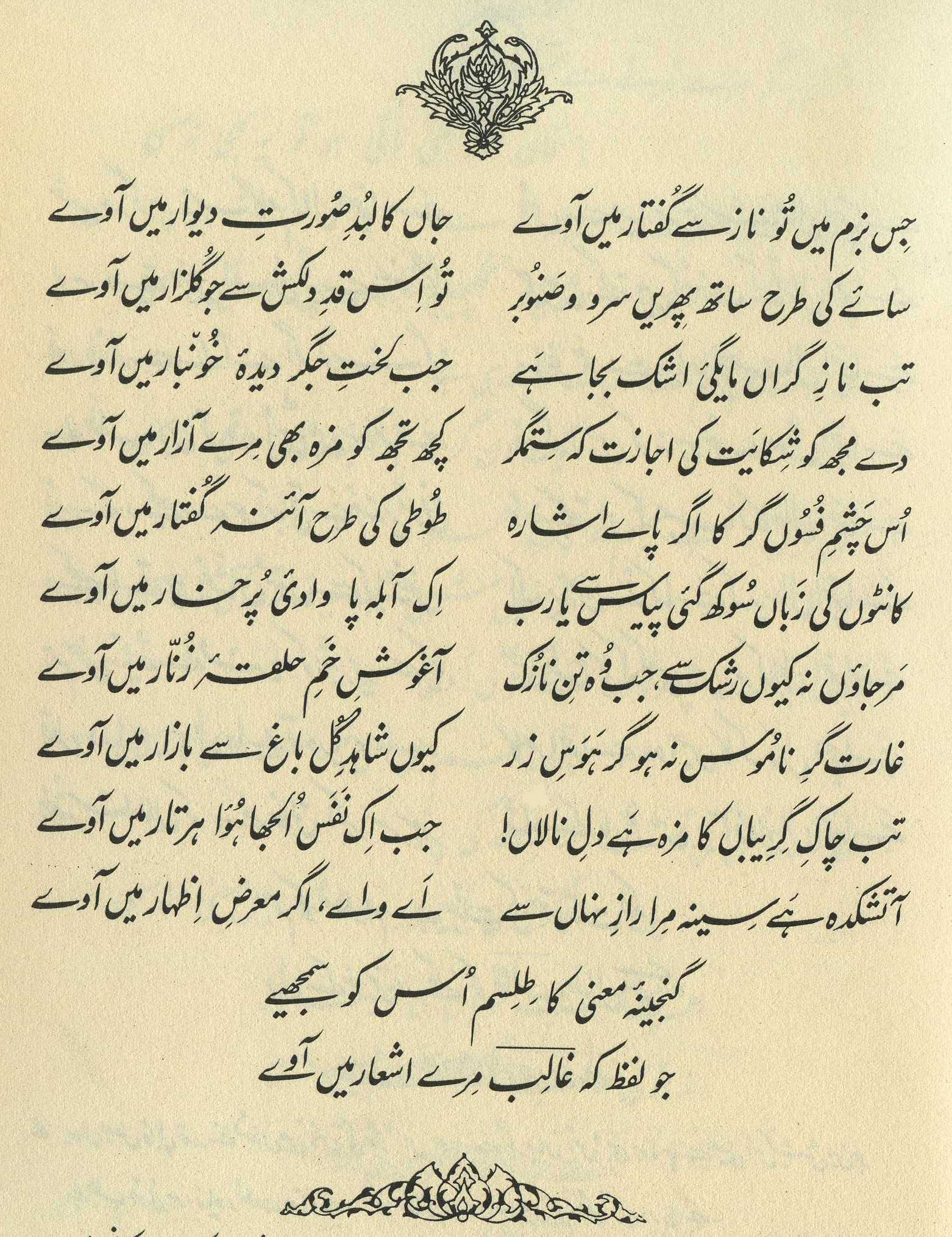
Here, by 'tearing of the collar' is meant the torn-ness of the collar; that is, the pleasure of tearing is that the breath too would be drawn out with the collar, and breathing would be finished. (194)
== Nazm page 194

He says, 'Oh lamenting heart, the pleasure of tearing the collar is that with the thread, the breath too would be drawn out, and when the 'thread of a breath' [] would break and emerge'. (250)
Oh my lament-producing heart, the pleasure of tearing the collar is when with every lament one breath too would be drawn out. That is, the pleasure of madness is that a person would not remain alive and would give his life. (339)
Some manuscripts have instead of in the first line; Arshi discusses the textual situation in his introduction, p. 123.
This verse has the same grammatical and rhetorical structure as 173,3 : the correlative clause is first, the relative one second. Thus suspense is maximized.
But what really energizes the verse is the wordplay involving an idiomatic metaphor so well-known that it's not even used in the verse. Only its separate pieces are there-- and in fact it's even more enjoyable that way, since we have the creative pleasure of putting it together for ourselves. Bekhud Dihlavi uses the phrase outright: he speaks of the 'thread of a breath' []. A breath, like a thread, is linear and has a beginning and an end; one also pulls in or out, or 'draws' [], a breath, as one does in English too. Ghalib makes excellent creative use of such metaphors: remember the literalness of the 'thread of the gaze' [] in 171,1 , which was compared to the thread of the garment-hem. In the present verse, the 'thread of the breath' is part of the fabric and/or the sewing-thread of the collar, so that it's agonizingly (and thus, in ghazal logic, also pleasurably) ripped apart when the mad lover tears his collar (for more on this see 17,9 ).
In addition, itself has several meanings (see the definition above). The meaning of 'breath or respiration' is the most obvious, of course. But 'the voice or sound from the breast' could almost be (especially in the lover's case) a kind of subtle moan or groan, so it works well with the address to 'lamenting heart' in the first line. And if we take the meaning, by extension, of 'a moment', then the rhetorical thrust of the verse becomes even sharper: the real pleasure of 'tearing the collar' is when you can tear away the breaths or moments of your life along with it. (On versus see 15,6 .)
Note for grammar fans: To take as a vocative, though it's not marked as such, is the line of least resistance. Alternatively, we could take it as a predicate nominative ('then the pleasure is a lamenting heart'); this isn't semantically impossible, but it doesn't seem very exciting either; it's hard to see what it would add to the verse.
graphics/tornfabric.jpg