Verse 11816ilhai
G2
1
from the assault/onrush of grief, to this extent I've obtained abasement/'low-headedness'
2
that between the thread of the garment-hem and the thread of the gaze, the difference/distance is difficult [to tell]
'Assault, attack; effort; impetuosity; --crowd, throng, concourse, mob; a swarm'.
'Downcast, dejected; depressed; mean, abject, vile; --backward, inverted; prone; head-downwards; upside-down, topsy-turvy'.
'Separation, intervening space, interval; distance; division, partition; interruption; dispersion; distinction, difference; discrimination'.
| References | |
|---|---|
| Arshi, Imtiyaz Ali | Ghazal# 146 |
| Raza, Kalidas Gupta | 232-33 |
| Nuskhah-e-Hamidiyah | 211-212 |
| Asi, Abdul Bari | 225-226 |
| Gyan Chand | 343-344 |
| Hamid Ali Khan | Open Image |
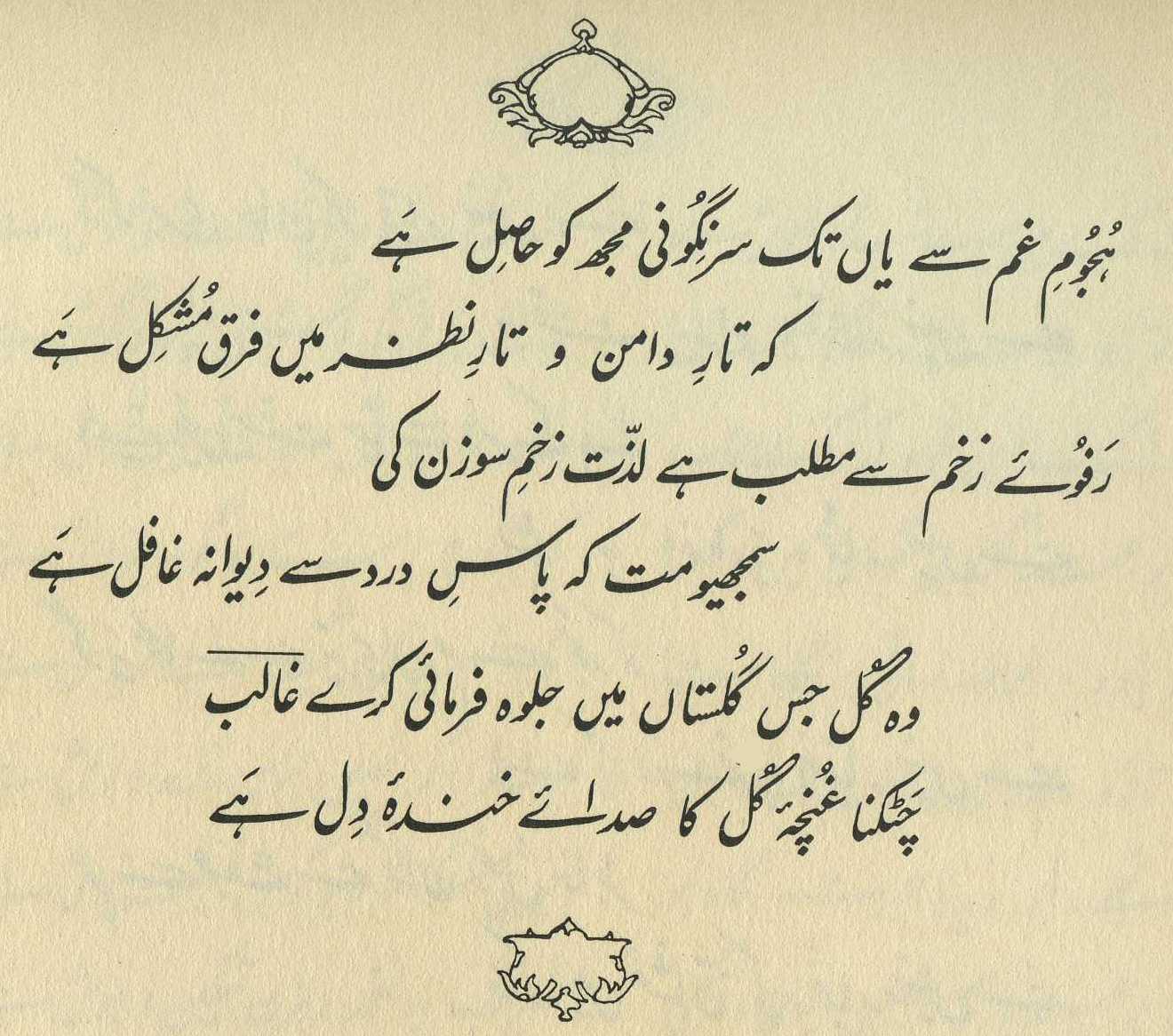
From the burden of grief, the head has sunk down to the garment-hem; now the thread of the garment-hem has become so juxtaposed to the thread of the gaze that it's difficult to distinguish between them. (192)
== Nazm page 192

He says, 'So much grief has fallen to my lot that from the burden of it my head has sunk down to the hem of my robe in such a way that a difference is not perceptible between the threads of the robe and the thread of the gaze.' (247)
From the abundance of grief my head has bowed down in such a way that it is difficult to distinguish between the thread of the gaze and the thread of the garment-hem. That is, now my head doesn't get lifted up from my knees. (335)
This verse offers two kinds of wordplay. The first is based on the multivalence of (literally, 'low-headedness'). As can be seen from the definition above, it has a wide range of meanings, all of which work cleverly with the second line. Why is the lover's head so greatly lowered? Perhaps because (1) he's been assaulted by a vicious mob of griefs, and they have beaten him down under their onslaught. Or perhaps because (2) his griefs include many humiliating memories and realizations about his abject sufferings, so that his head is bowed in embarrassment; he can't possibly look anybody in the eye. Or perhaps because (3) he's been made truly 'vile' or 'mean' by his desperate passion, so that he feels not just social embarrassment but moral shame: he is not worthy to raise his head. Or perhaps because (4) he's been so undone by grief that he's literally 'topsy-turvy', his whole life is 'upside-down'. Any-- or all, since they're not mutually exclusive-- of these possibilities would beautifully and wittily interact with the second line.
The second line offers us an excellent 'objective correlative': both the garment-hem, literally, and the gaze, metaphorically, are associated with a 'thread'. The garment-hem is not just made of (threads of) fabric, but also is probably embroidered with a fancy border that would involve the addition of special 'threads'; in a long, dignified robe, the garment-hem is located as low as possible, somewhere down near the ankles. And of course the gaze is a 'thread'; this metaphorical equation is so strongly established that the 'thread of the gaze' can actually be used for book-binding purposes, as in 10,12 , where gaze imagery is discussed. (Because the gaze is so clearly a thread, it can also become a hair, as in 172,2 .) The commentators point out the meaning, but not the cleverness or wit.
For another extravagant evocation of this hunched-over position, see 172,1 .
graphics/threads.jpg