Verse 21816ilhai
G2
1
through repair of the wound, the purpose is the pleasure/relish of the wound of the needle
2 a
don't consider that the madman is heedless of the respect/attention due to pain!
2 b
don't consider that the madman is heedless, because of regard/consideration for pain!
tlab>> : 'A question, demand, request, petition; proposition; wish, desire; object, intention, aim, purpose, pursuit, motive'.
'Pleasure, delight, enjoyment; sweetness, deliciousness; taste, flavour, relish, savour; —an aphrodisiac; an amorous philter'.
is a metrically compressed form of , the future imperative for ( GRAMMAR )
'Watching, guarding, taking care (of), observing; observance, consideration, attention (to), regard, respect'.
'Unmindful, forgetful, neglectful, negligent, heedless, inadvertent, inattentive, remiss, thoughtless, careless; indolent; imprudent; senseless, unconscious'.
| References | |
|---|---|
| Arshi, Imtiyaz Ali | Ghazal# 146 |
| Raza, Kalidas Gupta | 232-33 |
| Nuskhah-e-Hamidiyah | 211-212 |
| Asi, Abdul Bari | 225-226 |
| Gyan Chand | 343-344 |
| Hamid Ali Khan | Open Image |
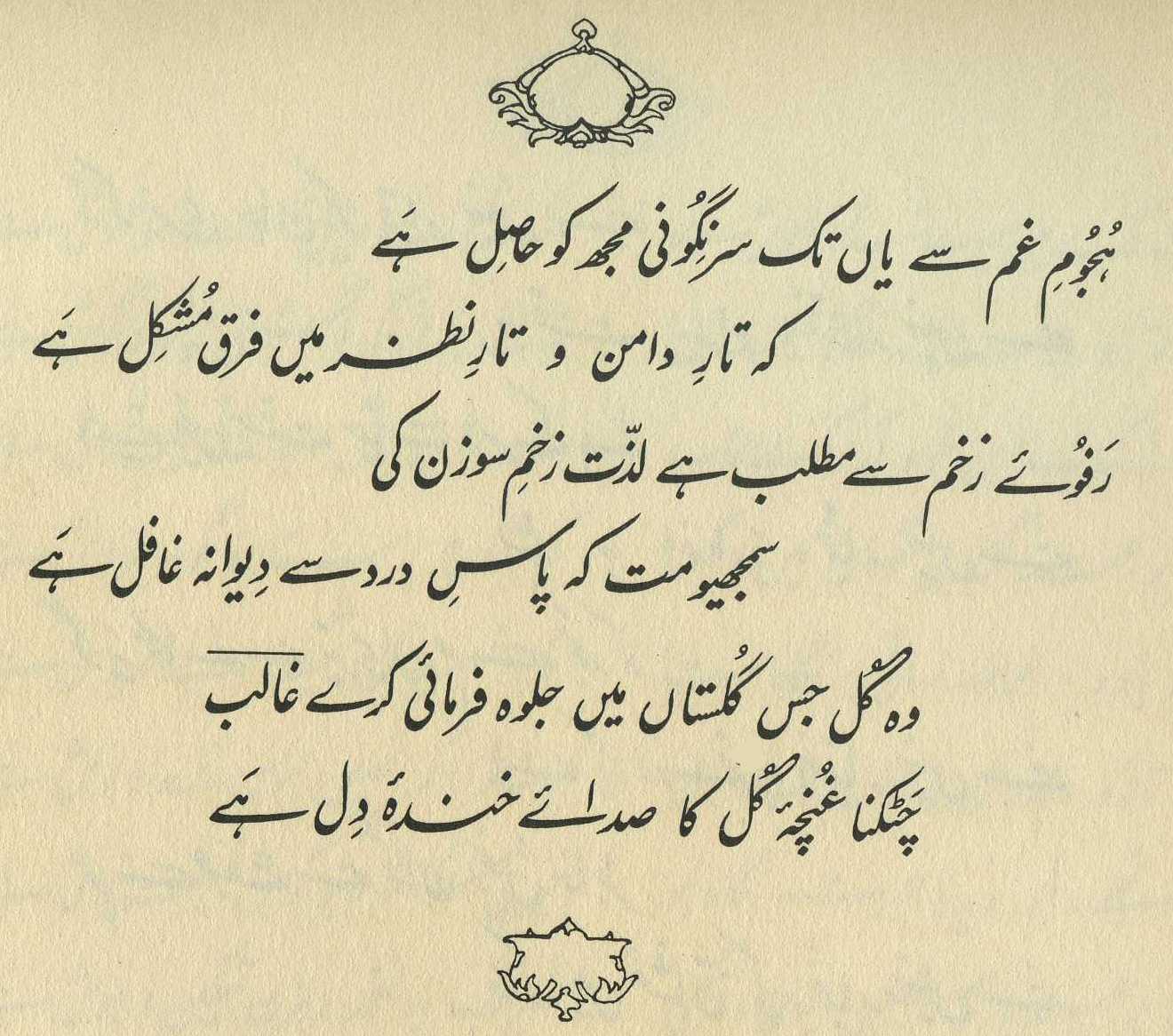
In place of the author has used , from the [metrical] requirement of the verse. (192)
== Nazm page 192

He says, by having the wound stitched up, my goal [] is the pleasure of the wound of the needle. And having obtained that pleaure, when I become self-less [] and entranced, and then return to my senses and writhe with pleasure, don't consider that the madman has become heedless because of the pain of the wound. (247-48)
If the madman has caused his wounds to be stitched up, then his intention is not health. Rather, he wants to experience the pleasure of the needle as well: 87,6 . (335)
Compare 87,6 . (228, 265)
This verse is a fraternal twin of 87,6 , although the greater abstraction of its second line-- in this one, no Other with his cynical or naive eye-- seems to make it slightly less excruciatingly physical. But we're back at the old 'pleasure of pain' paradox, around which so many ghazal verses revolve.
The second line plays neatly with the possibilities of , seconded by the ambiguities of the wonderfully versatile little postposition . Thus paas-e dard se ;Gaafil honaa can mean 'to be heedless of the consideration due to pain' (2a): that is, not to treat pain with all the respect/attention it deserves (in this case, a respect shown by seeking out every possible kind of it). Or the phrase can mean 'to be heedless, from regard for pain' (2b): that is, to neglect his duty as a lover, because of excessive concern about pain (in this case, by having his wound sewn up, which of course is a dubious or even improper act for a lover).
Bekhud Dihlavi tries to read 'heedless' [] as referring to a state of mystical trance that the lover goes into while the wound is being sewed up. This is really stretching the meaning of a bit too far, I think.
graphics/sewingneedles.jpg