Verse 31816ilhai
G2
1
in the garden in which that rose would display its glory/appearance, Ghalib
2
the cracking/bursting of the rosebud is the voice/sound of the laughter/smile of the heart
'To break, to crack with a report, to split, burst, explode; to burst or open (as a bud), to bloom'.
'Laughing, smiling; a laugh; laughter'.
| References | |
|---|---|
| Arshi, Imtiyaz Ali | Ghazal# 146 |
| Raza, Kalidas Gupta | 232-33 |
| Nuskhah-e-Hamidiyah | 211-212 |
| Asi, Abdul Bari | 225-226 |
| Gyan Chand | 343-344 |
| Hamid Ali Khan | Open Image |
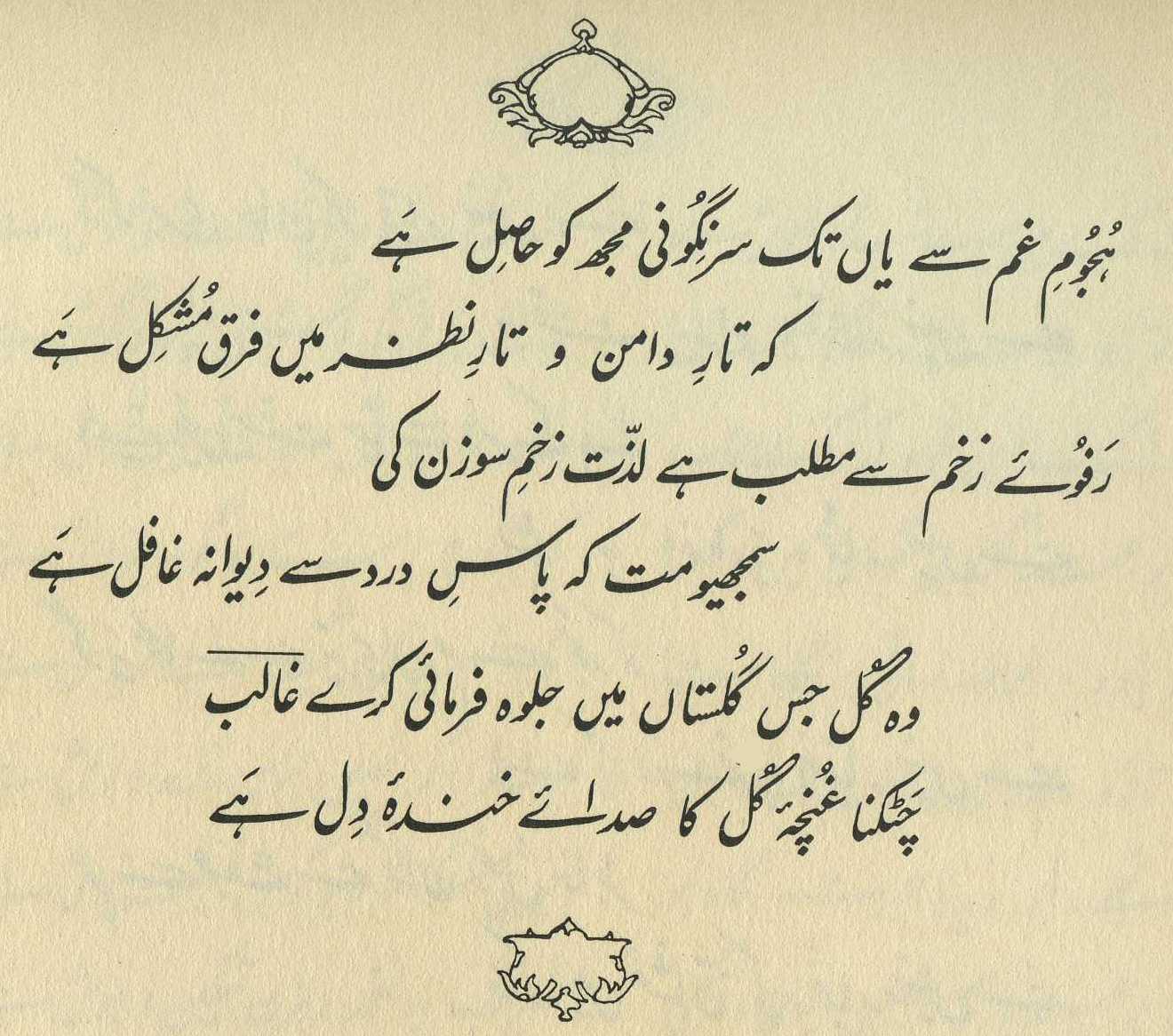
The bud of a rose has a similitude with the heart. The meaning is that from her coming, the heart of the garden {becomes delighted / bursts into bloom} []. There, consider the bud a cracking/bursting, that the voice/sound of the laughter of the heart has been raised. (192)
== Nazm page 192

He says, the garden in which that rose-bodied one would, oh Ghalib, come for a stroll-- when from the effect of her heart-attracting beauty the rose-buds burst open, from them the voice/sound of the hearts laughter emerges. The meaning is that having seen her, the heart of the garden too {becomes delighted / bursts into bloom} []. {248}
Having seen the beloved, his heart {becomes delighted / bursts into bloom} []. From this, the thought has taken root in his heart that whatever garden the beloved enters, there it's wrong to consider that the opening of the buds is 'blooming'; rather, the buds' heart is bursting with the turmoil of joy. (335)
There's a whole set of bud/rose/smile imagery that's very well established in the ghazal world. The closed bud is 'narrow' [] like a 'narrow' or unhappy heart; then when the bud opens out it 'smiles' or 'laughs'; but of course its opening out is also the beginning of its momentary, fugitive bloom of full beauty, after which it will wither rapidly into death. See for example 155,2 , in which the rose's anxiety/scatteredness (of petals) is brilliantly evoked.
The commentators take the present verse as expressing joy and awe, with everybody in the garden captivated by the beloved's beauty. But the nuances of the cracking/bursting [] shouldn't be ignored. The bud's opening is a brief little explosion of sound or motion-- and in the next instant, that moment is gone forever. That's what the joy of the heart is-- a brief moment of sheer delight, followed by an opening-out into a kind of 'bloom'-- and in a few days the petals fall, and it's all over.
Nor is it any ordinary rose, it's 'that rose'-- the human or Divine beloved. But how exactly is 'that rose' different from ordinary roses? Perhaps because its glory/appearance is more potent? Perhaps because it's crueller and more deadly to its lovers? Perhaps because it kills more quickly (which may even be a good thing)?
Moreover, 'that rose' might not display its glory/appearance in just any old garden. Rather, the first line is careful to specify that the effects described in the second line happen in whichever particular garden [] where 'that rose' would or might choose (in the subjunctive) to display itself. A mystical garden? The garden of the lover's heart?
As so often, we're left to put together the mood of the verse from a variety of complex elements: a special rose, a particular garden, a manifestation of joy which is also a conspicuously momentary one and a prelude to decline and death. Which prevails, the joy of that brilliant , or the sorrow of its instant, irrevocable loss? The opening of the bud might be like the 'dance of a spark' in 78,6 .
graphics/rosebud.jpg