Verse 21816aa;Nhai
G4
1
from bud to full bloomings, the provision/'leaf' of contentment-- 'known' [to be nonexistent]!
2
despite heart-{composure/collectedness}, the sleep/dream of the rose is disordered/disturbed/scattered
'Leaf (syn. ); --warlike apparatus; provisions or necessaries for a journey or march; —a musical instrument; melody'.
'Health, soundness; safety, security; well-being, welfare, freedom from evil or discomfort, &c.; success, prosperity'.
'Sleep; dream, vision'.
'Dispersed, scattered; disordered, confused; dishevelled, tossed (as hair); amazed, distracted, perplexed, bewildered, deranged; troubled, distressed, wretched; ruined'.
| References | |
|---|---|
| Arshi, Imtiyaz Ali | Ghazal# 173 |
| Raza, Kalidas Gupta | 258-59 |
| Nuskhah-e-Hamidiyah | 259-260 |
| Gyan Chand | 387-388,552-553 |
| Hamid Ali Khan | Open Image |
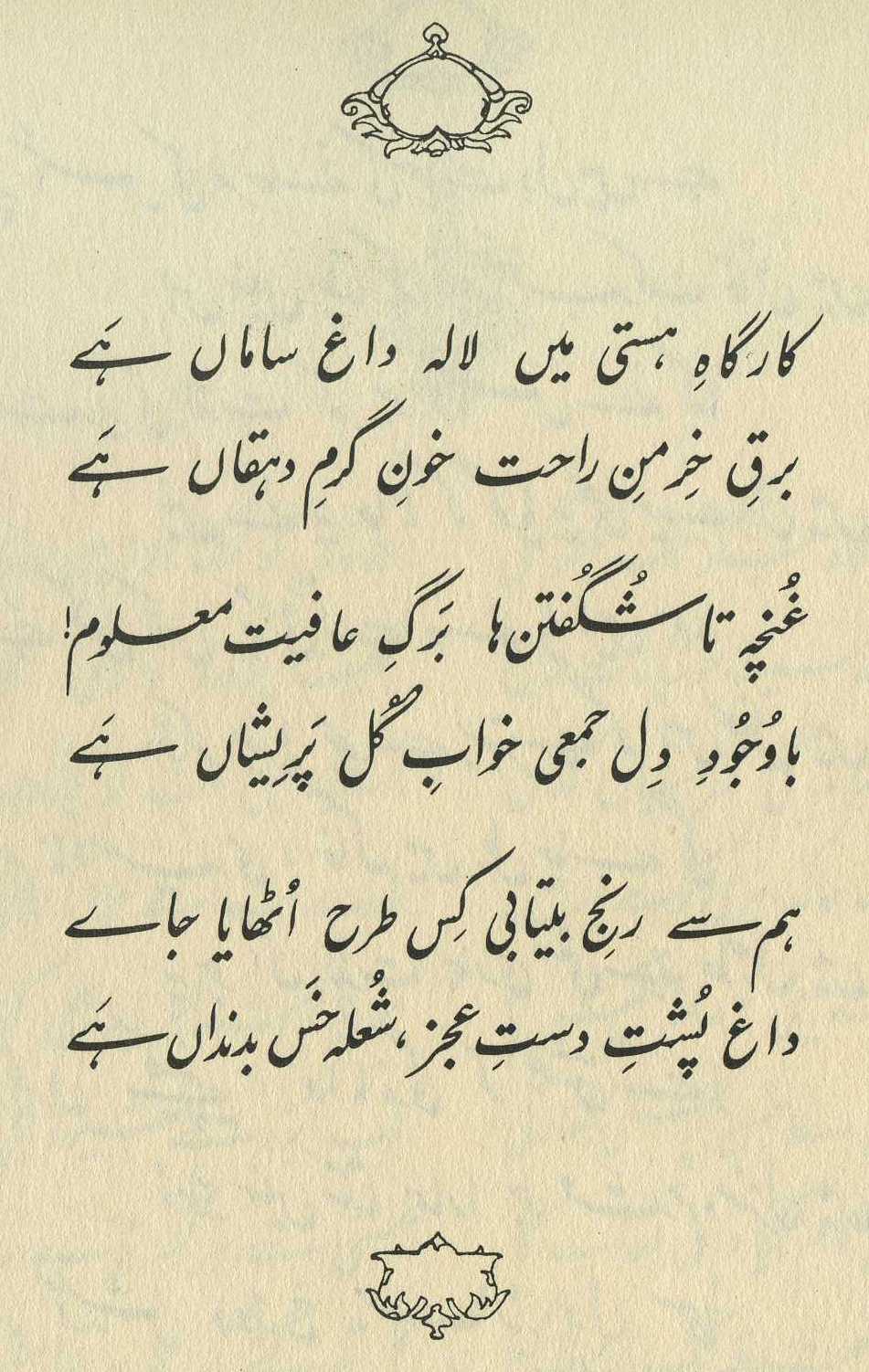
[1866(?), to Shakir:] When the bud emerges, it looks like a pinecone. And as long as the flower remains, the 'provision of contentment' is 'known'. Here, 'known' [] means 'nonexistent' []. And the 'provision of contentment' means 'the property of rest' []. [An illustrative Persian line.] means 'supplies and equipment' []. The sleep/dream of the rose, the personality [] of the rose, is with regard to its silence and its prostration in fatigue []. Its is obvious: that is, its blooming-- that same dishevelment of the petals of the flower. The bud seems composed. Despite this composure, the rose is destined to a disordered sleep/dream. (Arshi p.279)
==Urdu text: Khaliq Anjum vol. 2, p. 845
==Another trans.: Daud Rahbar , pp. 278-79
That is, as long as the bud openly shows its attainment of the 'provision of contentment'-- that is, its remaining happy through contentment-- how can this be known to happen? When this is the case, then the rose has, instead of 'heart-composure', 'anxiety'. And thus the bud has been used as a simile , and from that the aspect of 'heart-collectedness' is manifest. In the same way, the scattering of the petals of the opened rose makes manifest the aspect of 'disturbed'. And the rose's silence and prostration in fatigue show the state of sleep/dream. In short, since all these three states befall the rose, then despite its 'heart-collectedness', the sleep/dream of the rose remains disordered/scattered. And the cause of this disorder is that it broods, 'let's see whether in this realm of disaster the 'provision of contentment' is possible or not'. (167)
== Nazm page 167

[A paraphrase of Nazm's comments.] (299-300)
The Persian verb doesn't look good in Urdu alone like that, without being in some construction. And in addition, Janab Ghalib has added a to it. (360)
In there is an . The reason is that it means 'leaf', and also 'wealth, treasure' []. In connection with the rose, meaning 'leaf' is the most obvious meaning. But here he has taken the remote meaning. (272)
This verse has constructed for the rose a two-stage life cycle: the closed ('composed, collected') bud, followed by the opened ('disturbed, disquieted') rose. At no stage of its life does the rose obtain the 'provisions, supplies'-- or 'leaf'-- of contentment, which is what makes its 'sleep/dream' actually 'disturbed', even if as a bud it looks 'composed'. Ghalib himself explains all this in the letter cited above-- what a rare treat!
Shadan complains about the Persian plural form , or 'bloomings'. This is one of Ghalib's pluralized abstractions; for other examples, see 1,2 . While in other instances the plural form seems to enrich the meaning, here the case is harder to make. The single 'bud' followed by a multiple set of 'bloomings' could perhaps be said to heighten the contrast between the tightness of the former and the scatteredness of the latter, but really that's rather weak. The plural form of course fits nicely into the meter; perhaps even Ghalib once in a while uses just a small wisp of padding .
The first line has a vigorous colloquial effect; it's really an idiomatic negative exclamation (for more on this use of , see 4,3 ). But what's not clear is to whom the rose's predestined lack of the 'provision' of contentment is 'known'. Is some observer exclaiming about the rose's fate, and analyzing the rose's restless sleep/dream? Or does the first line contain the content of the rose's intuitive awareness, the cause of its restless sleep/dream?
Josh claims that 'in there's an ': on first reading we take to mean 'leaf', to go with 'bud' and 'bloomings'; later we realize that what the word really means here is 'provisions' or 'wealth' (see the definition above). I'd say that both meanings apply. Since the verse is entirely about the life of a rose, why wouldn't the rose dream, or brood, about a (real or metaphorical) 'leaf' of contentment? But past a certain point, parsing the exact metaphorical grammar of a ghazal verse becomes a hopeless exercise-- especially in the case of a poet like Ghalib, who enjoys setting up fine, lucid metaphorical equations, and then subvert them or tangle them up.
What I really love about this verse is the second line. It stuck in my mind the first time I ever heard it. It has that great sense of ' mood ', and so much flowingness and resonance! You don't even need the first line, in order to enjoy the second one very fully. In fact it's almost better without the first line, for then you're left to imagine for yourself the nature of the rose's restlessness in its sleep/dream. Then it's a line full of mystery, with a powerful ominousness that evokes for us our own similar fate.
For more on verses, see 44,5x . For another verse that plays (less effectively) with 'collectedness', dream/sleep, and the rose, see 431x,5 . And along similar lines there's also 212,2 .
Also, see Mir 's famous and ' unattainably simple ' meditation on buds and roses, M 6,2 . Is Mir's verse incomparable, or can Ghalib's second line almost measure up?
graphics/bud.jpg