Verse 21821aa;Nniklaa
G5
In this meter the first long syllable may be replaced by a short; and the next-to-last long syllable may be replaced by two shorts.
1
the wound did not {do justice to / finish off} the narrowness/difficulty of the heart, oh Lord
2
even/also the arrow, from the wounded/slaughtered breast, emerged wing-fluttering
'To do justice (to), to appreciate, to give due praise (to)'.
'Straitness, narrowness, tightness, closeness; scantiness, scarcity, distress, difficulty, want, poverty'.
| References | |
|---|---|
| Arshi, Imtiyaz Ali | Ghazal# 6 |
| Raza, Kalidas Gupta | 320-322 |
| Nuskhah-e-Hamidiyah | 33-34,36-37 |
| Asi, Abdul Bari | 54-55 |
| Gyan Chand | 70-72 |
| Hamid Ali Khan | Open Image |
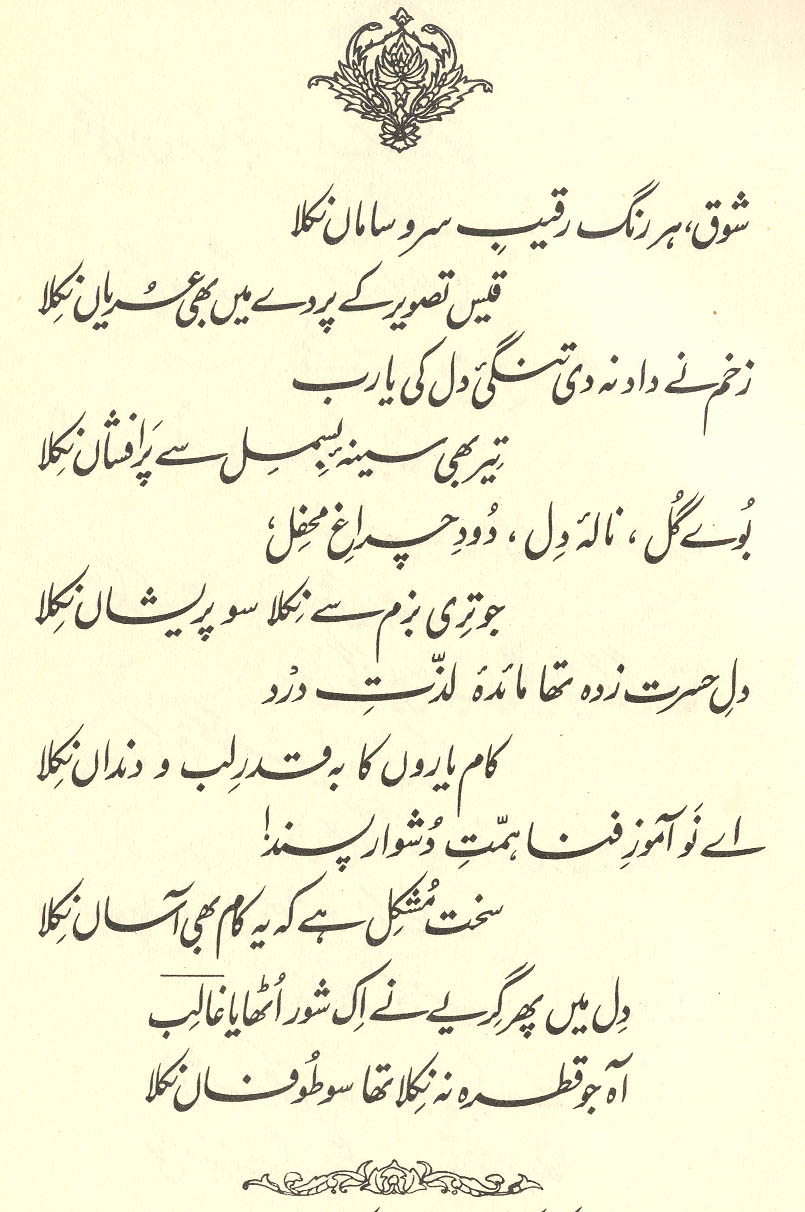
[1865, to Shakir:] I have invented ['drawn out of my temperament'] this new idea ], as in this verse: 209,4 . That is to say, the wound of an arrow is constricted, because there is a single hole, and the wound of a sword is wide, because it opens up a sort of niche. , that is to say, 'it did not put an end to the narrowness'. , that is to say, 'restless', and this word is suitable [] for an arrow. The result is that the arrow didn't at all finish off the narrowness of the heart-- it itself took alarm at the constriction of the place and emerged with wings fluttering and head bewildered.
==Urdu text: Khaliq Anjum vol. 2, pp. 837-38
==another trans.: Daud Rahbar , p. 283
That is, not even the wound in the heart could cope with the narrowness of the heart, and it too complained about the narrowness of the heart: that very arrow by which the wound was made was so constrained by my narrowness of heart that it emerged writhing. In the arrow's writhing it flies more; for this reason 'wing-fluttering', which is a verbal device for a bird, has affinity with an arrow. (6)
== Nazm page 6 ; Nazm page 7


Urdu text: Vajid 1902 {6}
There is one aspect that apparently none of the commentators has noticed. Reflect on 'narrowness of the heart'. This may mean that even before a wound was made, the heart was narrow, and it was hoped that the wound of passion would put an end to the narrowness of the heart. But within the heart the narrowness was so intense that not even the arrow of love could be effective. The narrowness of the heart was such that the arrow wasn't finding a way out; it somehow swept its wings and emerged fluttering, the way a bird emerges from some narrow place.
Accordingly, the interpretation turns out to be that the speaker's heart was, because of the affairs of the world and the [see 5,6 ], so narrow and grief-stricken that not even the wound of passion could ease it. In this way 'narrowness of the heart' is a metaphor, and has also been used in its dictionary meaning. This is Mir and Ghalib's special style. In the light of this interpretation this verse is a picture of Ghalib's fundamental hopelessness and sense of loss, for even the wound of passion, which is said to be the fruit of one's whole life-- even that is in reality vain, ineffective, and insubstantial.
== (1989: 31) 2006: 37-38
This is the third of the three ' meaningless verses ' that Ghalib explained in a letter in 1865.
The grief-stricken heart is colloquially said in Urdu to change its shape and become 'narrow' or 'tight' []. (In English, by contrast, it changes its location: it 'sinks' and becomes 'down'.) The lover's heart is so constricted that even the arrow of passion can't easily get through-- the arrow is on the verge of being trapped there, and finally struggles out in panic, with its wings fluttering and flapping awkwardly. The arrow would normally be powerful and force its way through, tearing the heart open; but here the 'narrowness' of the lover's grief is so overwhelming that not even the arrow (which brings more grief) can really 'open it out' and bring it the relief of destruction. The heart's constriction is the sign of a deathlike grief, but also confers a kind of obsessive focus that renders it immune to external threats.
For an arrow to have 'wings' is delightfully appropriate, since it has 'feathers' made of actual bird feathers, and these help to enable and guide its flight just as a bird's wings do. Ghalib is fond of unlikely wing-flutterers: in addition to the arrow here, we have a candle in 75,5 ; polish-lines in a mirror in 113,6 ; the lover in 166,4 ; and a wave of blood in 176,6 .
graphics/arrows.jpg