Verse 7x1821aa;Nniklaa
G5
In this meter the first long syllable may be replaced by a short; and the next-to-last long syllable may be replaced by two shorts.
1
even/also from the workshop/factory of madness I emerged naked
2
a collar or two didn't turn out to be in my {destiny/'cutting-out'}
'A workshop, factory, manufactory; an arsenal; a dockyard; a laboratory; any place where public works are carried on; an office; a great work; a business, concern; way of action, procedure'.
'Division, distribution, partition (of a thing);... a portion, share lot; fortune, fate, destiny; divine decree'.
'Half, part, some'.
| References | |
|---|---|
| Arshi, Imtiyaz Ali | Ghazal# 6 |
| Raza, Kalidas Gupta | 320-322 |
| Nuskhah-e-Hamidiyah | 33-34,36-37 |
| Asi, Abdul Bari | 54-55 |
| Gyan Chand | 70-72 |
| Hamid Ali Khan | Open Image |
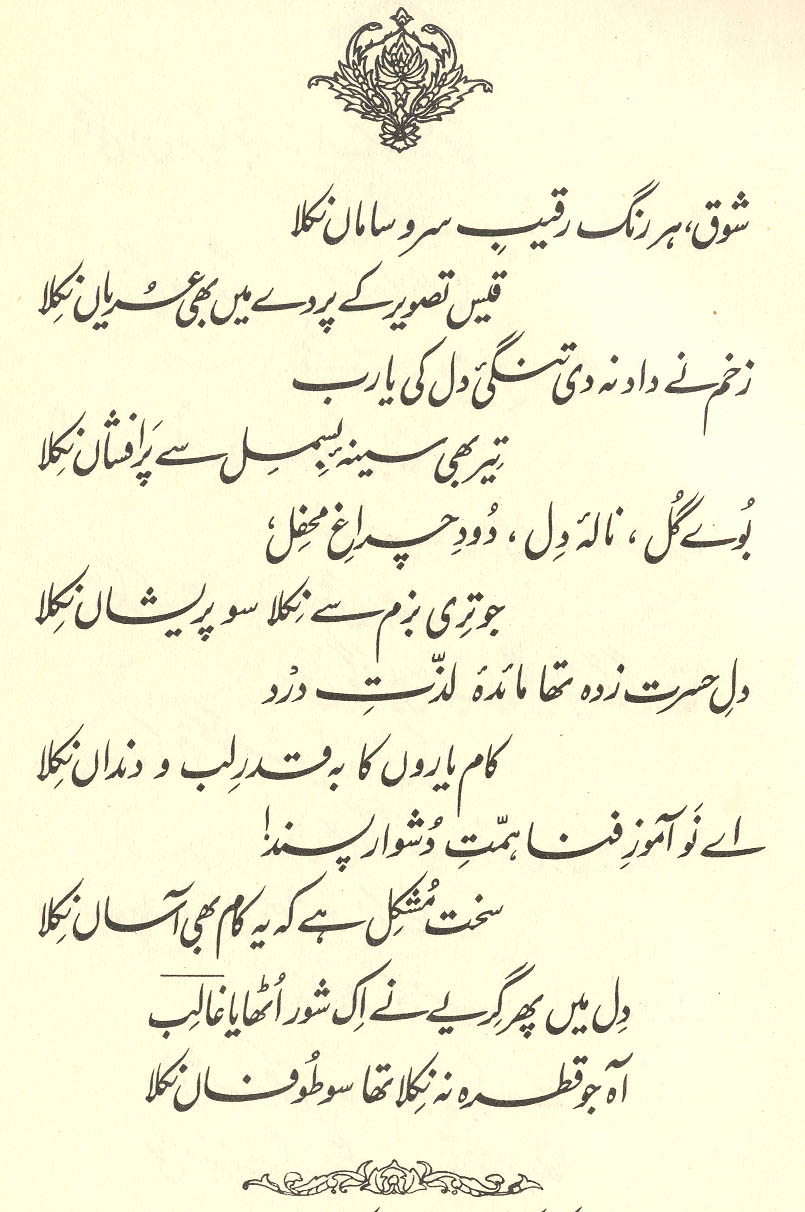
I came vainly back from the workshop of madness, and even in that workshop no collar turned out to be in my destiny. It was necessary for there to be many collars in the workshop of madness.
== Asi, p. 54
He has imagined madness as a world of madness, and in that capacity has called it a workshop where madmen are steadily created and sent forth. Then he has reflected that at the time when the madmen are created, it's necessary that their clothing would be removed; for this reason there must be heaps of torn-up garment-hems and collars lying around. But this idea was incorrect. After experience, he says that he went into a workshop where there ought to be no shortage of garment-hems and collars-- but look at the ill-fortune, that even there he obtained not even a single torn collar! ....
The eloquence in it is this: that by forming a mad desire, the poet is giving proof of his being mad. Along these lines is a peerless verse by Hakim Momin Khan:
[work a cure of the ebullience of wildness/madness, physician
bring me a whole wilderness/jungle from the bazaar]
== Zamin, p. 34
Since they call a 'factory' [] a workshop, from this Ghalib has created the thought that there must be many fabrics there. But even from there he emerged naked. No collar-- that is, garment-- became available to him. In the verse is superfluous, because to emerge naked from the workshop of madness is precisely what is natural. ought to have come at a time when there was some unexpected situation.
== Gyan Chand, p. 70
For background see S. R. Faruqi's choices . This verse is NOT one of his choices; I thought it was interesting and have added it myself. For more on Ghalib's unpublished verses, see the discussion in 4,8x .
The mad lover, as we know, rips open the neck of his kurta (actually a vertical slit neck, for which 'collar' is a misleading translation) as a matter of course. For a discussion of this basic ghazal theme , see 17,9 . The discussion in {17,9} also deals with the secondary sense of as the cutting-out of cloth (as well as of destiny)-- and in the present verse, does it also perhaps refer to the 'cutting out' of the lover himself, as he's shaped in the workshop of madness?
Here it seems that the lover didn't even have the chance to tear open his collar, for right from the 'workshop of madness'-- and what kind of place is that?-- he emerged naked. It seems that his destiny-- or his 'cutting-out', as in fabric-- didn't include 'a collar or two'. Here are some of the possible implications of this observation:
=His destiny was so impoverished and wretched that it didn't include even a few collars for him to rip open and thus temporarily ease his madness.
=Even before he actually emerged from the workshop of madness, he had already ripped to pieces the few collars destiny would have allocated to him.
=His special, elite destiny as a mad lover was nakedness, and this destiny was clear from the moment he emerged from the workshop of madness: unlike other lovers, he didn't even have the chance or need to rip open a series of collars.
This third possibility is where the comes in (contrary to Gyan Chand's claim). The speaker emerged naked not only from one more situation similar to the many ordinary situations in which he would have torn off his clothes (the 'also' case), but from, unexpectedly and remarkably, the very workshop of madness itself (the 'even' case).
Compare this verse's more fortunate cousin 6,1 , which (deservedly) made it into the published divan .
graphics/majnun.jpg