Verse 11x1821aa;Nniklaa
G5
In this meter the first long syllable may be replaced by a short; and the next-to-last long syllable may be replaced by two shorts.
1
look at the tumult of the disgrace of the heart-- that a single lament of ardor
2 a
was hidden in a hundred thousand veils/pardahs-- but {emerged / turned out to be} just as naked as ever
2 b
was hidden in a hundred thousand veils/pardahs-- but that very one {emerged / turned out to be} naked
'Cry, noise, outcry, exclamation, din, clamour, uproar, tumult, disturbance; renown'.
'Dishonoured, disgraced, infamous, ignominious; humiliated; open, notorious; accused; one held up to public view, as an example to deter'. (Steingass p.576)
| References | |
|---|---|
| Arshi, Imtiyaz Ali | Ghazal# 6 |
| Raza, Kalidas Gupta | 320-322 |
| Nuskhah-e-Hamidiyah | 33-34,36-37 |
| Asi, Abdul Bari | 54-55 |
| Gyan Chand | 70-72 |
| Hamid Ali Khan | Open Image |
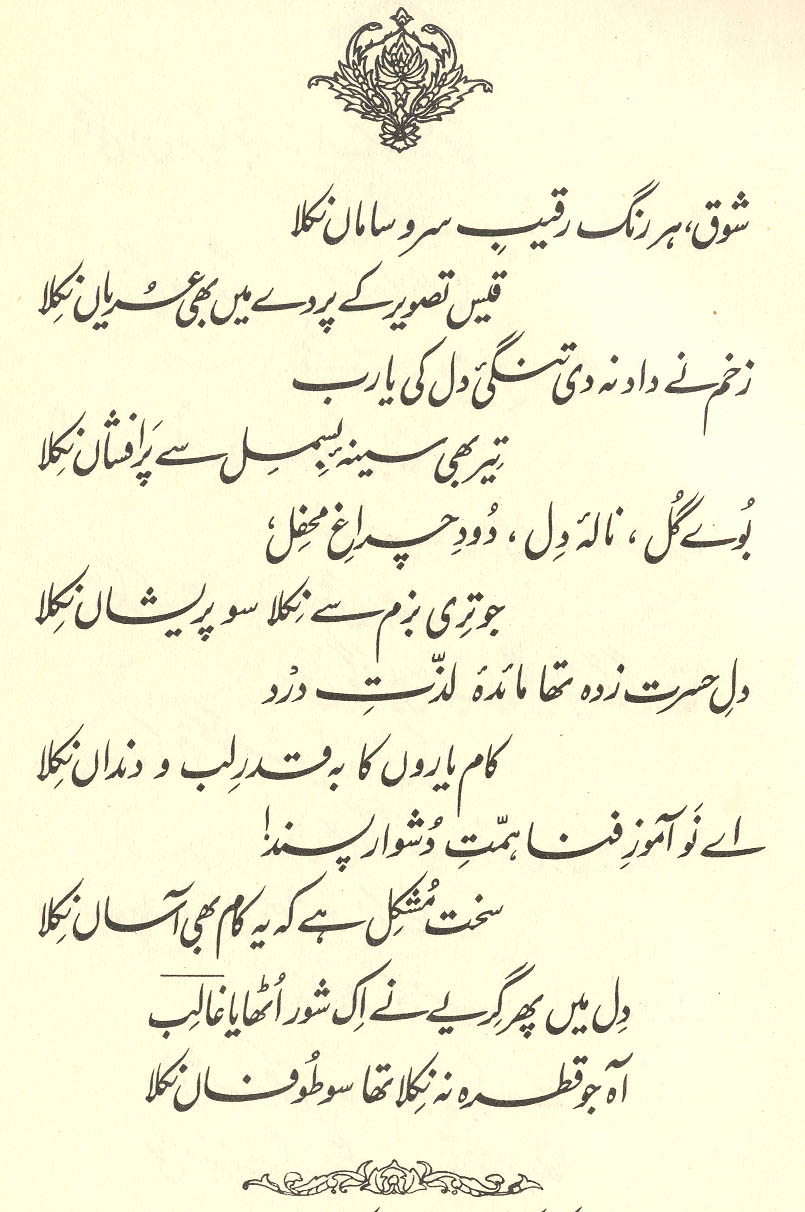
Just look at the heart's ardor for disgrace. A single ardent lament of the heart was hidden in a hundred thousand veils and became settled there. But nevertheless, its nakedness became manifest and remained so; and when it emerged, it emerged naked.
== Asi, p. 55
He has brought in for its affinity with . He has said instead of ... so that the that is at the end of the line would not be repeated.
== Zamin, p. 36
The place of the lament is in the throat and in the chamber of the mouth. This is as if the lament would be hidden within a veil/pardah. The disgrace of the lover's heart is to such an extent that it tried a thousand times to hide a single lament of passion, but it became manifest, and without any reserve came before everybody, in public view.
== Gyan Chand, p. 71
For background see S. R. Faruqi's choices . This verse is NOT one of his choices; I thought it was interesting and have added it myself. For more on Ghalib's unpublished verses, see the discussion in 4,8x .
For other examples of the use of 'naked' [], and discussion, see 6,1 . Obviously, nakedness is the opposite of being veiled, and of being in seclusion [], and of being hidden. And 'emerged' is how one leaves a state of veiling, or seclusion, or hiddenness; though can also mean 'turned out to be' (or 'emerged as'), which works as a perfect expression of surprise at such a change (from veiledness to exposure)-- or non-change (from nakedness to renewed nakedness).
The clever use of is the icing on the cake. Literally of course it means 'that very one', as in (2b). But colloquially, it can also mean something like 'in that very same (naked) condition', as in (2a).
Still, it's not hard to see why among 'nakedness' verses, 6,1 made it into the published divan , and this one didn't. This one has all the small pleasures of wordplay and clever multivalence, but none of the grand ones of astonishing meaning that are provided by {6,1}.
graphics/heartveil.jpg