Verse 41853aakahiye
G9
In this meter the next-to-last long syllable may be replaced by two shorts.
1
it is not a means/cause of ease/relief, the wound of the arrow-head
2
it's that wound of the sword that one should/would call exhilarating/'heart-opening'
'A means of access or approach, medium, means, instrumentality, agency, cause, occasion'.
'Quiet, rest, repose, ease, tranquillity, cessation of toil or trouble or inconvenience, freedom from toil or trouble, &c., relief; pleasure'.
'Opening, expanding; displaying; loosening; solving; revealing'.
| References | |
|---|---|
| Arshi, Imtiyaz Ali | Ghazal# 228 |
| Raza, Kalidas Gupta | 441-42 |
| Hamid Ali Khan | Open Image |
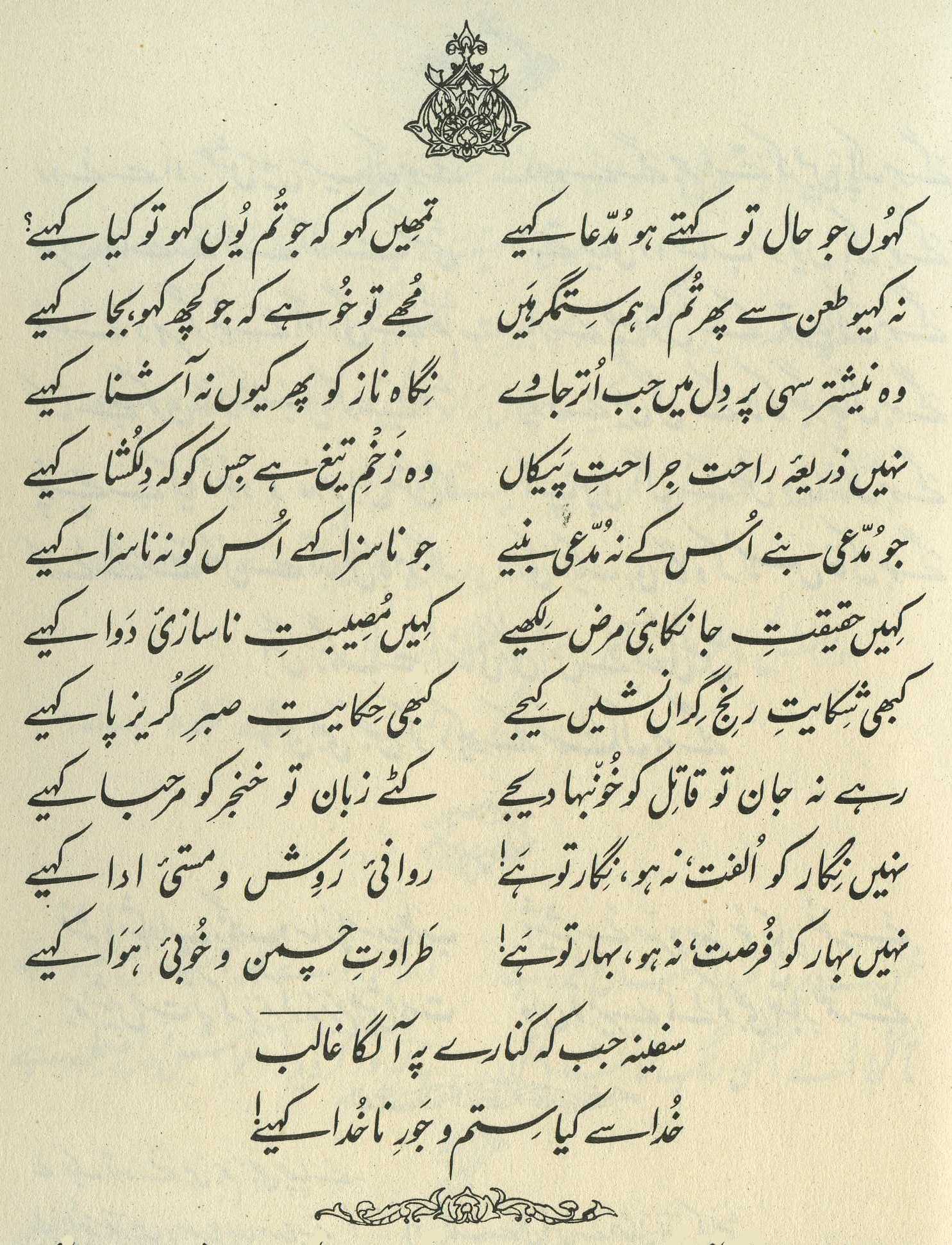
[See the discussion of this verse in connection with 6,2 .]
'Heart-opening' is that thing through which the narrowness of the heart [] would be removed, and expansion [] of temperament would be attained. Here he explains the pleasure of a wound: that the wound of an arrow is not a cause of ease/relief/pleasure. But how to describe the wound of a sword! For from it the heart becomes happy. The sound-resemblance [] between and has been constructed through the art of eloquence []. (237)
== Nazm page 237

He says, the wound of the head of an arrow can't become the cause of expansion of temperament. The wound that one ought to call 'heart-opening' is the broad wound of a sword; through it the heart becomes joyous. (293)
In a state of happiness the heart opens, and in a state of sorrow it becomes confined. (422)
The first line gives us, as Nazm points out, the flowing and intriguing sound effects of , but it doesn't give us much of a clue about where the verse might be going. We might well expect that the second line would tell us more about the nature of the suffering inflicted by the arrow-head: its wound doesn't give , but perhaps it gives something else instead; for an example of this line of thought, see 20,4 . Of course, at a mushairah we would have to wait a bit before finding out.
When we finally hear the second line, it introduces us to the wound of the sword, which is to be contrasted to the wound of the arrow in some way-- some way that we can't at all guess until, in proper mushairah-verse style, the last possible moment. Then when we're finally allowed to hear 'heart-opening' [], it all comes together with a sudden rush of meaning. For the general metaphorical contrast is now clear: the arrow-wound isn't pleasing/satisfying, but the sword-wound is. And at the same moment we realize that if we 'concretize' the metaphors, we've also been given the reason.
For the sword-wound is 'heart-opening' in a literal sense, since it lays the heart open with a broad, deep slash, and thus provides both more of the pleasure of pain (that favorite ghazal paradox), and also more effective access to the 'relief/ease' (and even 'exhilaration') of death. Thus it's superior to the arrow-wound, which makes a 'narrow' hole and thus is unable to 'open' the literal 'narrowness' (metaphorically, the unhappiness) of the heart.
For a close cousin of this verse-- as Ghalib himself points out-- see 6,2 . For a similar use of 'heart-opening', see 4,14x . On the idiomatically flexible possibilities of , see 209,1 .
graphics/sword.jpg