Verse 111853aakahiye
G9
In this meter the next-to-last long syllable may be replaced by two shorts.
1
when/since the ship has come and docked at the shore, Ghalib
2 a
will you tell the Lord about the cruelty and oppression of the captain/'ship-lord'?
2 b
as if you will tell the Lord about the cruelty and oppression of the captain/'ship-lord'!
2 c
how you will tell the Lord about the cruelty and oppression of the captain/'ship-lord'!
'adv. & conj. At the time when, when; while; since (temp. & caus.)'.
| References | |
|---|---|
| Arshi, Imtiyaz Ali | Ghazal# 228 |
| Raza, Kalidas Gupta | 441-42 |
| Hamid Ali Khan | Open Image |
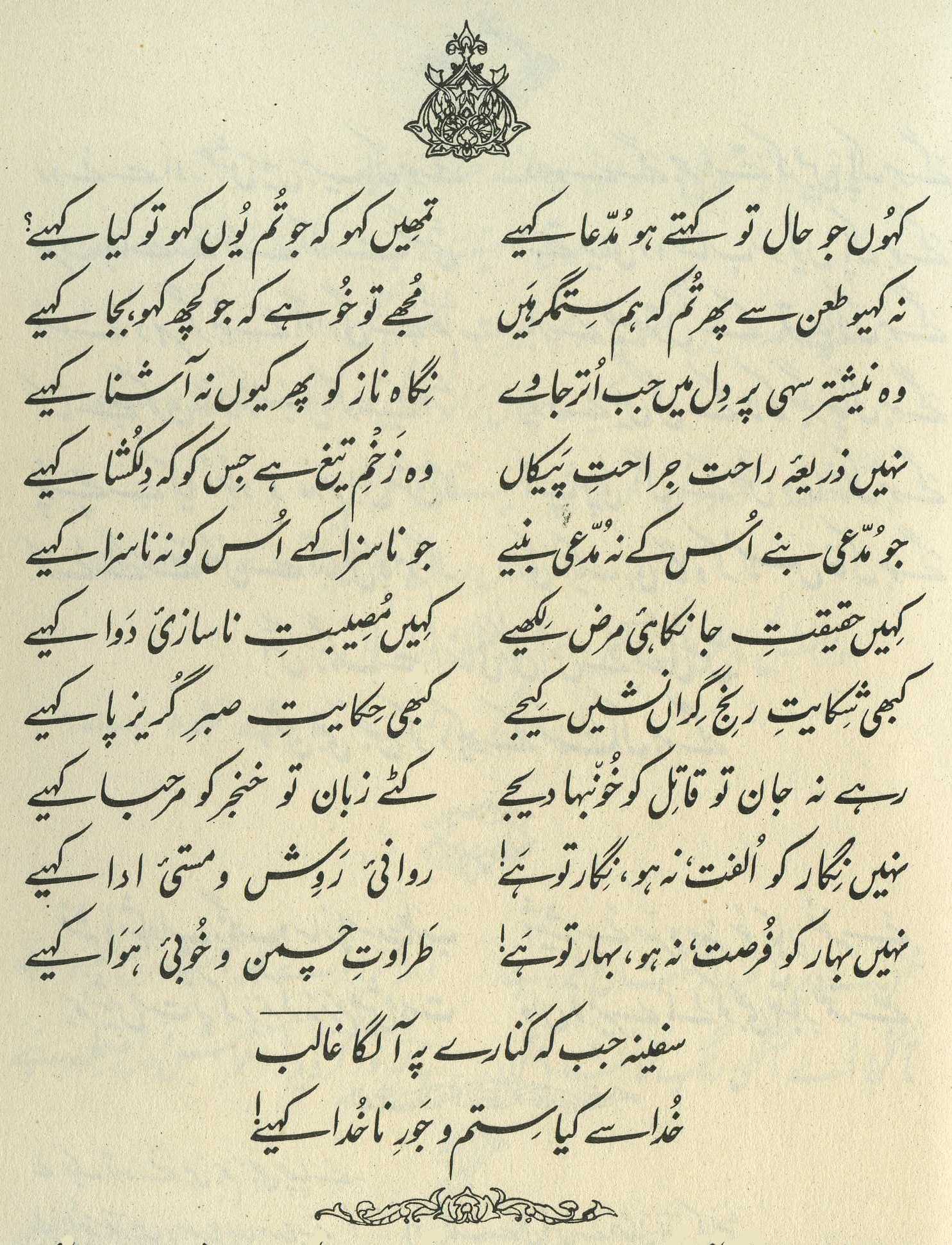
That is, if someone would have done evil, and that time would have passed, then one ought to forget about it, and not keep it in the heart. Luqman [a figure somewhat like Aesop] has summarized the wisdom of morality in four things:... two things are to be remembered: the coming of death, and the Lord's being present and all-seeing; and two things are to be forgotten: to have done some kindness to somebody, and somebody's having done some evil. (238)
== Nazm page 238

He says, 'Oh Ghalib, after the time of difficulty and trouble has passed, one ought to forget it, and not knot it up within the heart; rather, one ought not then even to complain to anyone'. (296)
You ought not to complain of the cruelty and oppression of the captain for this reason: that he may have been cruel, but he also brought you to shore. (426)
Here is a superb example of the delights of . The second line offers three possible readings. Since the ship has now reached the shore,
=Will you tell the Lord about the captain's cruelty and oppression, or won't you? There might be good arguments on both sides, and you'll have to think about it before deciding (2a).
=What! You will tell the Lord about the captain's cruelty and oppression?! Surely not! What's past is past, as the commentators observe, and why hold a futile grudge? Moreover, as Bekhud Mohani points out, the captain did after all fulfill his main task by getting you to shore (2b).
=How you will tell the Lord about the captain's cruelty and oppression! You will really give the Lord an earful! In the middle of the voyage, it's hard to judge these things rightly, or to anticipate how things might look tomorrow. And the captain can be very frightening. But now that you've arrived, you can safely report to the Lord how the captain had tormented you.
Needless to say, all three readings work most enjoyably, in their different ways, with the first line. The classic metaphor of life as a voyage, and death as arrival, hovers obviously around the verse, but of course it's not explicitly invoked; it's up to us to introduce it if we care to. Arrival is usually a good thing, especially after a long and difficult voyage; but arrival-as-death may be a more ambivalent state.
The wordplay of and is even richer than is first apparent. For though the is unquestionably derived from , 'ship', it also looks exactly like a negator (as in , 'injustice', or , 'hopelessness'). Thus overtones of a 'God' and a 'non-God' also seem to hover over the second line. Should one complain to the Lord about the activities of such a figure in the world? Does the Lord know already? Does the Lord want to hear about it? Is it perhaps beneath one's dignity even to mention it?
On the flexibility of , see 53,8 .
graphics/ship.jpg