Verse 51853aakahiye
G9
In this meter the next-to-last long syllable may be replaced by two shorts.
1 a
if someone would become an enemy, don't you become an enemy of him/her
1 b
if X would become an enemy of Y, don't you become an enemy of X/Y
1 c
if someone would become an enemy-- let him not become an enemy of her!
2 a
if someone would say something unworthy, don't you say something unworthy to him/her
2 b
if X would call Y unworthy, don't you call X/Y unworthy
2 c
if someone would call someone unworthy-- let him not call her unworthy!
'A claimant... plaintiff (in a lawsuit), complainant, prosecutor, accuser; --an enemy'.
'Unworthy, improper, impertinent, indecent; foolish; --undeserved, unmerited'.
| References | |
|---|---|
| Arshi, Imtiyaz Ali | Ghazal# 228 |
| Raza, Kalidas Gupta | 441-42 |
| Hamid Ali Khan | Open Image |
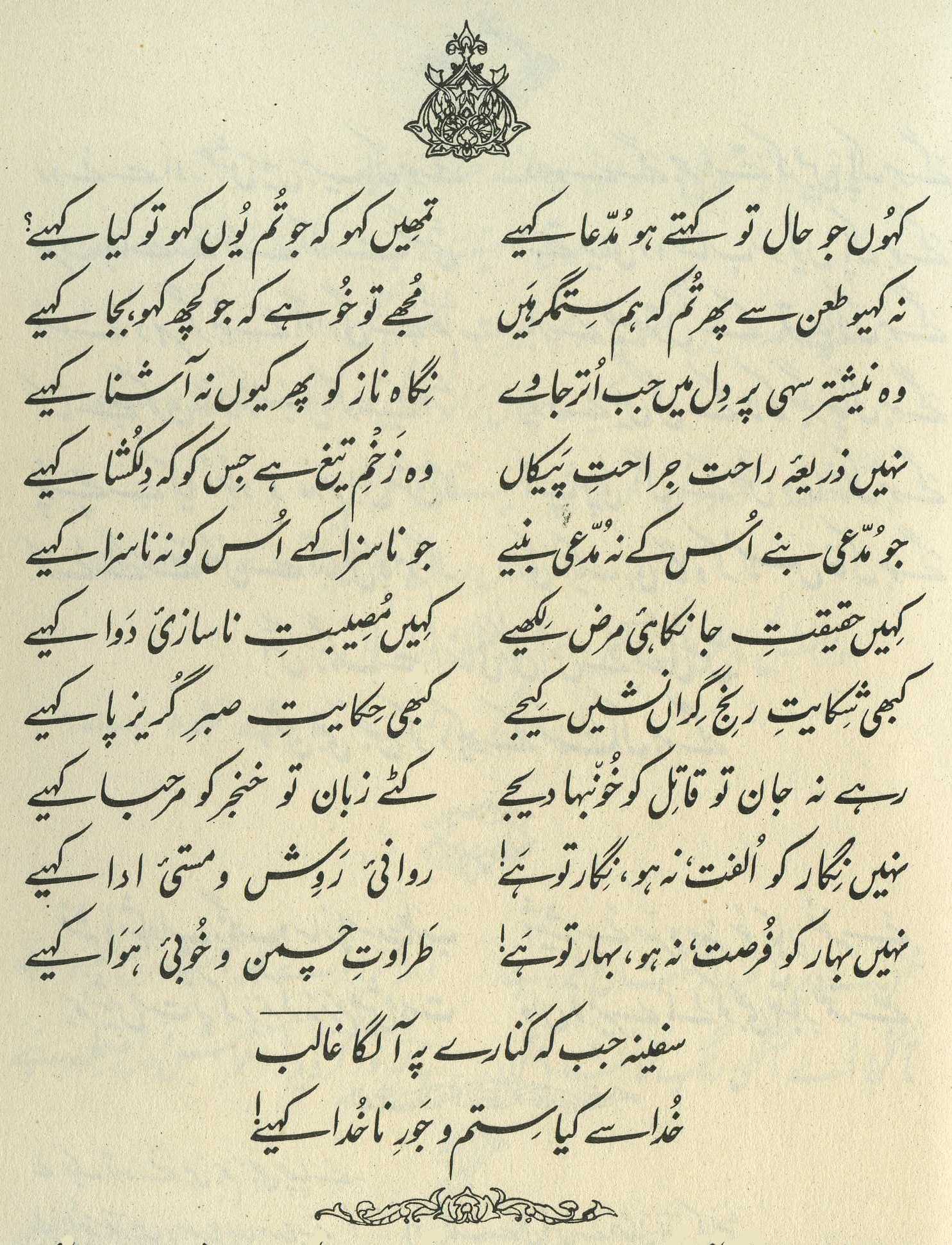
Although in the ghazal the theme s of rakishness [] and the worship of beautiful ones give much attractiveness, from time to time the poets, compelled by the rhyme , also compose moral [] themes. And this gives attractiveness up to the point when one or two verses are such as to require themes from which the ghazal doesn't remain the ghazal, but rather ought to be called an ode or a didactic poem []. In this verse for the name 'Baniye' [members of a merchant caste] to come, in the taste of the people of Lucknow will be crude; and indeed it seems bad. (237)
== Nazm page 237

He says, to respond to enmity with enmity is outside proper morality, and is not the quality of the people of capacity []. If anyone would vilify you, then in reply to this don't vilify him. Rather than a response of evil, goodness is better; instead of enmity, respond with kindness. (295)
[Disagreeing with Nazm:] Moral themes are not composed only under compulsion of the rhyme. Rather, these themes are a part of the ghazal. In the poetry of Hafiz, etc., ghazal upon ghazal has been largely filled with moral themes. [An example from Hafiz.] (423)
It's a morality-teaching verse, and it's clear. (469)
means 'enemy'. The people of Lucknow will certainly object to . The theme is moral. (339)
Meaning: if someone would show enmity toward you, don't show enmity toward him; and if someone would vilify you, don't vilify him. (792)
If someone would become an antagonist and enemy, then one ought not to seek to become an enemy of his. The person who would say unbecoming things about us-- in response to them, one ought not to say the same kind of things. (672)
On the first reading (1a,2a) this verse indeed looks like a flat truism about virtuous behavior-- so much so that it clearly bothers Nazm, and he has to explain it, quite unpersuasively, as something compelled by the needs of the rhyme . In fact it's a negative form ('Don't do unto others as you don't want them to do unto you') of the Golden Rule. In a ghazal by Ghalib, do we really need this sort of platitude, one that everybody already knows? (Compare 215,6 and 215,7 .)
As always, the thing to do is to examine the verse more closely. And then we notice that both lines have a conspicuous kind of hinge in the middle: a postpositional phrase [] that could quite easily be read either with the if-clause, or with the then-clause. If we take it as applying to the then-clause, we have the commentators' flat moralistic reading. But if we take it as applying to the if-clause, then we have a third party introduced: 'if someone would become an enemy of that one', if someone would call that one unworthy'. And now since in the if-clause we have two antecedents, we have two possibilities for the then-clause: either the listener is enjoined not to retaliate in kind against the persecutor on behalf of the victim, or the listener is enjoined not to join the persecutor in harassing the victim. I've tried above to show the possibilities in a neutral way by using 'X' and 'Y'. Various scenarios can now be imagined, involving the fickle Rival nastily gossipping about the beloved, and/or the cruel beloved persecuting the hapless Rival.
Then, as I was carefully figuring out all the complexities of (1b,2b), all at once the verse rearranged itself in my mind, and the sheer amusingness of the third reading (1c,2c) suddenly struck me. This third reading is the one with that great 'click' feeling, the sense that the mushairah audience would have burst out laughing and raised a chorus of . Even on this third reading the verse is so , so purely exclamatory, that two tones for it are possible: either it's a plea or demand from the lover that no mere mortal should presume to say a word against the all-powerful and all-adorable beloved, no matter what; or else it's a warning to the rash fool who would have the insane, suicidal hardihood to stick his head into a tiger's lair and call the tiger names. 'If you want to attack somebody, go attack somebody else-- but woe betide you if you attack her!' It's this latter reading that's the truly funny one, and my favorite. I'm convinced (though of course I can't prove it) that this is the one Ghalib most wanted us to see, and to relish. (As always, the gender is somewhat arbitrarily, but at least consistently, supplied by my translation; in the Urdu it's of course 'that one'.)
Nazm's objection to the verb is that it's also the (pluralized) name of the merchant caste-grouping ' Baniya ', and thus a kind of pun. But is it simply the accidental, poetically irrelevant pun itself that he objects to, or is it the fact that the Baniyas are an un-aristocratic or un-poetic group, so that the intrusion of their name somehow lowers the tone of the verse? I think it's the former, but I'm not sure.
On the idiomatically flexible use of , see 209,1 . Here is used flexibly as well, as a sort of general proposing of action, not necessarily a specific second-person polite imperative.
graphics/goldenrule.jpg