Verse 21853aakahiye
G9
In this meter the next-to-last long syllable may be replaced by two shorts.
1
don't say again/then, by way of a taunt, that 'We're a tyrant!'
2
I have a habit/disposition that whatever you would say, one would/should say 'Right!'
'Nature, disposition, temper; habit, custom; way, manner'.
| References | |
|---|---|
| Arshi, Imtiyaz Ali | Ghazal# 228 |
| Raza, Kalidas Gupta | 441-42 |
| Hamid Ali Khan | Open Image |
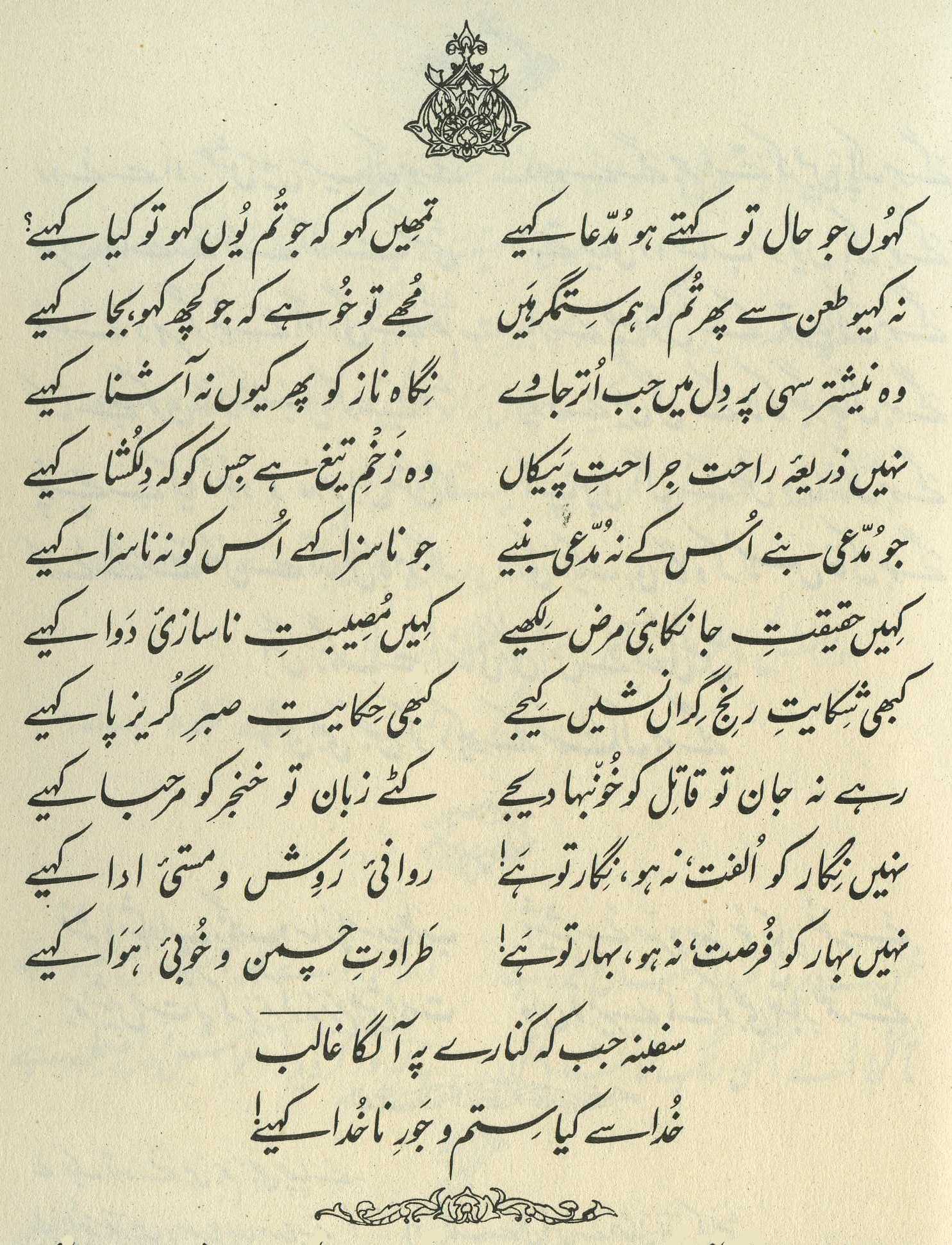
The occasion of this speech is that the beloved had said by way of a taunt, 'We're a tyrant'. He said, 'You're right'. At this she became angry: 'God is great-- he really considers us a tyrant!' To excuse himself, he becomes angry and is saying, 'Don't say again/then', etc. The great pleasure in this verse is that from her addressing him he became so entranced that he considered the speech and the address meaningless and began to say 'Right, correct', and with every such word she grew angry. (237)
== Nazm page 237

He says, you are well aware of my habit: that my habit is always to say to every word of yours 'Correct' and 'Right'. So why did you say, as a taunt, 'We're a tyrant'? According to my habit, from my tongue there emerged 'Right, correct'. Now why are you displeased with me without cause? From now on, don't tauntingly call yourself a tyrant, otherwise I will still, without pausing to think or reflect, say 'Right'. (294-95)
From the second line the etiquette of the beloved's gathering becomes clear: that people who sit there can't, when the beloved speaks, say anything at all except 'Right, correct'. (422)
The lover urges the beloved not say 'again/then' [], 'by way of a taunt', 'We are a tyrant'. But why exactly should she not? Which part of that behavior described in the first line is the objectionable part? Here are some possibilities:
=The beloved shouldn't say that she's a tyrant if she doesn't want the lover to agree with her, because he automatically agrees with everything she says.
=The beloved needn't repeat again that she's a tyrant, because the lover already knows it and accepts it completely.
=The beloved needn't continue to taunt the lover by gloating about her tyranny, because he's already as humble and submissive as he can possibly be.
=The beloved shouldn't waste her energy trying to get a rise out of the lover with taunts-- it's useless, because she has so vexed him and/or worn him down that he doesn't even listen to her any more, he just automatically mumbles some vague agreement.
For after all, what a wonderfully multivalent response it is, simply to say 'right' []-- literally, 'appopriate' or 'in place'. Like 'Right' or 'Of course' in English, it can sound completely humble and submissive, completely bored and inattentive, or completely hostile and sarcastic. Do I even need to point out that Ghalib allows us, and thus compels us, to decide for ourselves about the tone?
On the idiomatically flexible use of , see 209,1 .
graphics/submission.jpg