Verse 21816iirkaa
G1
1 a
digging through the tough-lifednesses of solitude/loneliness-- don't ask!
1 b
the digging done by the tough-lifednesses of solitude/loneliness-- don't ask!
2
to make daybreak from/'of' night is to bring the 'river of milk'
'Digging, excavating, hollowing out; --examining, investigating; ... pains, toil, labour, trouble'.
The state of having a 'tough life', being resilient and stubborn and hard to kill, like a weed.
| References | |
|---|---|
| Arshi, Imtiyaz Ali | Ghazal# 1 |
| Raza, Kalidas Gupta | 140 |
| Nuskhah-e-Hamidiyah | 27-28 |
| Asi, Abdul Bari | 49-50 |
| Gyan Chand | 59-61 |
| Hamid Ali Khan | Open Image |
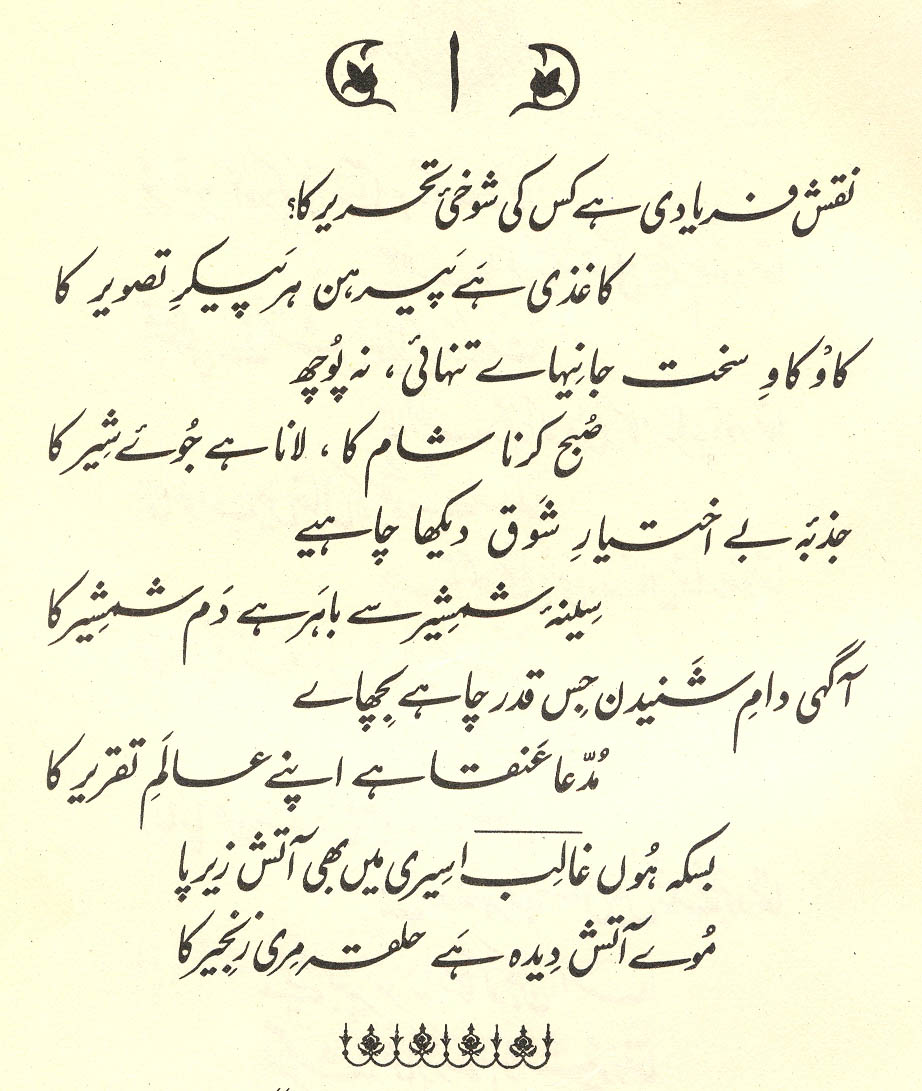
is 'digging, scraping'. The meaning is, in solitude and separation, don't even ask about the kinds of excavation and wear and tear that I experience at the hands of the movement of tough-lifedness and the inability to die. To pass the night, and to turn it into morning, is not less than bringing the river of milk. That is, just as it was a difficult task for Farhad to bring the river of milk, in the same way it's extremely difficult for me to turn night into morning. In this verse the poet has used as similes Kohkan for himself, the mountain for his tough-lifedness during the night of separation, and the river of milk for the whiteness of daybreak. (2)
== Nazm page 2

Urdu text: Vajid 1902 {1}
The sound of Farhad 's axe falling on granite seems to be heard, and has taken on an onomatopoetic role-- for the invention of which the wreath is on Mirza [Ghalib]'s head. (3)
But there is a special point in the second line.... That is, success in bringing milk proved to be a message of death for Kohkan . In the same way, I will be able to end this evening of grief only by dying. (49-50)
ABOUT PLURALIZED ABSTRACTIONS: To be called, 'tough-lifed', is not a compliment but almost an insult; it implies a weed-like hardihood, a kind of shamelessness (another example: 2,2x ). To pluralize its abstract-noun form is just as clumsy in Urdu as it is in English, and seems to multiply the awkwardness, clumsiness, and terrifying persistence of solitude. For other such pluralized abstractions, not all of which are so radical, see 8,4x for 'flowingnesses'; 21,7 for 'wanderingnesses'; 35,3 for 'simplicities'; 51,9x for 'gone-from-self-nesses'; 63,4x for 'bentnesses'. In 108,7 we have 'fatigues/laggings'; in 108,10x we have 'melancholy-heartednesses'. In 111,2 and 153,7 we have 'party-adornings' (or even 'party-adorningnesses'). In 149,4 we have 'unveilednesses'; in 155,2 , 'bloomings'; in 167,1 , 'immoderatenesses'; in 182,4x , 'donkey-mindednesses'; in 190,8 , 'forlornnesses'; in 211,1 , 'intoxications'; in 212,5x , 'self-sellings'; in 351x,2 , 'numbnesses'; in 360x,4 , 'faithfulnesses'; in 376x,5 and 404x,1 , 'cookednesses'. They're a favorite device of Ghalib' s. They also of course add a metrically convenient syllable or two-- often too cleverly to constitute out-and-out ' padding '. (There's also a list of often-abstract 'Personifications' in the Names Index .)
In the present verse, the first line is almost incomprehensible until we hear the second-- a typical ploy in the mushairah -based oral poetics of the ghazal. And in fact, the whole verse would be incomprehensible unless we knew the stories about Farhad and Shirin.
Farhad was a stone-mason; he fell desperately in love with the princess Shirin. His helpless passion became the talk of the town. Shirin's husband, Khusrau, decided to mock him by playing a cruel joke. He told Farhad that he could have Shirin if within a fixed time he could cut a channel through the Pillarless Mountain [] to bring milk for her bath. The task was impossible, but such was Farhad's mad zeal that eventually he had almost completed it. Alarmed, Khusrau sent an old woman to tell him that Shirin was dead. When he heard the news, he plunged his axe into his own forehead and died. (This is not exactly Nizami's version, but it seems to be the gist of Ghalib's.)
This story is told in varying versions throughout the Persianized cultural world, but its most famous literary source is the Khamsah [] of the Persian poet Nizami Ganjavi (1140-1230). Of the five masnavi s contained in this work, the second, and most famous, is ' Khusrau and Shirin ' []. Khusrau is identified with the historical Khusrau II (r.590-628), the last king in the Sasanian dynasty, and Shirin is an Armenian princess. Here is a prose rendering of Nizami's version, with discussion: Peter Chelkowski et al, 1975: pp. 21-48 .
The grammar of the construction makes possible both the active (1a) reading, in which the speaker does the digging, and the passive (1b) reading, in which the speaker experiences the digging. For a similarly multivalent case involving the related , see 13,7 . For another verse, see 424x,3 .
And don't the two readings work brilliantly, as the two halves of a terrible night? You have to claw your way through deserts of loneliness, before deserts of loneliness claw their way through you. And who is the 'you'? Ghalib doesn't say. So of course it can be all of us.
graphics/milkchannel.jpg