Verse 71821aabaa;Ndhte hai;N
G11
In this meter the first long syllable may be replaced by a short; and the next-to-last long syllable may be replaced by two shorts.
1
the fatigues/delays/opennesses of the people of contrivance!
2
even/also on blisters they apply/'bind' henna
'Forethought, judgment; deliberation, counsel; opinion, advice; expedient, contrivance, plan, device; provision, management, arrangement ... skill'.
'The remaining or lagging behind (esp. from fatigue); --openness; exposure'.
| References | |
|---|---|
| Arshi, Imtiyaz Ali | Ghazal# 92 |
| Raza, Kalidas Gupta | 335 |
| Nuskhah-e-Hamidiyah | 159 |
| Asi, Abdul Bari | 166-167 |
| Gyan Chand | 269-270 |
| Hamid Ali Khan | Open Image |
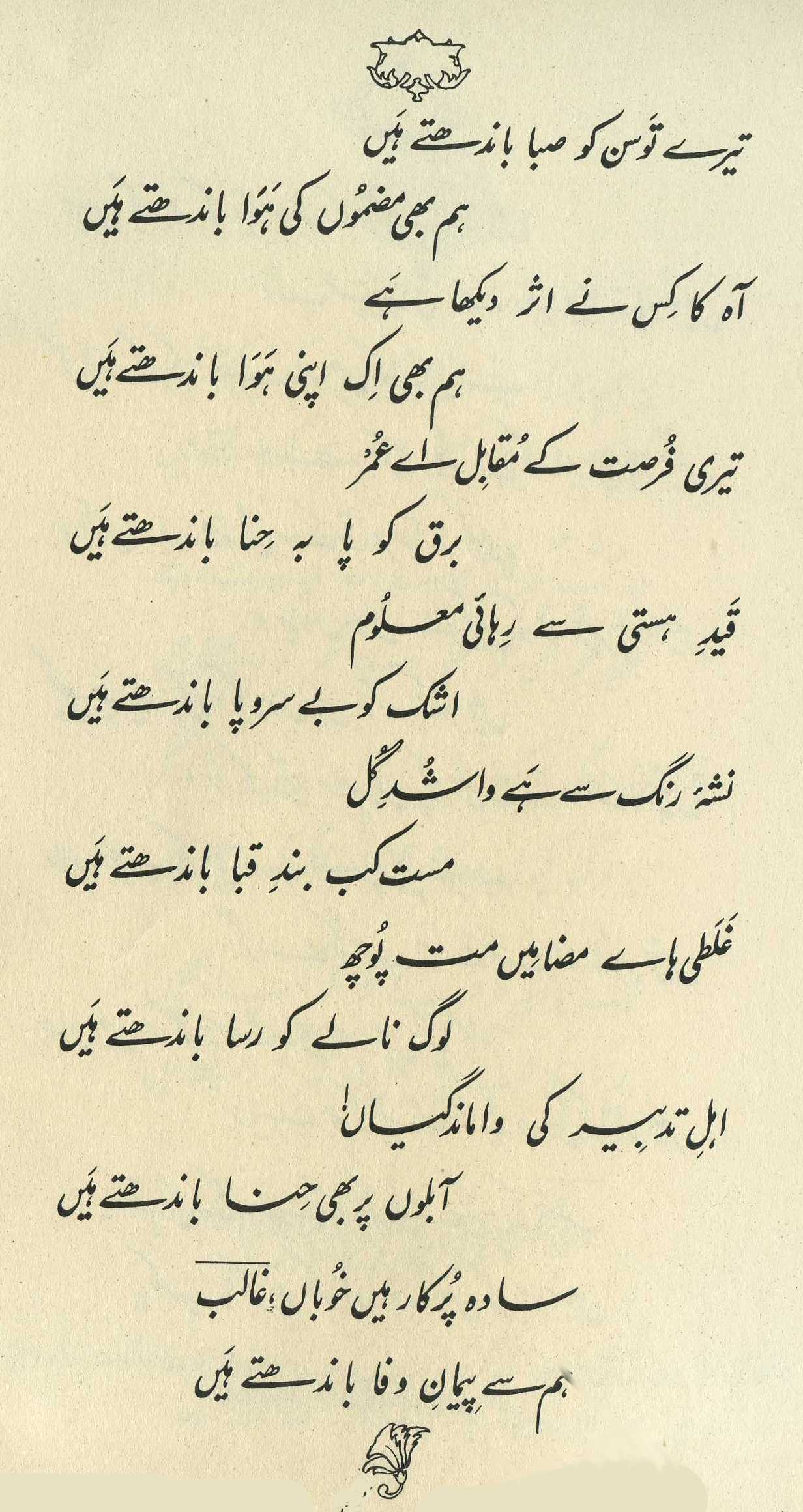
This is a sneer at the 'people of wisdom', that if there is a blister on their foot, then they apply henna to it. That is, for one thing the blister itself would be a cause of lagging, and on top of that they also apply henna, and became fatigued and 'excused'. By comparison to this, praise of the 'people of madness' is intended: that with their blister-filled feet they run around in the thorn-filled desert. (113)
== Nazm page 113

That is, first of all a man with blisters on his feet becomes 'excused' from walking and moving about. And on top of this, by way of medicine, to put henna on them makes the feet absolutely useless. By comparison to this, look at the 'people of madness': even with blistered feet, they traverse the thorn-filled desert. (164)
He expresses the virtue of madness: the people of madness, running over thorns, burst their blisters. They don't, like the people of wisdom, apply henna to their blisters. (216)
For another, and much more graceful, use in this ghazal of a hennaed foot to indicate slowness, see 108,3 . By contrast, the present verse hovers on the edge of what I call grotesquerie. The commentators explain the contrasting behavior that they feel underlies this verse. On the one hand, mad lovers with blistered feet run over thorny paths-- until the bloody blisters burst on the thorns, and create elegant red patterns on the feet like those of henna (on henna, see 18,4 ). They don't explicitly extend the imagery this far, but this is apparently what they have in mind. Ugh!
On the other hand, prudent or lazy or devious people apply henna even to their blisters. They thus ensure that they are doubly excused from putting their blistered feet to the ground. Playing it safe, they put henna on their blisters, perhaps just with the excuse of festivity, or perhaps by way of medicine, as Bekhud Dihlavi maintains. Thus they are doubly able to avoid hard work, danger, and running around even on smooth paths, much less on thorns.
Since verse concerns persons of 'contrivance', or 'invention', or 'forethought' (see the definition above), there's a third possibility as well. The 'people of contrivance' are, by definition, clever enough to present themselves always in a good light, and to make everything of theirs desirable; they distract attention from their worse features by diverting the eye to beautifications instead. If they have blisters on their feet, such that the feet would be unattractive and one wouldn't normally call attention to them, they go right ahead and put henna on them. This is a resourceful attempt at concealment-- which invokes the secondary meaning of , 'openness, exposure'. The speaker thus exclaims sarcastically at the 'opennesses' of the people of contrivance-- which are really, and very cleverly, concealments.
Perhaps lovers themselves too are, in their own way, 'people of contrivance'. They are joyous in the midst of their sufferings. When the time comes for festivity and celebration, even their blistered feet will not stop them. They are ready to put henna on right over the blisters, as a way of affirming that the blisters are natural to their feet, that they accept and even celebrate the pain. Thus the speaker may exclaim at their 'fatigues' or 'delays' which are not really due to henna, as a bystander would think, but to pain; or at their 'opennesses', their rejoicing in their wretched condition.
Since the first line is a simple exclamation, with no hint at all about its tone, we're left to decide for ourselves whether the speaker admires the 'people of contrivance', or disdains them, or is simply astonished by their behavior.
And why the plural abstraction? Just to emphasize the complexity and multifariousness of their behavior? For more on such pluralized abstractions, see 1,2 .
graphics/forhenna.jpg