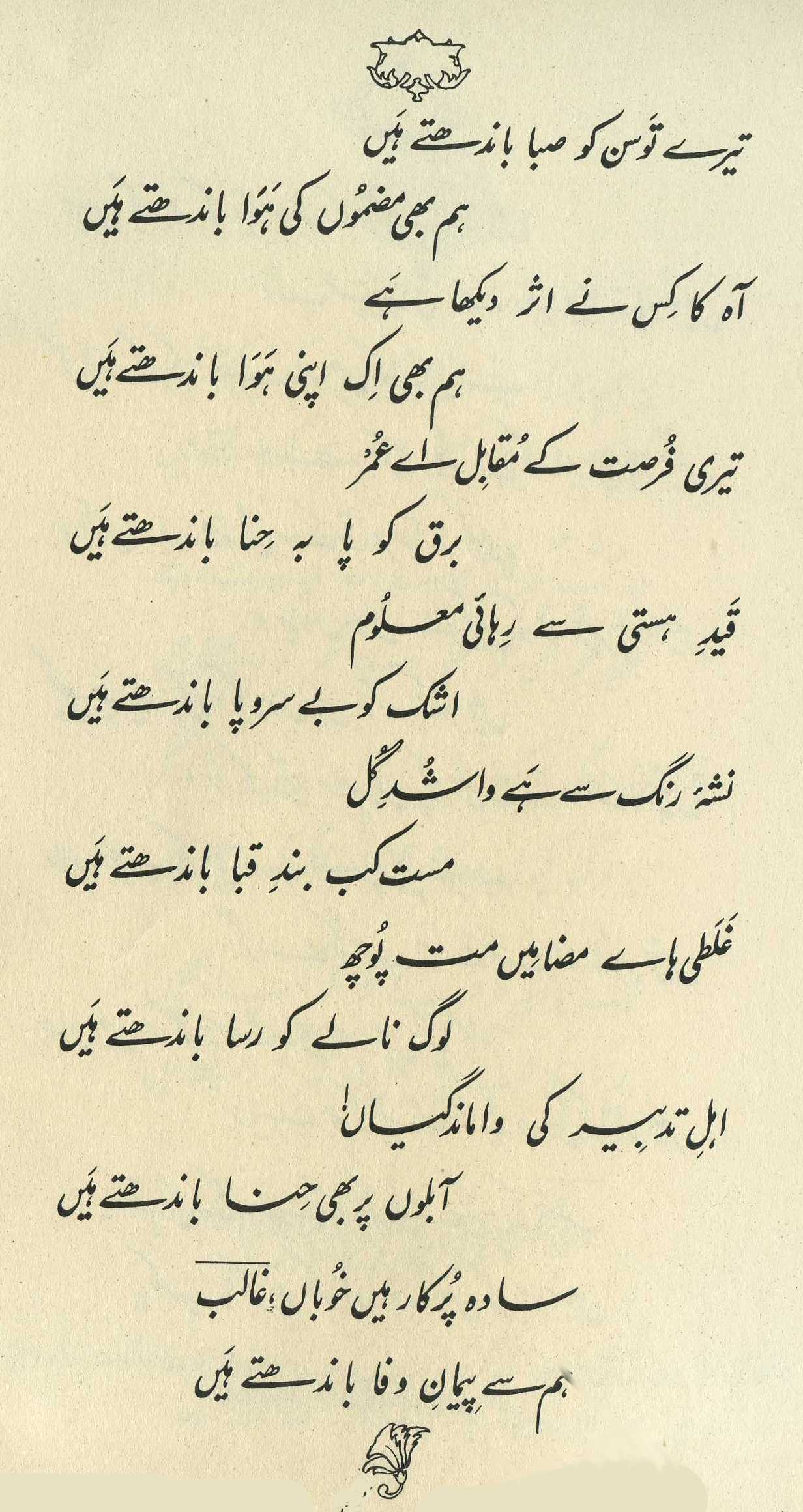
Verse 21821aabaa;Ndhte hai;N
G11
In this meter the first long syllable may be replaced by a short; and the next-to-last long syllable may be replaced by two shorts.
1
who has seen an effect of a sigh?
2 a
even/also we {boast about / invent/ show off} one [thing] of our own
2 b
even/also we versify/'bind' a single/particular/unique/excellent love/desire/breeze of our own
'To fasten together, put together, join, connect, conglomerate, unite, gather, pack, set... e.g. ...; to build, construct (dam, bridge, &c.); to compose (verses).
'Air, atmosphere, ether, the space between heaven and earth; --air, wind, gentle gale; --a gas; --flight; ...rumour, report; --credit, good name; --affection, favour, love, mind, desire, passionate fondness; lust, carnal desire'.
'To make a name; --to boast, brag; --to invent; to romance'.
| References | |
|---|---|
| Arshi, Imtiyaz Ali | Ghazal# 92 |
| Raza, Kalidas Gupta | 335 |
| Nuskhah-e-Hamidiyah | 159 |
| Asi, Abdul Bari | 166-167 |
| Gyan Chand | 269-270 |
| Hamid Ali Khan | Open Image |
is used to mean 'to inspire with awe' []. (112)
== Nazm page 112

He says, we don't sigh because we hope for effect; nor do we believe that sighs normally have an effect. We only inspire her heart with awe of us. (163)
In a sigh there's no effect at all. We only intimidate [] the beloved, so that perhaps in this way something might get accomplished. (215)
Compare 145,3 . (222, 285)
This is the only divan verse that Ghalib chose to include from a formally identical but different ghazal; on this see 108,1 .
In this verse Ghalib has used the same rhyme -word as in the previous one, 108,1 . Plainly he had no problem with this kind of repetition; some later critics have declared it to be a flaw, but Ghalib obviously didn't share this view.
In general, the commentators take to mean something like 'to show off, to demonstrate one's power'. Some of them think this display is aimed at the beloved, and might even achieve something. Others leave its intention vague. Here are some possible readings of the verse:
=The speaker falsely boasts that his sighs have an effect (while privately recognizing that, alas, they don't).
=The speaker sighs loudly and publicly, so people will be impressed by his lover-like prowess (even though he knows all sighs are vain).
=The speaker incorporates his sighs into poetry, although even then he doubts that they'll accomplish much. (For more on this use of , see 108,1 .)
=The speaker doesn't sigh, since sighs are ineffective; instead, while other lovers sigh, he versifies his own desires and his own 'breeze', just to show his superiority.
The wordplay, however, is surely the real point. The word both means 'sigh', and makes the sound of a sigh; and what is a sigh if not a miniature version of a breeze or wind []? The pair and are also partial anagrams of each other (the latter is made out of the former plus one more letter). In the previous verse, 108,1 , the poet provided the 'wind' in the first line by comparing the beloved's steed to it; in this verse, the 'wind' is provided by a sigh.
In both cases, the wind is needed for word-and-meaning-play with in the second line. The multiple meanings of (breeze/love/desire), and then the double meaning of (versify/tie), and then the additional idiomatic meanings that they acquire when put together-- the effect is as complex and (ultimately) unresolvable as it is enjoyable.
graphics/sigh.jpg