Verse 41821aabaa;Ndhte hai;N
G11
In this meter the first long syllable may be replaced by a short; and the next-to-last long syllable may be replaced by two shorts.
1
release from the prison of existence-- 'known' [to be nonexistent]!
2 a
we/they versify/'bind' tears as '{helpless / futile / 'head-and-foot-less'}'
2 b
they bind {helpless / futile / 'head-and-foot-less'} tears
'Utterly without resources, very poor and wretched'.
| References | |
|---|---|
| Arshi, Imtiyaz Ali | Ghazal# 92 |
| Raza, Kalidas Gupta | 335 |
| Nuskhah-e-Hamidiyah | 159 |
| Asi, Abdul Bari | 166-167 |
| Gyan Chand | 269-270 |
| Hamid Ali Khan | Open Image |
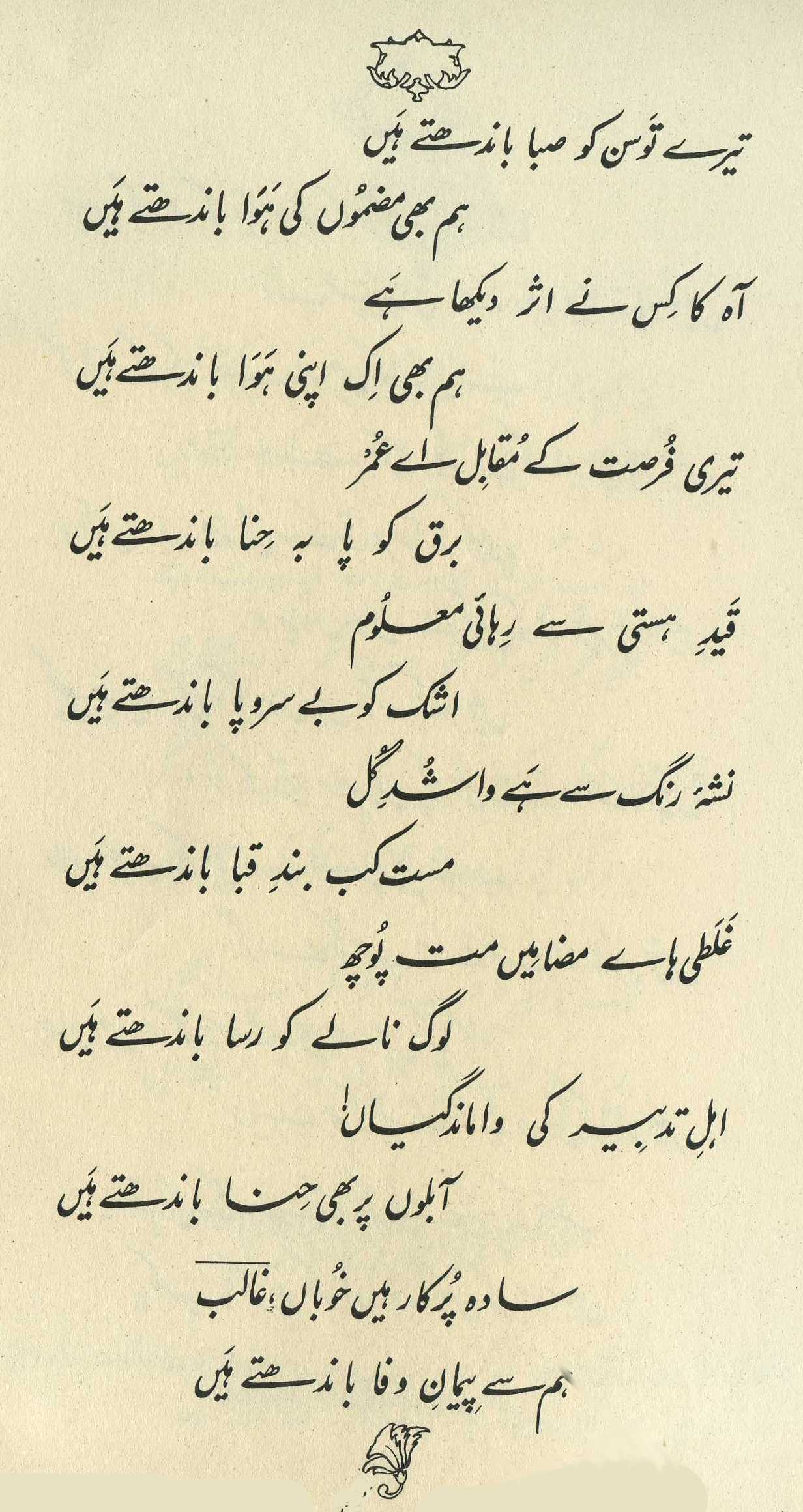
The pleasure is that if nonexistence preceded existence, and nonexistence is also powerless, then like a tear, mankind too is . And despite a tear's being {helpless, futile / 'without head and foot'}, we/they 'bind' it. And from binding something, its being bound presupposes its existence. The gist is that we will certainly remain in the prison of existence, and will not attain the rank of oblivion, which is freedom itself. (112)
== Nazm page 112

He says, man can become released and free from the prison of the world, and all other prisons, but not from the prison of existence. Even though a teardrop is 'without head and foot', we/they 'bind' it, and it is bound; and man too, like a tear, is . Thus we will certainly remain in the prison of existence, and will not attain the rank of oblivion, which is freedom itself. (124)
Release from the prison of existence is in no way possible. Just look-- they've confined tears in the prison of . Before existence, there is nonexistence; afterwards, nonexistence. For this reason it's been declared to be {helplessness, futility}. Now there is a test: when despite their being 'without head and foot' tears have been bound, how can man, who is similar to them in {helplessness, futility}, be free? (215)
What a contrast with 108,3 , the previous verse! Both are passionate, both (the first vocative, the second exclamatory). But the first (implicitly) laments the inconceivable briefness of life, while the second deplores its excruciating length and inescapability. Verses for two temperaments, or two moods-- juxtaposed accidentally, or on purpose?
The first line indignantly rejects the idea that there could possibly be any release from the prison of existence. This colloquial use of as a vigorous negative exclamatory marker is very common; for more about it see 4,3 . We expect that the second line will provide either the evidence that has generated this strong reaction, or a secondary effect of it.
And then, as so often in Ghalib, the second line opens up a number of available, and ultimately unresolvable, interpretive possibilities. Here are some of the main ones:
=Because of the situation described in line 1, in our poetry we depict and describe tears as 'helpless, futile', since it's clear that lamenting our plight will do no good. (For more on this use of , see 108,1 .)
=Even our helpless tears, which being 'without head and foot' have literally nothing that can be 'bound', are somehow 'bound' or tied up-- will jailers who can pull off a feat like that ever allow us who have heads and feet to escape?
=Just as tears have no top/beginning (head) or bottom/end (foot), so we humans have no access to the origin or end of our existence; we come from nonexistence, and return to it. Thus as long as we exist at all, we can't escape the 'prison of our existence', and thus can't know the true freedom of oblivion. (This is Nazm's reading, followed more or less by everybody else.)
There's also the elegant wordplay of 'release' [] and 'to bind' [], set off of course by the double meaning of the latter. But above all, the word-and-meaning-play of , especially when combined with , energizes the verse.
graphics/prison.jpg