Verse 11821aabaa;Ndhte hai;N
G11
In this meter the first long syllable may be replaced by a short; and the next-to-last long syllable may be replaced by two shorts.
1
we versify/'bind' your steed as the breeze
2 a
even/also we {boast of / invent} a theme
2 b
even/also we versify/'bind' the wind/love/desire of a theme
''The east wind, or an easterly wind'; a gentle and pleasant breeze; the morning breeze; the zephyr'.
'To fasten together, put together, join, connect, conglomerate, unite, gather, pack, set... e.g. ...; to build, construct (dam, bridge, &c.); to compose (verses)'.
'Air, atmosphere, ether, the space between heaven and earth; --air, wind, gentle gale; --a gas; --flight; ...rumour, report; --credit, good name; --affection, favour, love, mind, desire, passionate fondness; lust, carnal desire'.
'To make a name; --to boast, brag; --to invent; to romance'.
| References | |
|---|---|
| Arshi, Imtiyaz Ali | Ghazal# 92 |
| Raza, Kalidas Gupta | 335 |
| Nuskhah-e-Hamidiyah | 159 |
| Asi, Abdul Bari | 166-167 |
| Gyan Chand | 269-270 |
| Hamid Ali Khan | Open Image |
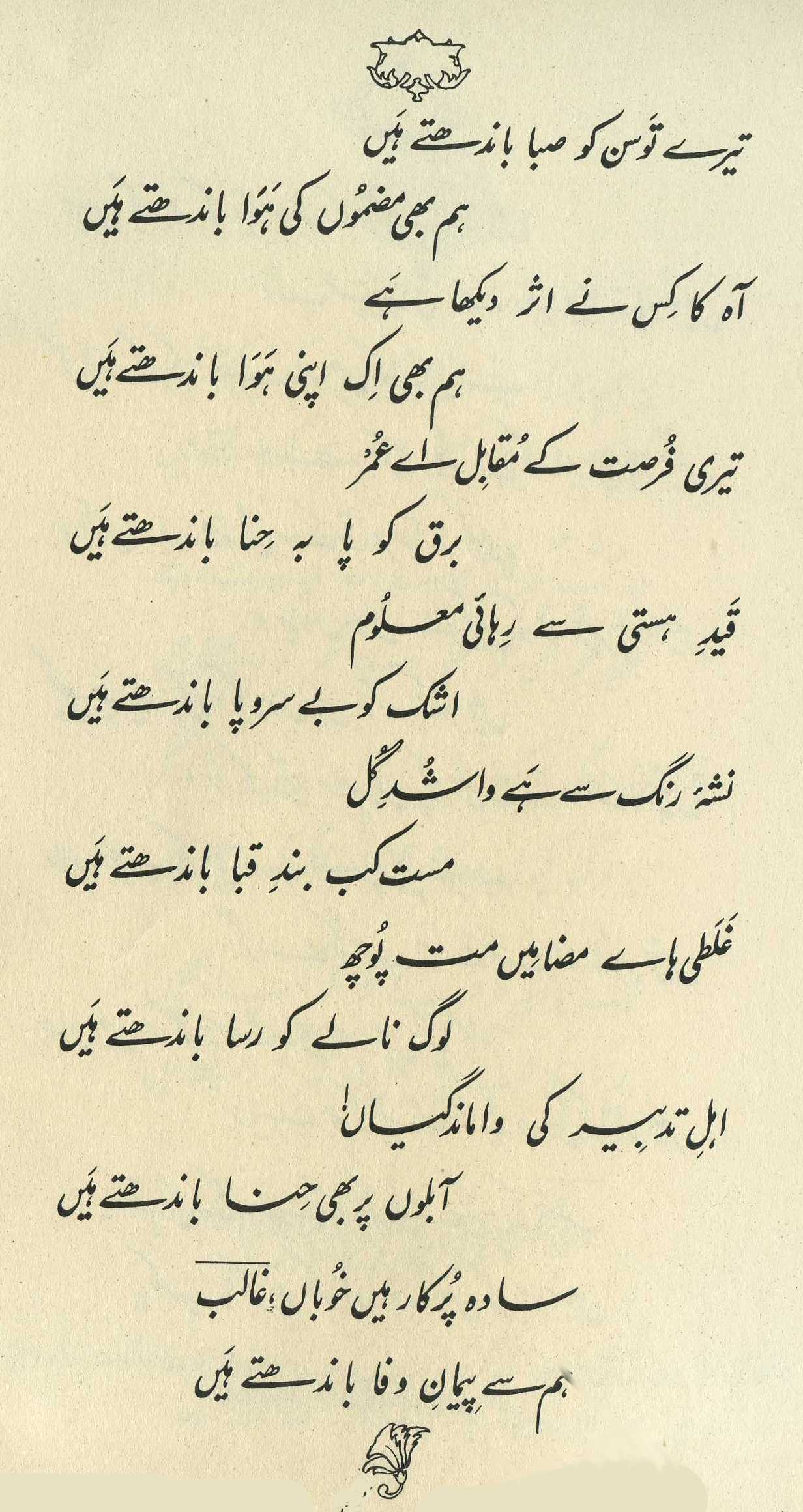
That is, giving for the steed the simile of the breeze, we {boast of / invent} elegance of expression. (112)
== Nazm page 112

He says, having given for your steed the simile of the breeze, we {boast of / invent} our theme-writing. Otherwise, your steed is swifter than the breeze. (163)
By calling your steed the breeze, its honor is not increased. Rather, in that way we establish the coin of our elegance of expression. (215)
Ghalib originally composed a ghazal of seven verses (Raza pp. 335-36); he chose to include all seven verses from it in his published divan . He also included in the divan version a single verse from another, formally identical ghazal (Raza p. 335) from the same year (1821); that verse he inserted as 108,2 . For more on this second ghazal, see 108,9x .
Because of its refrain , this whole ghazal plays on the verb , literally 'to bind' (see the definition above), which counts among its numerous derived meanings that of 'to compose', as in to compose verses. For another such striking example, see 29 , which has the refrain of . When poets versify/'bind' something, they incorporate it both into poetic language (usually through metaphor or simile) and into a metrical line of verse. The only verses that don't use this poetic meaning at all are 108,7 and 108,8 .
And then, in the present verse, look at all the secondary wordplay as well! People 'tie' (or 'bind') a horse with a tether-- but the lover also 'ties' the addressee's horse in the sense of 'binding' or incorporating it into a verse. The horse is versified or 'bound' as the breeze-- and who can bind the breeze?
Then there are the two words for breeze, in the first line and in the second. The word , with its related meanings of wind and love and desire, is surely the pivot around which the verse turns. (For very similar patterns of wordplay, see the next verse, 108,2 .)
The idiomatic sense of works perfectly for poetic purposes: the speaker boasts of his poetic theme , he invents his poetic theme. But if the words are read literally, he also versifies/'binds' the wind, or the desire, of a theme. And is it the desire 'of' a theme in the sense of 'the desire belonging to a theme', or in the sense of the poet's desire 'for' a theme?
Thus the juxtaposition of becomes so complex and enjoyable-- who can 'bind' the wind, or love, or desire? who can versify the wind, or love, or desire? And yet that's exactly what the poet does: he invents his themes, and he boasts of them. And if the poet is Ghalib, doesn't he have a right to?
graphics/windhorse.jpg