Verse 9x1821aabaa;Ndhte hai;N
G11
In this meter the first long syllable may be replaced by a short; and the next-to-last long syllable may be replaced by two shorts.
1
when she applies/'binds' henna to the feet
2
she 'binds' my hands, separated/apart/away
'To bind, tie, fix, fasten; to tie up, tighten; to bind up, dress (hair, &c.); to fasten or tie (on or round), bind (round), put (on) ... ; to chain, enchain, fetter; ... fasten together, put together, join, connect, conglomerate, unite'.
'Separated, parted; separate, distinct, away, apart, aside, asunder, absent; different; peculiar; extraordinary'.
| References | |
|---|---|
| Arshi, Imtiyaz Ali | Ghazal# 92 |
| Raza, Kalidas Gupta | 335 |
| Nuskhah-e-Hamidiyah | 159 |
| Asi, Abdul Bari | 166-167 |
| Gyan Chand | 269-270 |
| Hamid Ali Khan | Open Image |
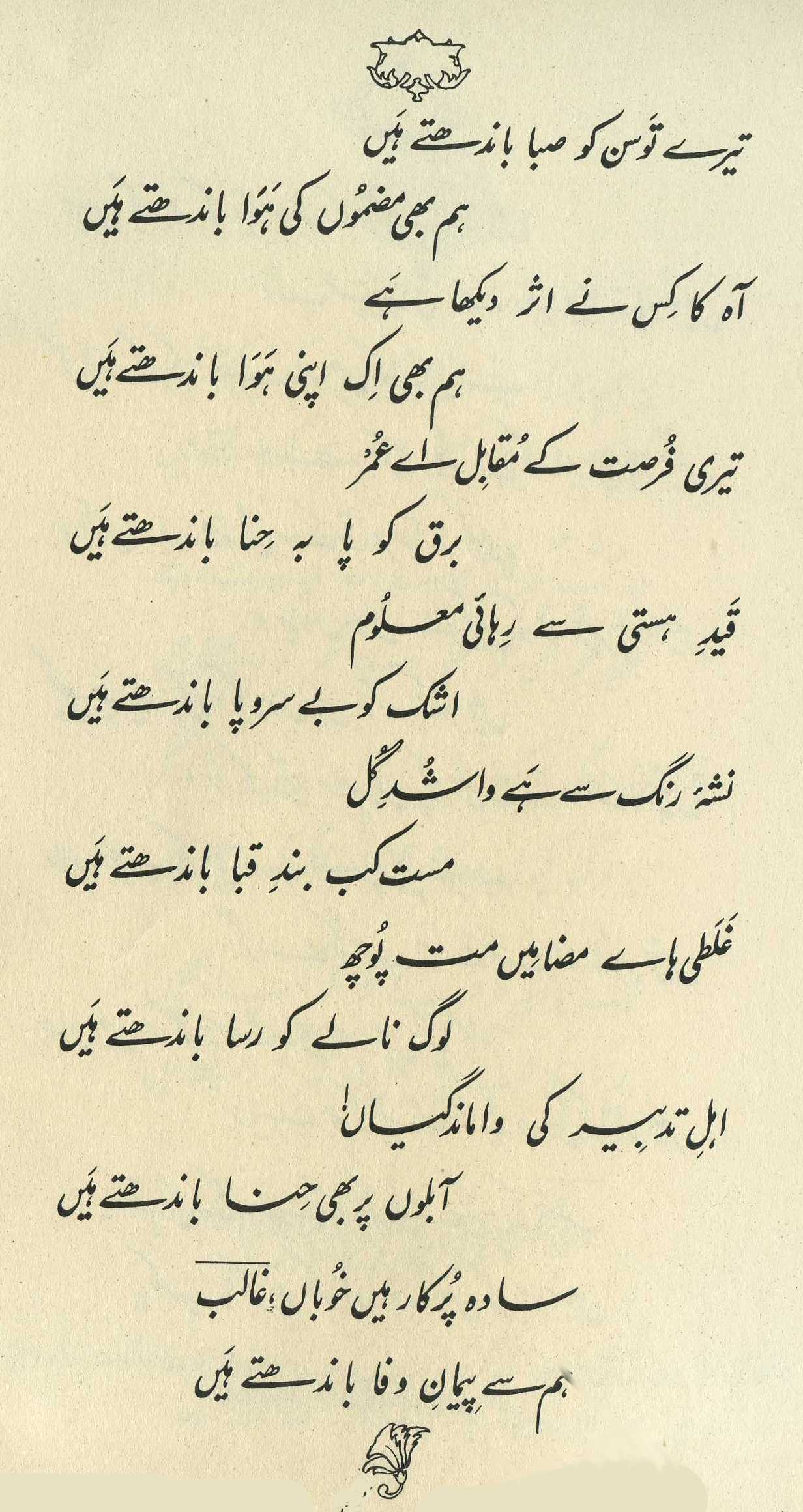
'When my beloved puts henna on her feet, then she binds my hands separately.' In my view, in this verse there's nothing except that when she 'binds' henna onto her feet, then she 'binds' the hands. There is this single comparison, and no other pleasure.
== Asi, p. 166
So that when my feet will be henna-ed, then she will tease/torment me.
== Zamin, p. 243
When she applies henna to her feet, then she causes my hands to be bound. The reason for this is perhaps so that I wouldn't sacrifice myself [] for her beautiful feet. Another reason is so that on seeing her feet I wouldn't, in my writhing, begin to scratch my breast into embroidery patterns.
== Gyan Chand, p. 269
For background see S. R. Faruqi's choices . For more on Ghalib's unpublished verses, see the discussion in 4,8x .
Here's a textbook case of a mushairah -verse. Nothing is going on in it except wordplay-- but then, who would say that wordplay is nothing? (Of course, the 'natural poetry' people would, but that's their problem and not Ghalib's.)
The first line sets us up for something, but there's really no guessing what. Then (after the usual mushairah-performance delay) when we hear the second line, it's not until the last possible moment-- with the rhyme -word -- that we suddenly get it all.
In a general way we have the juxtaposition of the beloved's feet and the lover's hands, unified by the excellently versatile verb -- which can refer (see the definition above) to the act of applying henna, and also to the act of binding or imprisoning (as a captive is bound), and also to the act of tying together (as hands are tied together). For more on henna, see 18,4 . (Zamin thinks the feet too are the lover's, but that doesn't seem very persuasive.)
But still, it's that most strikingly energizes the verse (see the definition above). Just look at how every one of its possibilities becomes operative:
=The beloved 'binds' the lover's hands so that they're 'separated' from her feet.
=Paradoxically, she 'binds-together' his 'separated' hands.
=She binds his hands in a 'different' way from the way she 'binds' or applies the henna.
=The sight of her 'binding' henna on her feet paralyzes him, 'binding' his hands in a 'peculiar, extraordinary' way
Not bad for a little thirteen-word verse, huh? It has an amusing, enjoyable punch, and then we're ready to move on to the next one.
graphics/hennaedfoot2.jpg