Verse 13x1821aabaa;Ndhte hai;N
G11
In this meter the first long syllable may be replaced by a short; and the next-to-last long syllable may be replaced by two shorts.
1
whose heart fled from curls?! -- for, Asad
2
we/they versify/'bind' the teeth/'hand' of the comb as [bearing] 'destiny/fate '
'A comb; a (cock's) comb, a crest'.
'Divine decree, predestination; fate, destiny; fatality; death; decree, mandate, judgment, order, charge, edict; office, or sentence (of a judge)'.
| References | |
|---|---|
| Arshi, Imtiyaz Ali | Ghazal# 92 |
| Raza, Kalidas Gupta | 335 |
| Nuskhah-e-Hamidiyah | 159 |
| Asi, Abdul Bari | 166-167 |
| Gyan Chand | 269-270 |
| Hamid Ali Khan | Open Image |
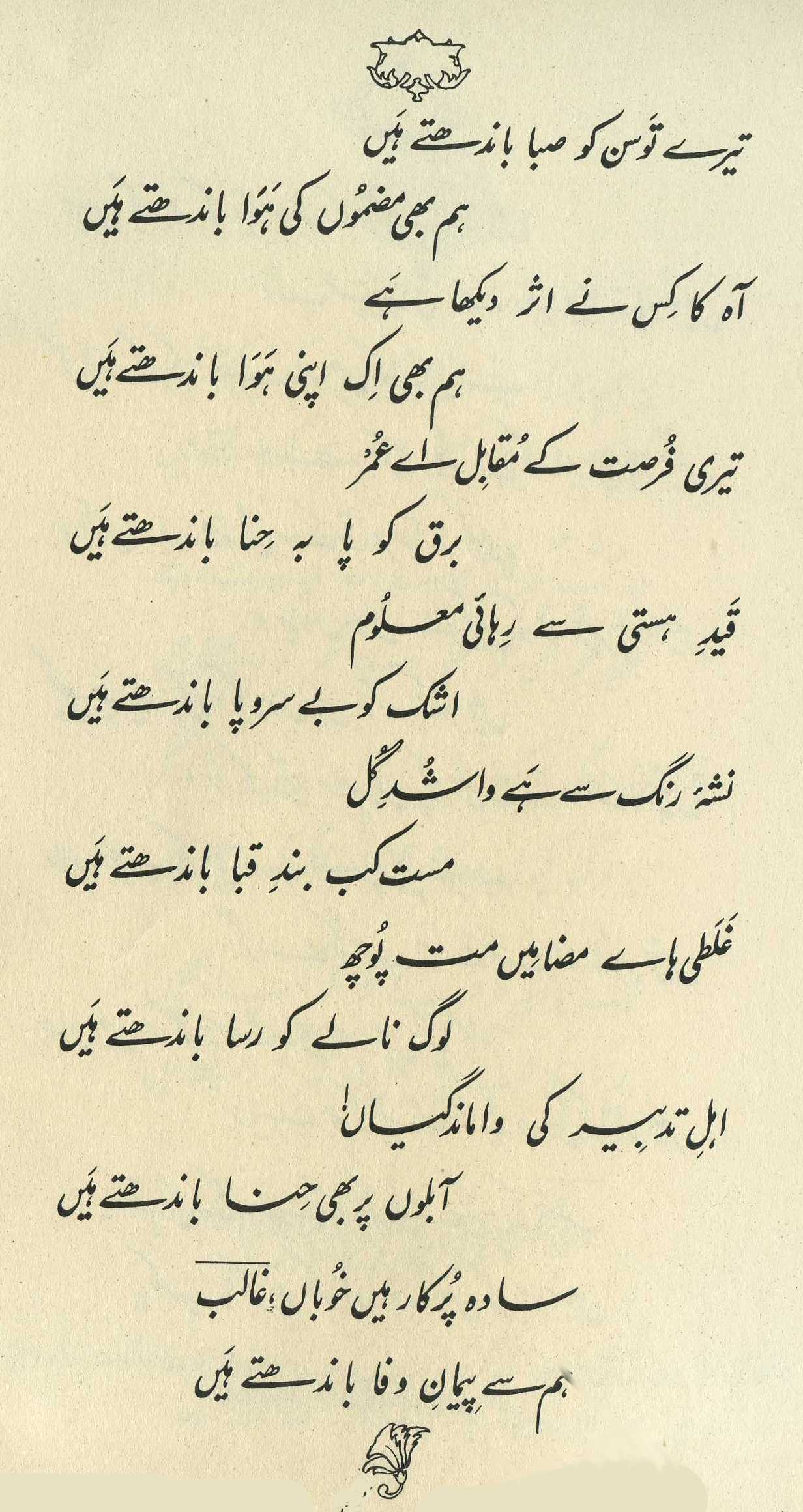
Oh Lord, who was the kind of captive whose heart had fled from the beloved's curls? And because the comb helped in this flight, to this day its hands are bound behind its back. Consider the two ends [] of the comb to be its 'hands'.
== Asi, p. 167
Since the comb remains entangled in curls behind the head, it's as if its hands have been bound in punishment for its lack of watchfulness-- which permitted the heart of some lover to flee from the curls.
In this verse the 'binding of the culprit's hands' by 'fate' has been used incorrectly. The culprit's hands are bound behind the culprit's back; here, the situation is the reverse. The comb's hands have not been bound behind the comb's back; rather, the beloved's curls have been used on its hands. This is exactly the reason for the verse's being omitted [from the divan].
== Zamin, p. 244
By 'hand of the comb' is meant the teeth on both sides of the comb. Consider the middle of the comb to be its waist, as if the comb's two hands have been tied/bound to its waist. To bind the hands behind is a sign of captivity. What crime did the comb commit, that it is being given this punishment? Did it, at the time of the arranging of the beloved's curls, did it cause some heart to fall out, and it fled-- the punishment for which the comb is enduring?
== Gyan Chand, p. 270
For background see S. R. Faruqi's choices . For more on Ghalib's unpublished verses, see the discussion in 4,8x .
On the literary use of as 'to versify', see 108,1 .
The commentators read the verse as recounting the guilt and punishment of the comb; this isn't very satisfactory even to them, since they have trouble envisioning the binding of the comb's 'hands' (that is, its teeth). The wordplay is of course there, but I think they are misreading the general sense of the verse: it's not about the guilt or punishment of the comb, but about the comb's role as an agent of fate or death.
The lover considers it impossible that anyone's heart-- and most especially, his own-- might have fled from the bondage of the beloved's chain-like curls. Why, just the opposite in fact! To flee would be not only un-loverlike, but also impossible: the coming of the comb is as inescapable and inevitable as the coming of death and fate.
The lover's heart is so snugly, so willingly, embedded within the curls that the comb that straightens out the curls, and brings them into some sort of order or restraint, is perceived by the lover as an agent of fate/death. Because it's death to the lover's heart to be combed out of the beloved's hair? Because since the heart refuses to move from the curls, the deadly teeth of the comb will slice it into pieces? Because the lover's heart can't bear to see the beloved's adorably wayward curls being straightened out by the cruel comb? In any case, the result is that the heart, a helpless captive of the curls, meets its destined fate at the 'hands' of the comb.
The heart may be a helpless captive, but the poet is not; for it's the poet who himself deliberately versifies or 'binds' the comb-teeth as 'death/fate'. That is, he versifies the 'hand of the comb' as the 'hand of fate/death'. The 'hand of fate' is a cliche in Urdu just as it is in English; in fact, Ghalib specifically uses in 38,2 , so it's easy to see it lurking in .
Would the comb-teeth have such a deadly, cosmic role, if the poet didn't confer it upon them in his verse? Perhaps not. For the reason that no one flees from the curls isn't because the comb-teeth are as intrinsically un-fleeable as death/fate. Rather, it's that the poets versify the comb-teeth in the guise of death/fate. Perhaps they're just recognizing an objective reality-- but the ghazal world being what it is, it's at least as likely that they're creating a reality of their own.
Just for pleasure, here are two nineteenth-century Indian combs; one has a rock-crystal handle and a chain for wearing around the neck, and the other contains a small built-in perfume vial.
graphics/comb1.jpg
graphics/comb2.jpg