Verse 21821arnah hu))aa thaa
G13
1
the hand of fate/destiny dropped/released [it] like the Moon of Nakhshab
2
the sun had not yet/still become equal to her
'Name of a city in Turkestan, famous for the appearance of the moon which the impostor Muqanna' caused to ascend from a pit in the neighbourhood (called ) during the space of two months'.
'Yet; still; further; just now, at present; hitherto, to this very time; --not yet'.
| References | |
|---|---|
| Arshi, Imtiyaz Ali | Ghazal# 28 |
| Raza, Kalidas Gupta | 329 |
| Nuskhah-e-Hamidiyah | 75-76 |
| Hamid Ali Khan | Open Image |
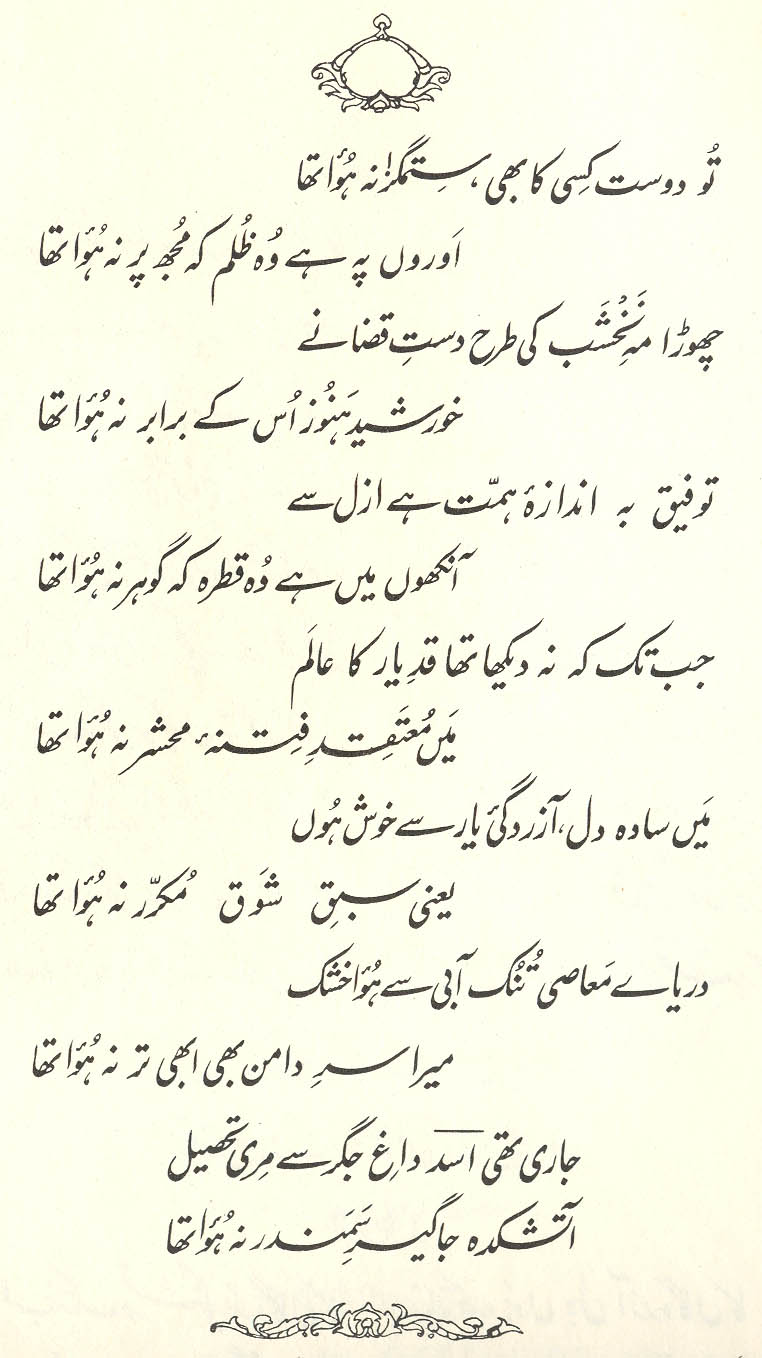
He has compared the sun to the beauty of the beloved, and declared it to be a deficient creation; for it he has given the simile of the moon of Nakhshab.
==Urdu text: Yadgar-e Ghalib , p. 127
That is, the sun itself remained deficient, the way it's well known that the Moon of Nakhshab made by ibn Muqanna' remained deficient. (37)
== Nazm page 37

Urdu text: Vajid 1902 {38}
The 'moon of Nakhshab' is that artificial moon which Hakim Ibn-e 'Ata, known as Ibn Muqanna', caused to rise from the Pit of Nakhshab. This moon had been prepared by means of [magic] prescriptions []. Its light could not spread for a long distance, and compared to the real moon it was established to be a deficient creation. For two months it kept emerging from the Pit of Nakhshab; afterwards it fell into pieces. He says, considering it deficient and useless like the 'moon of Nakhshab', the hand of creation dropped it, although the sun had still not become equal in perfection to the face of the beloved. (73)
The verse is an elegant exploitation of a single anecdote from Islamic story tradition. For poetic purposes, all we need to know is that the Moon of Nakhshab was artificially made, was an inferior copy of a superior original, and was destined to fall apart after a short lifespan. For other purposes, here's one take on its alleged creator, * al-Muqanna *.
One pivot on which the verse turns is the word , meaning both 'still' and 'yet, now'. For more on the creative use of , see 3,4 .
In addition, there's the versatile , with its range of meanings including both 'to release' and 'to abandon'. So there are two obvious readings of the verse:
=The hand of destiny released it [to shine as well as it could], like the Moon of Nakhshab, [although] the sun had not yet become equal to her [and thus needed more work].
=The hand of destiny dropped it [in vexation], like the [short-lived] Moon of Nakhshab, [because] the sun had still not [after its best efforts] become equal to her.
As hardly needs to be said, 'that one' is the beloved, and the clever multivalence of the compliment hardly needs to be elaborated. The beloved's beauty is the original, the sun is the copy; the beloved's beauty is inimitable, and the hand of destiny itself can't duplicate it; the beloved's beauty is lasting and real, the sun is contrived and transitory by comparison. This verse thus belongs to the 'snide remarks about the natural world' set; for others, see 4,8x .
graphics/artificialmoon.jpg