Verse 61821arnah hu))aa thaa
G13
1
the sea/river of sins, from lack of water, became dry
2
even/also my garment-hem had not yet/now become wet
'Acts of disobedience, sins, crimes'.
'Skirt (of a garment)'.
'A skirt, tail, hem, border; ... the foot or skirt of a mountain'. (Steingass p.500)
| References | |
|---|---|
| Arshi, Imtiyaz Ali | Ghazal# 28 |
| Raza, Kalidas Gupta | 329 |
| Nuskhah-e-Hamidiyah | 75-76 |
| Hamid Ali Khan | Open Image |
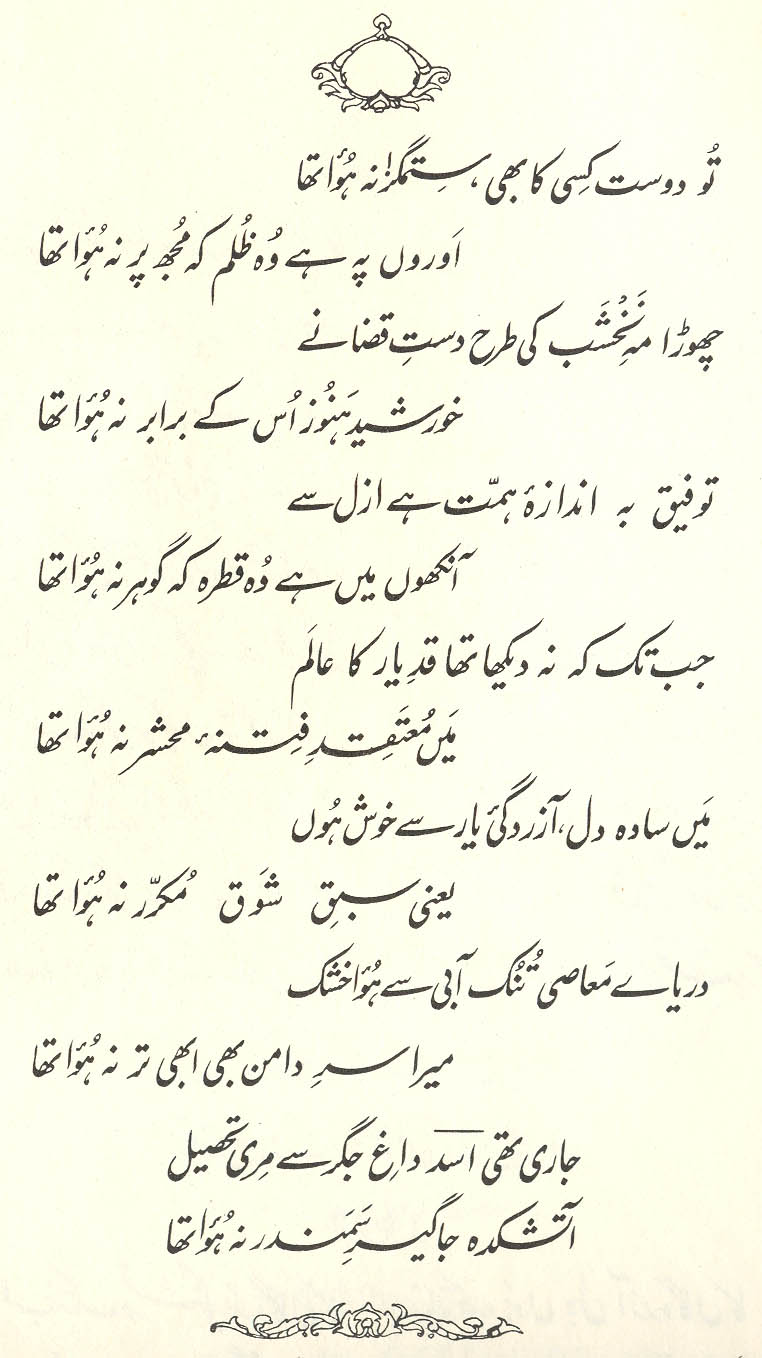
One day the late Ustad Zauq and I were discussing Mirza Sahib's style of ' delicate thought ' and Persian constructions, and people's various temperaments. I said, 'If some verse manages to come out without convolutions, it's as devastating as Doomsday!' He said, 'Very good!' Then he said, 'Even his better verses, people fail to appreciate. I will recite some of his verses to you'. He recited a number of individual verses. One is still in my memory: {38,6}.
There is no doubt that through the power of his name [since 'Asad' means 'lion'], he was a lion of the thickets of theme s and meanings. Two things have a special connection with his style. The first is that ' meaning-creation ' and 'delicate thought' were his special pursuit. The second is that because he had more practice in Persian, and a long connection with it, he used to put a number of words into constructions in ways in which they are not spoken. But those verses that turned out clear and lucid are beyond compare.
==Azad: Pritchett and Faruqi , pp. 405-06
He says that in committing sins our enthusiasm is so capacious that although the sea of sinfulness has dried up, still not even the edge of our garment has become wet. In the anthology [] Ab-e Hayat it is written that Zauq was extremely fond of this verse, and used to say that Mirza did not know his own good verses. This is the same kind of thing that Maulana Azurdah said, when he had heard an excellent verse of Mirza's and wished to praise it: 'What accomplishment Mirza has shown in this verse! This is a verse in my own style.' In short, even when one contemporary is praising another contemporary, he will definitely put in something or other that will either necessarily imply that poet's faults, or cause his own praise to emerge even more highly.
==Urdu text: Yadgar-e Ghalib , pp. 141-42
Idiomatically, they call a sinner a 'wet-skirted one' []. The meaning is that the hem of my garment soaked up the entire sea of sinfulness, so that it dried out, and even so not even the edge of my garment-hem was thoroughly wetted. That is, however many sins there were, I committed them all; even with that, I had not had my fill. (37)
== Nazm page 37

Urdu text: Vajid 1902 {38}
This verse of Mir Dard 's too achieves the same excellence, in connection with the same wordplay []:
[
Shaikh
, don't make too much of our sinfulness/'wet-garment-hemmedness'
if we would wring out our garment-hem, then the
Angel
s would perform ablutions]. (107)
Compare 117,2 . (176, 243)
This verse couldn't be any more different in style from its complex predecessor 38,6 . The sequence might almost have been set up to illustrate Azad's point (expressed through words attributed to Zauq) in the anecdote above.
The Persian/Urdu pair of expressions and , literally 'pure-garment-hemmedness' and 'wet-garment-hemmedness', are used in the ghazal world for virtue/purity versus sinfulness/pollution. As Arshi points out, 117,2 is a good companion piece for the present verse. For another treatment of similar imagery, see 103,2x . And for a paradoxical reversal of the 'wetness as sinfulness' logic, see 210,1 .
Platts's 'skirt' doesn't quite capture the sense of as a 'garment-hem', the part of the garment that would become stained from walking in mud or filth (thus the metaphorical use). Steingass's description does a bit better; see the definitions above. The famous verse of Dard's cited by Josh is a good example of the usage: it's easy to imagine someone picking up and wringing out the hem or border of his long robe or garment, while to wring out the whole 'skirt' (in the modern sense) he'd have to take off his clothes.
In the present verse, the lover represents his sinfulness as so grandiose and extreme that his garment-hem had soaked up the whole of the 'ocean of sinfulness' and still was not even wet. What a hyperbolic display of , 'mischievousness', and how the audience must have relished it! The great sinner is thus also completely pure, since his garment-hem is still (through no 'fault' of his) unstained. And the verse suggests that he remains actively, boastfully, eager for more chances to sin.
The second line also includes some clever rhymes-- / surrounding / -- that add to the sense of flowingness .
graphics/dryriver.jpg