Verse 2x1816arnahii;N
G1
1
through/by control/restraint, the intention/meaning is not anything other than liberation
2 a
the garment-hem of the image/likeness is not wetter than the water/luster of the mirror
2 b
the garment-hem of the image/likeness is not wet from/with the water/luster of the mirror
2 c
the garment-hem of the image/likeness is not wet like the water/luster of the mirror
t>> : 'Keeping, taking care of, guarding, defending, watching over, ruling, governing; regulation, government, direction, discipline; restraint, control, check'.
'Liberation, deliverance, salvation; —humility'.
'Resemblance, likeness, picture, portrait, image, effigy'.
'Water; water or lustre (in gems); temper (of steel, &c.); edge or sharpness (of a sword, &c.); sparkle, lustre; splendour; elegance; dignity, honour, character, reputation'.
| References | |
|---|---|
| Arshi, Imtiyaz Ali | Ghazal# 99 |
| Raza, Kalidas Gupta | 213-14 |
| Nuskhah-e-Hamidiyah | 163-164 |
| Asi, Abdul Bari | 185-186 |
| Gyan Chand | 299-300 |
| Hamid Ali Khan | Open Image |
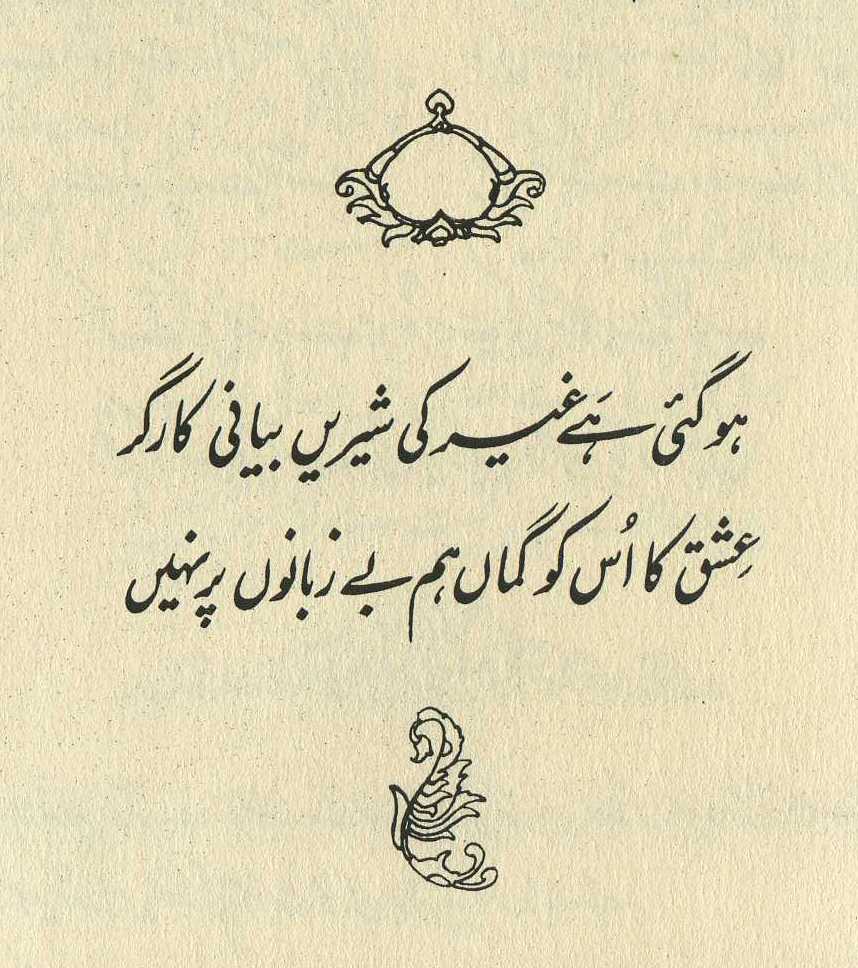
Through practicing control, there is no other intention except freedom. The way the garment-hem of a picture never becomes wet from the 'water' of a mirror, in just the same way people who have control have no other intention than liberation.
== Asi, p. 185
That is, through control and restraint, there is no other purpose than freedom. Look-- a picture is immersed in the 'water' of some mirrors, but while being in the captivity and restraint of 'wet-skirtedness', to be free is a futile idea. Indeed, if we would take the meaning to be 'through control, to be unpolluted by sensuality and detachment', then the meaning works well. There remains the question of whether the se meanings are accepted by dictionaries and colloquial usage or not-- that is for Ghalib to consider.
== Zamin, p. 265
We have restrained our tears so that we would remain protected from the disgrace or other normal consequences of passion. The objection can be raised that if there are tears present in our eyes, how have we become free from the illness of passion? Like the lamenting and complaining lover, we've remained captive to it. But this objection is not correct. On a mirror, there's the water/luster of the metal backing. Despite this, when a reflection is shown within it, it doesn't become wet from the 'water' of the mirror. Our purpose too from the control of tears is only exactly this: that we want to remain free of the disreputable crowd of lovers. On the two meanings of , 'glitter' and 'water', the theme of this verse has been constructed.
== Gyan Chand, p. 200
For background see S. R. Faruqi's choices . For more on Ghalib's unpublished verses, see the discussion in 4,8x .
The connection between a wet garment-hem and sinfulness is at the heart of this highly metaphysical verse. To have a wet garment-hem is, in the Persian and Urdu ghazal world, a mark of sinfulness; for discussion and examples, see 38,6 . Traditionally, the garment-hem is wet because it's been stained by the mud or filth of the street; thus the metaphorical use.
In the present verse, Gyan Chand claims that the wetness in question is that of tears. This idea isn't without precedent. Here's how Mir Dard uses some of the same imagery:
[like a candle, we, in this gathering
had come wet-eyed, departed wet-garment-hemmed]
In Dard's verse, the lover is seemingly made by his own tears (just as a candle drips with 'tears' as it burns, and ends up guttering out in a pool of melted wax that's like a 'wet' garment-hem).
Thus on Gyan Chand's reading, in the present verse the 'control/restraint' refers to the holding back of tears; this provides some nice kinds of affinity with the second line. But nothing in the verse itself requires such a reading; the 'control/restraint' can clearly be of any general kind (see the definition above), and the second line provides other sources and meanings for water and wetness that don't require tears at all.
The first line is in fact so broadly framed that it almost can't be interpreted at all, without some kind of narrowing-down assistance of the second line. All the significant nouns in the first line are extremely abstract and multivalent. We can't tell, for example, whether such 'control/restraint' is desirable or undesirable; successful or unsuccessful; pleasurable or painful; perpetual or intermittent; voluntary or coerced; physical or mental. It could apply to practically anything in one's emotional or physical repertoire of behavior, or to the whole idea of one's behavior in general.
Moreover-- Gyan Chand to the contrary-- there's no indication at all that the 'control/restraint' under discussion applies only, or even especially, to the speaker and/or to a lover. It could apply to anybody or any group of people, or to all us humans. Nowhere in the verse is its range limited or identified.
Then, as so often in Ghalib, the second line cleverly multiplies the already extreme multivalences. It's a fascinating little piece of grammatical ambiguity, a kind of symphony in se . The reading (2a) is the comparative: on the lines of X , 'bigger than X', we have X , 'wetter than X'. The reading (2b) is the usual instrumental use of : 'from, with, by means of'. And the reading (2c) takes as short for , 'like, in the manner of'.
Thus it's possible to take the second line in three quite distinct senses, each of which can be made to interlock in at least one or two ways with the some of the many possible readings of the broadly generalizing first line. And since this is an 'A,B' verse, we have to decide for ourselves how to connect the two lines. Do both lines describe the same situation? Do they describe parallel or similar situations? Is one line primary, and the other a mere illustration of it? Do they describe different situations, that are being contrasted in some way?
That's why this verse is what I call a 'generator'. There are so many endlessly ramifying ways to read it that the task of fixing on a few seems almost hopeless.
Which is not to say it's not piquant. That second line-- the idea of the garment-hem of an image or likeness (or reflection) being (or not being) 'wet' from the of the mirror is so alluring. What does it mean to call the 'water/luster/ of the mirror 'wet' in the first place? Doesn't that line end up digging itself into one's imagination? And yet-- what to do with it?
graphics/mirrorwater.jpg