Verse 11816arnahii;N
G1
1
the Other 's sweetness of explanation/description has become effective
2
she/he does not suspect us tongueless ones of passion
'Declaration, assertion, affirmation; explanation, exposition, description, relation, disclosure, unfolding, circumstantial indication or evidence; perspicuity, clearness'
'Doubt, distrust, suspicion; surmise, conjecture... --opinion, fancy, notion, supposition, imagination; --conceit, pride, haughtiness'.
| References | |
|---|---|
| Arshi, Imtiyaz Ali | Ghazal# 99 |
| Raza, Kalidas Gupta | 213-14 |
| Nuskhah-e-Hamidiyah | 163-164 |
| Asi, Abdul Bari | 185-186 |
| Gyan Chand | 299-300 |
| Hamid Ali Khan | Open Image |
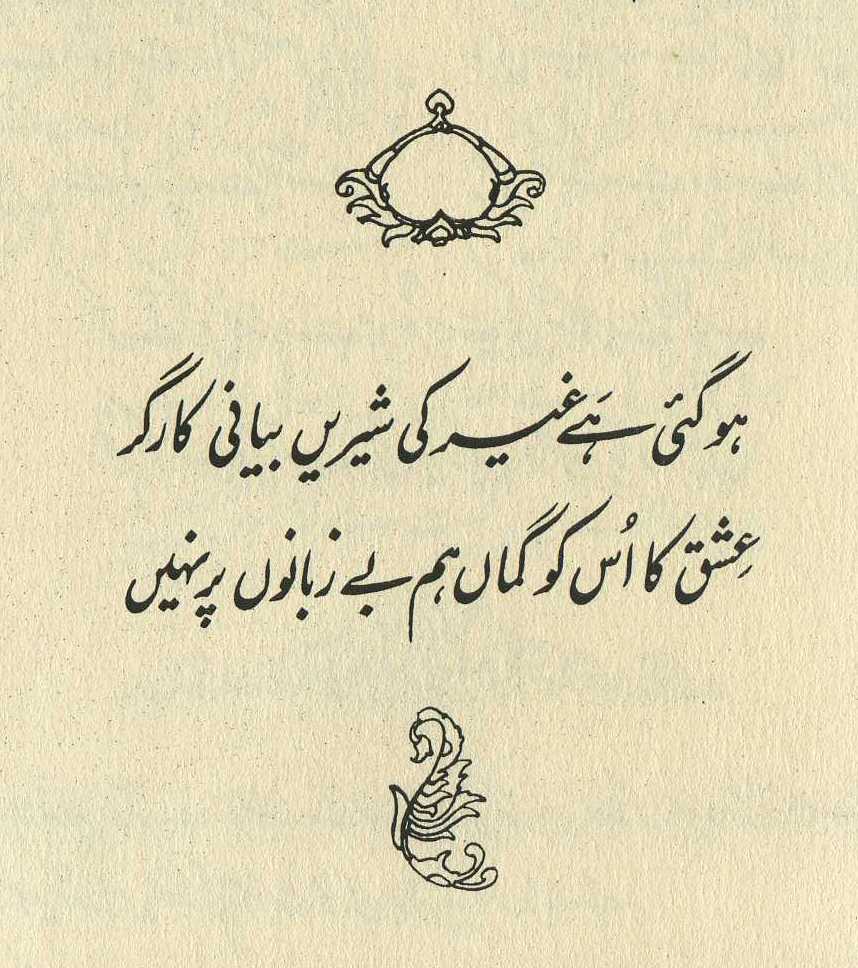
That is, the Other's sweetness of explanation/description has done its work on her, and she's begun to consider the Other her lover. And we who are tongueless-- for this reason she doesn't believe in our love. (109)
== Nazm page 109

From the Other's trickery she has considered, this person loves me, and all his claims are true and proper. We are tongueless; that is, taciturn. She doesn't believe in our love. (160)
The Rival 's magic has worked on the beloved. And we people who, through respect for courtesy, and patience, and submission, always remain silent-- not only does she not believe in our passion, but she doesn't even have a suspicion of it. (211)
Here are some possibilities that the commentators perhaps envision:
=The Other has told the beloved with honeyed words about his love, and she thinks that's what love is like; so she doesn't look for anything of the kind from us silent ones.
=The Other has told the beloved that he loves her and that we don't, and because of his honeyed words she believes him; and we tongueless ones can't offer any refutation.
=The beloved was angry at our presumption in daring to love her, but the Other has told her with honeyed words that we're innocent of the charge, so she no longer suspects us.
And we must add at least one more possibility, because the subject in the second line could equally well be the Other himself:
=The Other has fallen victim to his own eloquent propaganda, and thus no longer considers us a serious competitor; perhaps his error will improve our chances in the future.
In addition to the ambiguity of the colloquially unstated subject in the second line, these various readings are made possible by the versatile meanings of the cleverly chosen word -- which can range from a hostile 'suspicion' to a neutral 'opinion' (see the definition above).
Above all, this verse offers some lovely wordplay (and meaning-play too) between 'sweetness of explanation/description' [] and 'tongueless' []. In particular, an intriguing question arises: if the lover is 'tongueless' or inarticulate, is it expository speech itself that he lacks, or is it some special 'sweetness' of speech? The verse deliberately leaves it unclear which of the Other's assets is most effective.
But the elaborate discursive and polemical range of , combined with the 'sweetness', makes a verbal package that anybody might envy. No wonder the Other's rhetoric is so persuasive. Perhaps he has even (to his own future disadvantage?) persuaded himself. No doubt anybody would find him convincing. Anybody, that is, except the true lover, whose passion is beyond the level of sugary rhetoric-- and indeed, beyond speech itself.
The tone of this verse is so deadpan that it's impossible even to tell whether the lover is glad or sorry to be misunderstood in such a way. (And of course, the fact that the lover can 'speak' this verse might seem to give the lie to, or at least modify, his claim to be 'tongueless'.)
graphics/sweetspeech.jpg