Verse 71821arnah hu))aa thaa
G13
1
my collecting/profit/attainment had issued/operated, Asad , from the wound of the liver
2
the fire-place had not become the estate of the Salamander
'To flow, to issue (from, ), to be issued, be enacted; to be current... to circulate; to be in force, prevail; to proceed (as business), be in progress, to come into operation'.
'Getting, acquiring; collecting; gain, acquisition, profit, attainment; learning; collection (particularly of revenues or rents); the revenue jurisdiction of a '.
'Furnace; grate; chimney; fire-worshippers' temple'.
'Land and villages given by government as a reward for services or as a fee, a rent-free grant, a free-hold, a pension'.
| References | |
|---|---|
| Arshi, Imtiyaz Ali | Ghazal# 28 |
| Raza, Kalidas Gupta | 329 |
| Nuskhah-e-Hamidiyah | 75-76 |
| Hamid Ali Khan | Open Image |
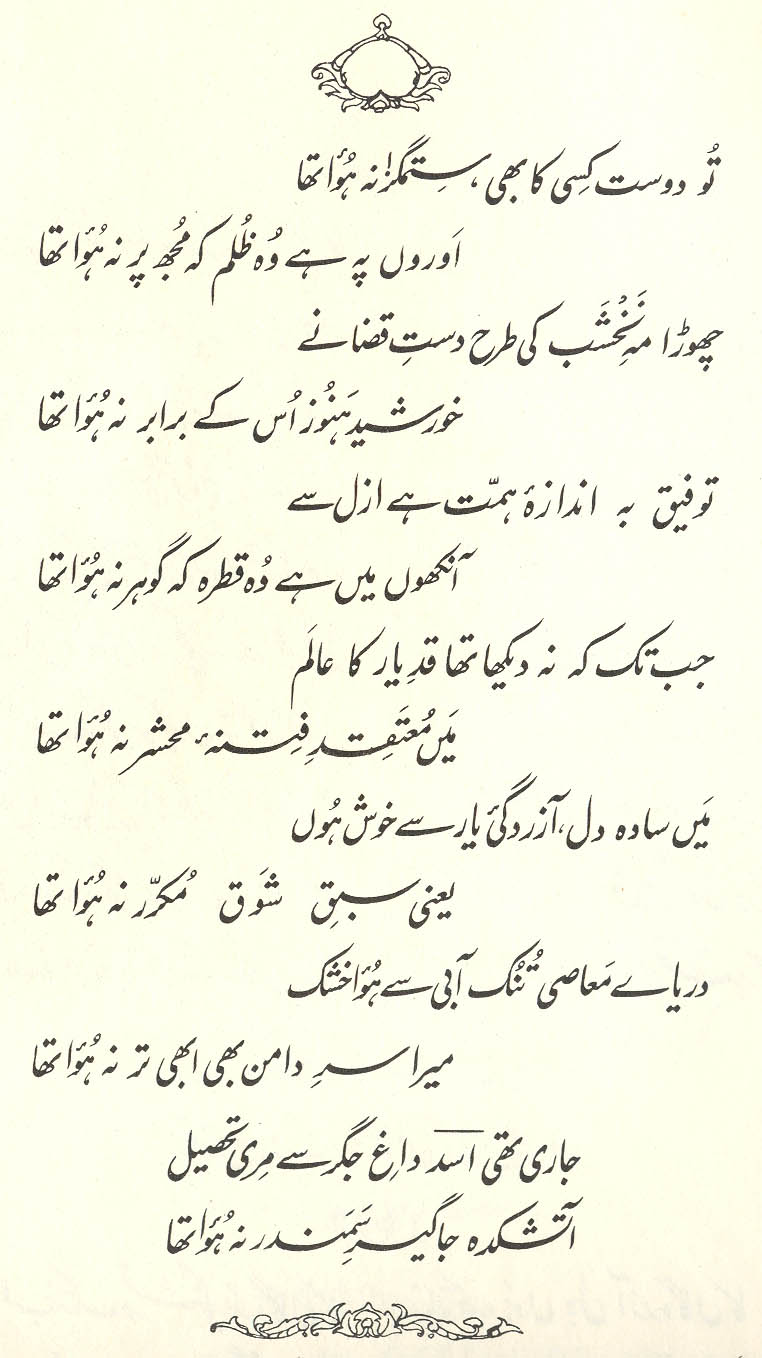
In this construction he has used the Salamander for his dominion, and the fireplace for the wound. And he has given priority to the wound: from it authority issues. That is, because of it, those sighs and laments that ceaselessly emerge, they are my jurisdiction, so it's as if the wound in the heart is my estate, when the Salamander did not obtain this benefit from the fireplace. (37)
== Nazm page 37

Urdu text: Vajid 1902 {38}
The Salamander is spoken of as a creature like the mongoose, but it is somewhat smaller than the mongoose. It is born in fire. Mirza Sahib says, through the wound in my liver I've held dominion, since a time when in the fireplace the Salamander hadn't even been born. That is, when the Salamander didn't even exist. (74)
I was acquiring courage from the wound in my liver at a time when the Salamander had not even been born, and the fireplace was collecting the wherewithal for burning from the wound in my liver. That is, the wound in my liver gave rise to fire, fireplace, and Salamander. (91)
The Salamander is an animal the size of a large rat, about which in Persian and Urdu literature the story is famous that it is born in fire and lives there, the way fish and other water creatures live in water, and if [they] take [it] out of the fire then it dies. Some declare it to be a winged creature, and its other name is 'fire-eater bird'.... As yet, no such animal or bird has been found. (148)
The Salamander of folklore has an extensive history. In the ghazal tradition, he is a mythical creature who dwells in fire; he may not even be a lizard-like amphibian at all.
The verse presents us with two 'A,B' lines, and it's for us to decide their relationship. If we take the lines as representing quasi-parallel situations, then the speaker is like the Salamander, and the wound/scar of his liver is like a fire-place. This works elegantly, because his heart and liver are always fiery and hot, burning with passion; no normal person could even endure such heat, but the true lover, like the Salamander in fire, can live in no other environment. To invoke the liver instead of the heart works well, because the liver is associated with endurance, and the verse emphasizes the long continuation of the speaker's fiery state. (For more on the liver versus the heart, see 30,2 .)
But these quasi-parallel situations are also contrasted: the speaker had X, the Salamander did not have Y. The sharpest and most obvious contrast is temporal: the speaker had X at a very early time, even when the Salamander did not yet have Y. Since the Salamander has been living in fire for centuries, the speaker's claim must go very far back indeed; he gloats over his ancient patent of nobility. His writ has run seemingly forever: he and his archetypal liver-wound go back farther than anyone can remember. Was there ever a time when he was not a lover-- when he didn't suffer, and didn't glory in the suffering?
The enjoyable bureaucratic wordplay adds a touch of humor to the verse. The speaker has a , while the Salamander has a . (While in wordplay terms, of course, the resonates irresistibly with the .) That makes the speaker a and Salamander a . Anybody who knows anything about British Indian history will recognize these two colonial administrative categories (Hobson-Jobson's tahseeldar and jagheerdar ). The former officer is more of a revenue collector, the latter more of a landlord, but there could be considerable overlap. Certainly Ghalib's audience would have known both categories very well. But is it better to have revenue-collecting rights based on a liver-wound, or residential rights in a fire-place?
Nazm reads the second line as an even stronger claim: by virtue of the wound of the liver, the speaker holds his rights and perquisites very legitimately; by contrast, the lowly Salamander has never become an estate-holder at all. Through the speaker's wounded liver he suffers for his rights, he pays for them in blood, so that they're powerfully established. By contrast, the Salamander is perfectly happy in fire, and never endures any pain at all, so that his claim is much weaker.
The reading of as 'fire-temple' is also a possibility (though nothing in the verse particularly invites such a reading); on this, see 173,10 . On this reading, the speaker's rights of collection and acquisition (of money? of 'attainment'? of learning?) are grounded in the almost sacred status of his wounded liver. His estate is thus a quasi-religious space, and is secured by his own inner struggle and suffering. By contrast, the petty and frivolous Salamander doesn't get to have such a sacred space as the 'fire-temple' for his estate at all: perhaps he's only allowed to visit it, not to claim it; or perhaps he's denied access to it entirely. On this reading, there's the Salamander's ordinary fire-- and then there's the speaker's sacred fire.
Compare Mir's similar claim of ancient rights and sufferings: he was a 'consecrated lamp' even before the winds were created: M 456,8 .
graphics/fireplace.jpg
graphics/salamanderfire.jpg