Verse 31816aahai
G2
1
the faithfulness of heart-stealers is coincidental; otherwise, oh companion
2
an effect of the complaint of melancholy hearts-- who has seen it?!
'Concurrence, agreement, accord, correspondence, coincidence; equality; union, unity, concord, harmony, unison, conformity; amity, friendship, affection; similarity of disposition; assent, consent'.
'Concurring, accidental, casual, occasional, incidental'.
| References | |
|---|---|
| Arshi, Imtiyaz Ali | Ghazal# 181 |
| Raza, Kalidas Gupta | 277-79 |
| Nuskhah-e-Hamidiyah | 234-241 |
| Asi, Abdul Bari | 238-240 |
| Gyan Chand | 367-371 |
| Hamid Ali Khan | Open Image |
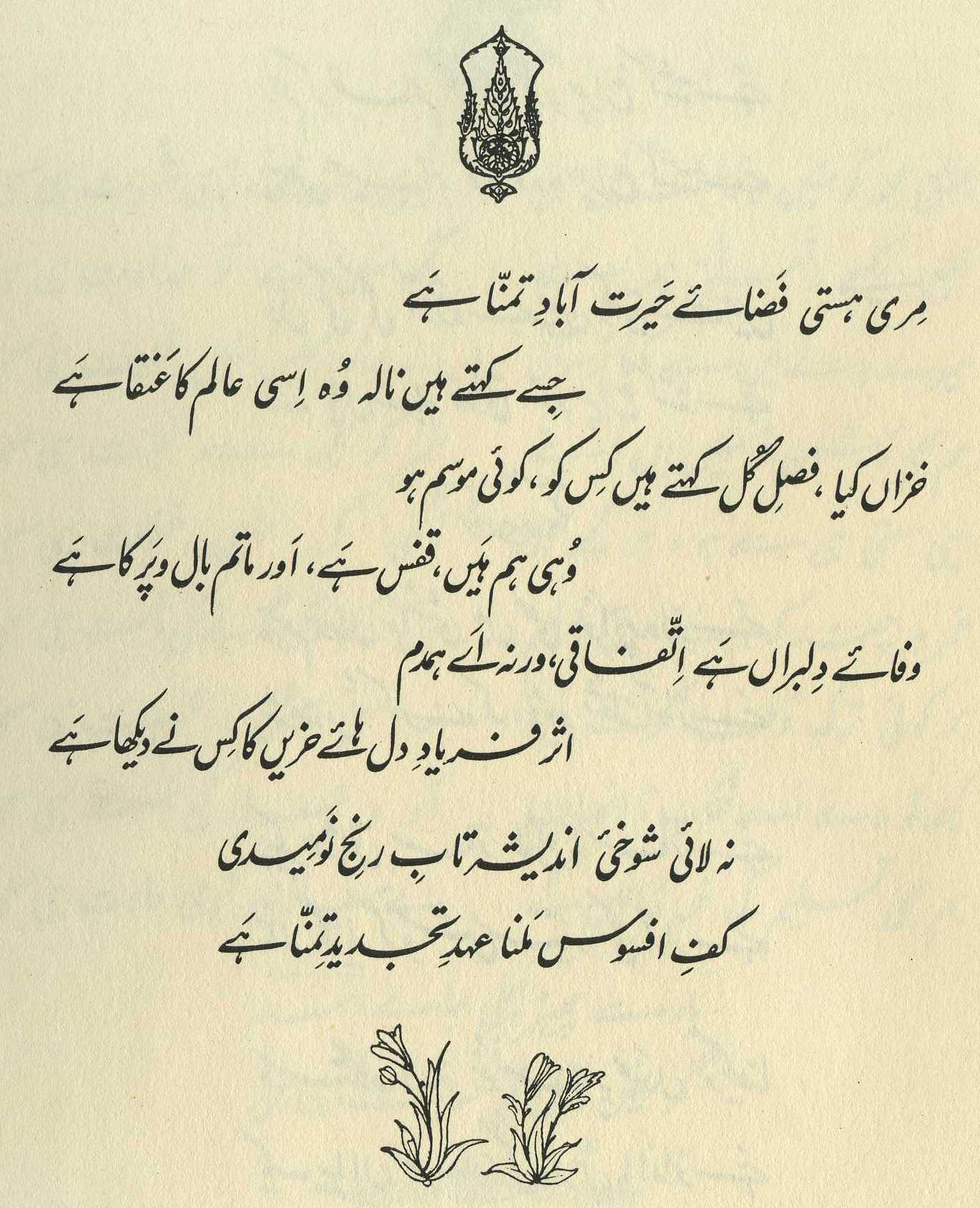
That is, the kindness of beautiful ones to their desirers is due to destiny and chance. We are not a believer in the effect of love. In this verse, is a [cf. Steingass pp.728-29]-- that is, the is not original, but rather is the sign of the past tense. It is called a ' rhyme for free' [], and is considered lax. (154)
[ : 'Verse that ends in and is of two classes. The first, which is called is at the end of words denoting the agent, as "weeping, a weeper," "laughing, a laugher." Words of this class are not allowed to rhyme with such words as "time," or "a bow." (In like manner, forming adjectives of relationship in such words as "fiery," "silvery," may not rhyme with such words as "earth," or "ambush.") The second class, which is called is at the end of words in the plural as "friends." Such words may not rhyme with a noun in the singular as "So-and-so." The occurrence of these terminations more than once in the Ghazal or Qasida is forbidden'. (Steingass pp.728-29)]
== Nazm page 154

He says, the finding of a faithful beloved is a matter of chance and fate. Otherwise, oh friend, we don't believe in the effects of laments and the effectiveness of love. That is, neither is the beloved tamed by the effect of love, nor does sighing and complaining work. (212)
By paying attention to the second line, one learns that this is the saying of a person to whom no one has been faithful at all. His companion is a believer in the effect of lamentation, but the lover doesn't agree with him. (282)
Compare 108,2 . (222, 285)
The excellent word is deployed here to fine effect. Although it has a specific meaning of 'coincidental, accidental, by chance' that is perfectly appropriate to the context of the verse, it can't help but remind us of its noun itself, which has a basic sense of something like 'coming together', and thus also can mean 'union, concord, amity, friendship, affection', and the like. The two senses of 'coming together'-- the evocation of harmony, union, affection on the one hand, and sheer random indifferent coincidence on the other-- that themselves 'come together' within a single word, work powerfully to give the verse a flavor of bitterness and irony.
Bekhud Mohani sees the verse as part of an extended argument: the lover's friend has sought to encourage him by presenting some kind of evidence of the faithfulness of some beloved-- maybe even the lover's own beloved. But the lover isn't buying it-- to him, even evidence of faithfulness is further evidence of radical unfaithfulness. It merely shows that the beloved is so completely ignorant of, or indifferent to, faithfulness that she doesn't even avoid it consistently.
Rather, she simply does what she pleases, and once in a while, by sheer chance, her behavior happens to briefly coincide with what looks like 'faithfulness'. (A stopped clock is right twice a day.) The lover has thus created a catch-22 situation: if she's unfaithful, that shows she's unfaithful; and even if sometime she's faithful, that simply shows how much her behavior is guided by chance and coincidence, and thus is radically unfaithful.
The 'effect of the complaint of melancholy hearts' is thus to generate something that can't be generated: to 'cause' something that comes about only by chance. And the plural 'hearts' gives the rhetorical question a bleak, if slightly petulant and grandiose, universality.
The doesn't seem to add much to the verse, and could surely be removed without any detectable damage. Doesn't it look a bit like padding ?
Compare this verse's far more enjoyable counterpart, 108,2 .
graphics/heart.jpg