Verse 41816aahai
G2
1
mischievousness of thought didn't bring strength/endurance for the sorrow of despair
2
to 'wring the hand of regret' is the vow/season of the renewing/newness of longing
'Playfulness, fun, mischief; pertness, sauciness; coquetry, wantonness; forwardness, boldness, insolence'.
'Thought, consideration, meditation, reflection; solicitude, anxiety, concern...; doubt, misgiving, suspicion; apprehension, dread, fear'.
'To wring the hands with regret'.
'Promise; bond, league, treaty; --a vow, an oath; --time, season, conjuncture; lifetime'.
'Renewing; renewal, novelty'.
| References | |
|---|---|
| Arshi, Imtiyaz Ali | Ghazal# 181 |
| Raza, Kalidas Gupta | 277-79 |
| Nuskhah-e-Hamidiyah | 234-241 |
| Asi, Abdul Bari | 238-240 |
| Gyan Chand | 367-371 |
| Hamid Ali Khan | Open Image |
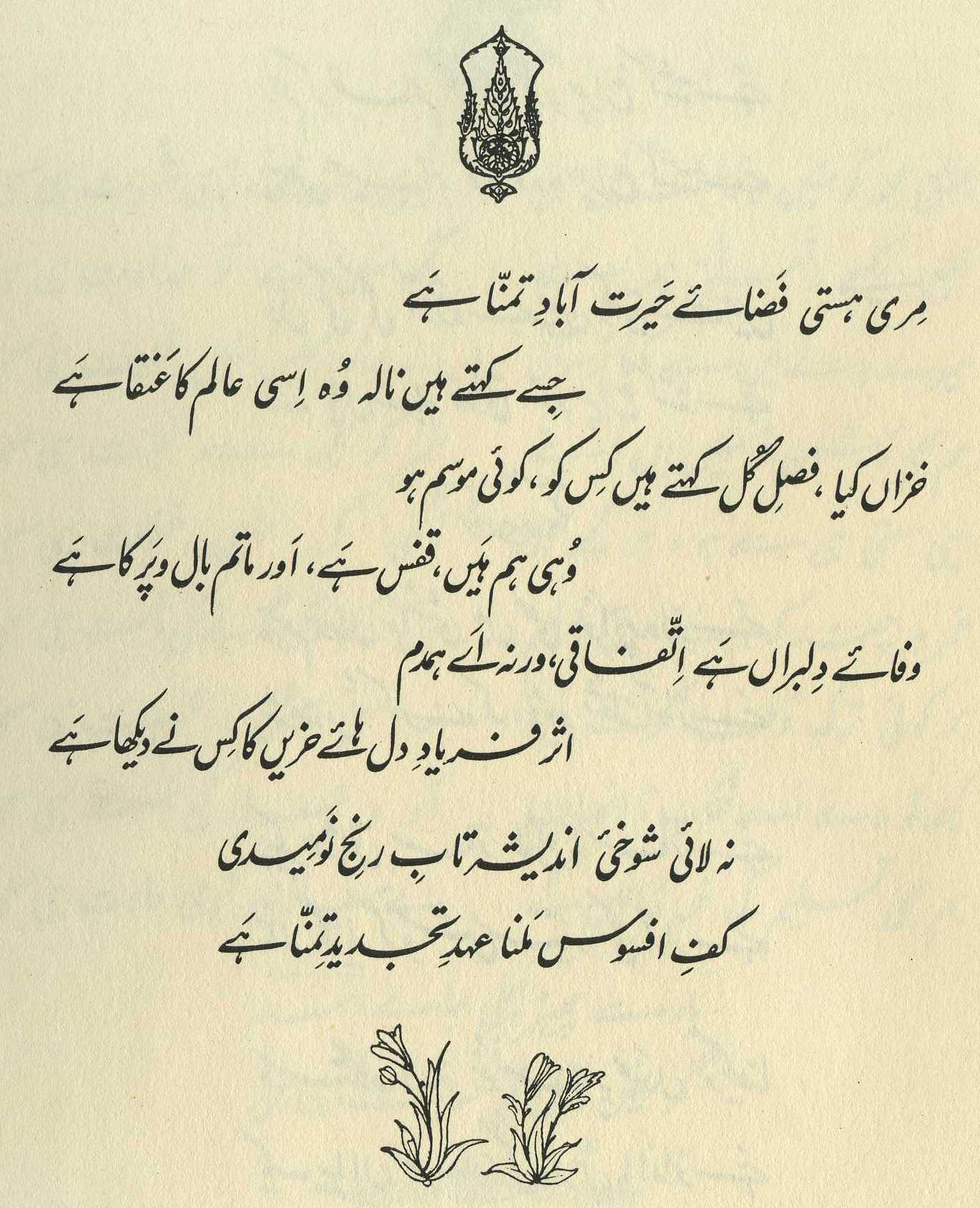
That is, the mischievousness of thought couldn't summon the strength to endure the shock of hopelessness and despair. To live in that very longing is despair, and in the state of despair they wring the hand of regret. The author has extended it, such that then this wringing of the hand is an initiation into longing. Here the author has, in the course of composition, said instead of . Although it is not idiomatic, the meaning is correct. (154)
== Nazm page 154

The meaning is that when in a state of despair I wring the hand of regret, I don't wring it because of hopelessness. Rather, at the lands of longing I am initiated a second time. At the time of [Sufi] initiation, the novice [] takes in both hands one of the hands of the master [], and expresses regret and repentance. And this is also the aspect of wringing the hand of regret. (212)
From the restlessness of our temperament it's impossible to sit still, and hopelessly we wash our hands of the pleasure of ardor and waiting; we can't endure it. When we again and again wring our hands at our failure, one ought not to consider that we've given up longing. Rather, its meaning is that we are taking a fresh vow of longing, all over again. At the time of taking a vow, one hand is slapped against the other.... The meaning of is that we had only longed, we hadn't made a vow of longing. But now, after failure, we are not wringing our hands. Rather, we are making a vow that we will definitely renew our longing. (872-73)
As so often, we're left to figure out for ourselves how to put the two lines together. If we take the first line as a cause and the second as an effect, then we learn that the 'mischievousness of thought' was unable to endure the sorrow of despair. Despair is hopelessness, and to feel a 'longing' is to have some kind of hope, even if a dim and hypothetical one. So that by 'wringing its hands', the 'mischievousness of thought' either (a) vowed to renew the longing it had earlier felt; or (b) initiated a fresh bout of longing. The second line clearly offers both possible readings:
=(a) Hand-wringing is really a kind of handshake marking a 'vow' of 'renewed' longing (after the old longing has worn itself, and the lover, out).
=(b) Hand-wringing marks the 'season' of 'new', fresh longing (before the lover goes beyond it, into longing so deep and desperate that it has no outer sign).
But what if the second line is the cause, and the first line the effect? Then the second line reports a discovery: that the speaker's longing is so intractable that (a) even hand-wringing is only a sign of a determined 'vow' to go deeper into renewed longing; or (b) hand-wringing is really only a preliminary stage of longing, before the worst of it kicks in. In either case, the situation is so grim that it must surely induce an unendurable despair (as reported in the first line).
Yet the lover's 'mischievousness of thought' can't muster the fortitude to endure despair. So perhaps his mind flees in disarray, back into longing-- only to be again driven out into despair. The verse sets up a vicious circle that seems to bite its own tail, as many times as the lover can bear to think about it. In fact, it sets up the kind of dead-end circling of futile thoughts that itself is one form of despair.
Compare the brilliant 230,7 , another verse about both helplessness, and the role of the hands in making vows.
graphics/wringinghands.jpg