Verse 11816aahai
G2
1
my existence is an expanse of amazement/stupefaction, inhabited by longing
2
what we/they call a 'lament'-- it is the Anqa of only/emphatically that world
'Width, spaciousness, openness; extensiveness (of ground, &c.); an open area, a court, a yard; a spacious tract, a wide expanse of land, a plain (syn. )'.
'Perturbation and stupor (of mind), astonishment, amazement, consternation'.
'Inhabited, populated, peopled; full of buildings and inhabitants, populous; settled (as a colony or town); cultivated, stored; full; occupied.... --flourishing, prosperous; pleasant; happy'.
| References | |
|---|---|
| Arshi, Imtiyaz Ali | Ghazal# 181 |
| Raza, Kalidas Gupta | 277-79 |
| Nuskhah-e-Hamidiyah | 234-241 |
| Asi, Abdul Bari | 238-240 |
| Gyan Chand | 367-371 |
| Hamid Ali Khan | Open Image |
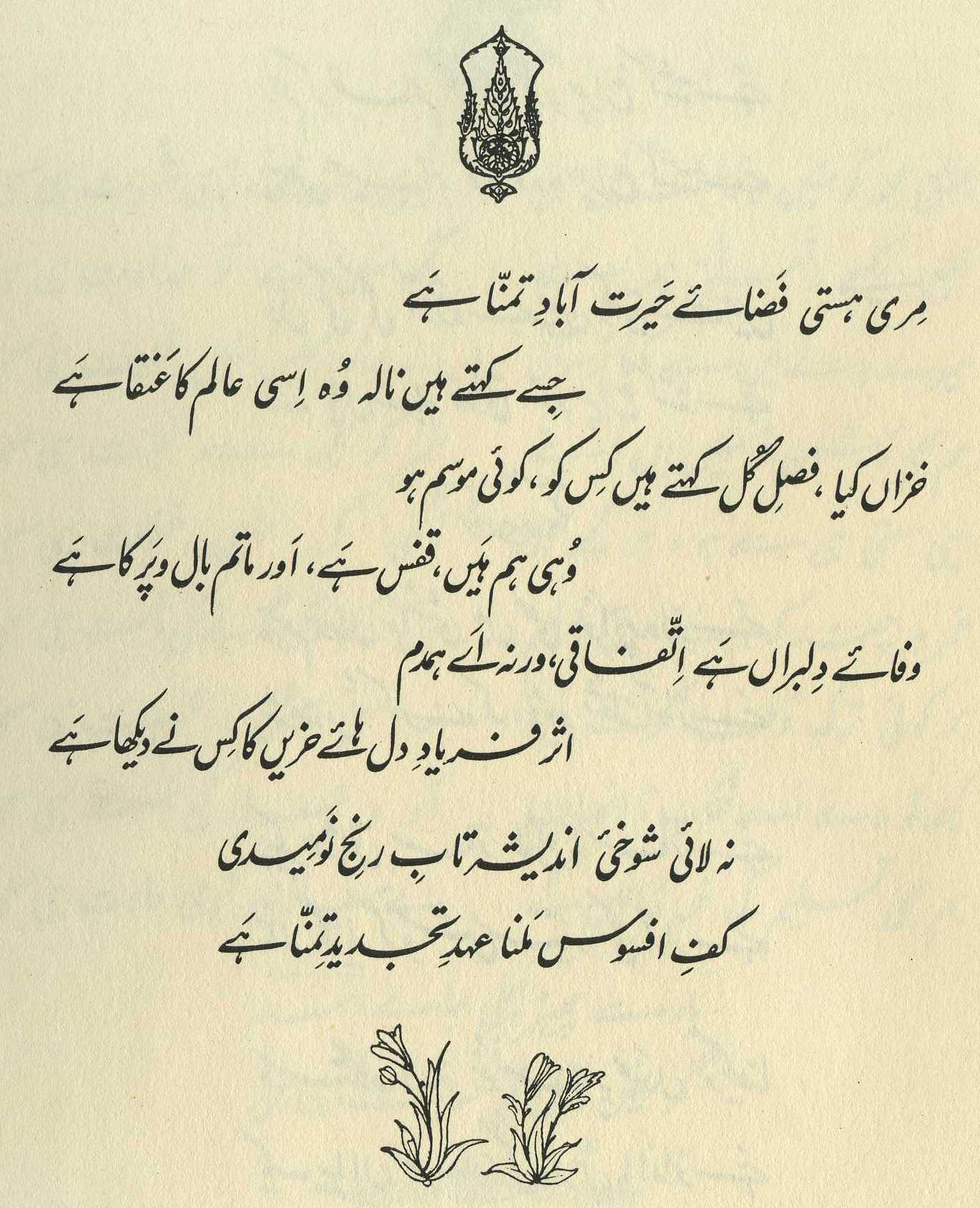
That is, amazement inhabits my existence, and among the necessities of amazement is it would make one motionless and voiceless. When in the excess of amazement the voice cannot emerge, then how could there be a lament? But along with longing there is necessarily lament. The gist is that there is lament, but it is voiceless-- like the Anqa bird, who is spoken of in the world, but whom nobody has seen. (154)
== Nazm page 154

He says, 'My existence brightens up the habitation of longing. Lament and complaint, names which the people of the world have assigned, are the Anqa of that world.' That is, no kind of voice is raised at all. In the Sufis' terminology, they call the station where the radiance of Being descends on the seeker, the 'station of amazement' []. (212)
My existence is a region of the amazement-habitation of longing, and a lament is the Anqa of that world. That is, in longing and love we are taking a stroll around the 'station of amazement', and this is the reason that our lip is unacquainted with lament. Whoever sees us finds us peaceful and silent. If we had not become absorbed in the radiances of the beloved's manifold glories, then we would have lamented and complained. (281)
In case anyone thought the previous verse, 144,1 , was too down-to-earth, here's the ideal antidote: a wildly esoteric, unvisualizably abstract one. The speaker's existence is a world of its own. This world consists of at least three things: a spacious plain of 'amazement' (on this see 51,9x ); a habitation lived in by 'longing'; and an Anqa bird.
Moreover, in the second line we learn that the Anqa has some kind of complex, crossover identity. What people call a 'lament' is the Anqa of that world. But what does this mean exactly? Does what is called a 'lament' in this world somehow morph, in that world, into an Anqa? Or does that world use 'Lament' as the name of the bird which in this world we call an Anqa? An Anqa would be exactly the right kind of bird to fly over the expansive field of 'amazement' and the town of 'longing', after all. Thus in that world, a 'Lament' would be a kind of bird that was known to exist, but that could never even be seen, much less captured. Nazm's reading, which emphasizes the stupefied silence imposed by 'amazement'-- on lamentation as well as all other speech-- makes good use of this sense of the Anqa.
Another question also hovers around the second line. To say 'what people call an X' is often a way to question a common opinion-- people think it's an X, but it's really a Y. Could the (unidentified) people possibly be wrong in their judgment? (Compare 20,6 , for a case in which the people are definitely wrong.) If people can see a crow and mistakenly call it a raven, perhaps they can see an Anqa and mistakenly call it a 'lament'. is there perhaps something wrong with our this-worldly notion of 'lament'? Needless to say, the verse gives us no way to decide.
I'd call this a verse of mood . Isn't its real charm the obscure eerieness of the first line? The silence and amazement are a perfect semantic fit to the elegance of the imagery. The second line provides a delicate finishing touch that completes the effect. Ghalib's other Anqa verses tend to be equally subtle and obscure.
graphics/emptycage.jpg