Verse 14x1816aahai
G2
1
dear friends, don't divert me with mention/telling of the 'union' of/with an Other
2 a
for/since/while here, the magic-spell of a sleep/dream is the story of the 'dream of Zulaikha '
2 a
for/since/while here, the story of the 'dream of Zulaikha ' is the magic-spell of a sleep/dream
'Dear, worthy, precious, highly esteemed, greatly valued, honoured, respected, beloved; —a great man; a worthy or pious personage, a saint; one beloved, a dear friend; a relation, relative; —a great potentate, a title of the king of Egypt'.
'Other, another; different; altered, changed (for the worse); bad; strange, foreign;—another person, an outsider, a stranger, foreigner; a rival'.
'To cause to be pleased, to amuse, divert, recreate, entertain, cheer, enliven'.
'Incantation, charm, spell, verses used in spells or enchantments, fascination, sorcery, witchcraft'.
'Sleep; dream, vision'.
| References | |
|---|---|
| Arshi, Imtiyaz Ali | Ghazal# 181 |
| Raza, Kalidas Gupta | 277-79 |
| Nuskhah-e-Hamidiyah | 234-241 |
| Asi, Abdul Bari | 238-240 |
| Gyan Chand | 367-371 |
| Hamid Ali Khan | Open Image |
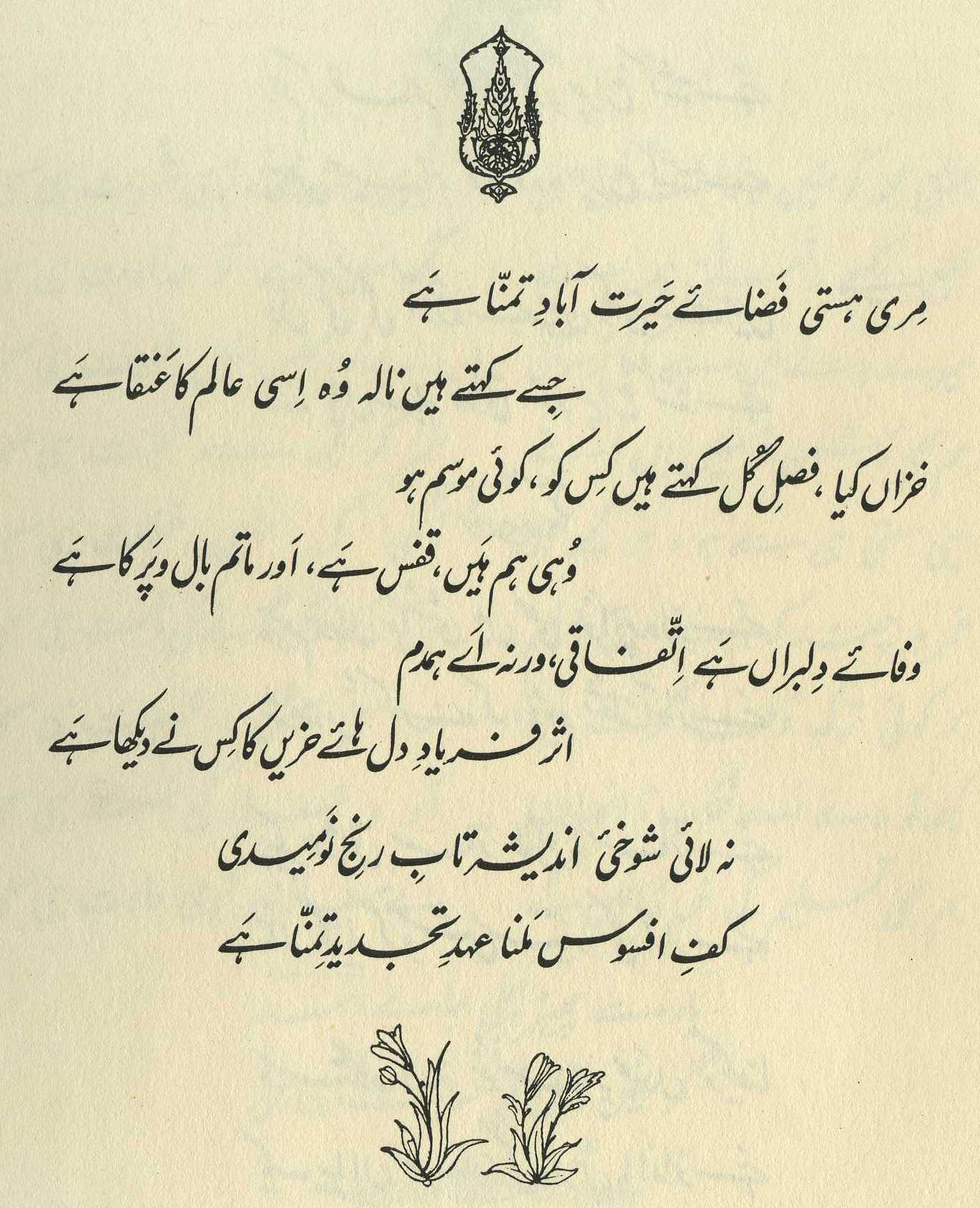
Companions and friends want to put me to sleep (divert me) with the mention of union with the friend/beloved. But their magic spell for sleep, with regard to me becomes the story of the 'dream of Zulaikha', and in the ardor for listening to a story my sleep is banished. Mirza wanted to change this half-Persian into Urdu, but has infiltrated into it. What-- to mention to the lover, the beloved's union with some Other-- is this the work of dear ones, or of enemies?! And will that mention be to amuse him, or to inflame him [with jealousy/envy]?!
== Zamin, pp. 361-362
is that mantra from the reciting of which an enemy would fall asleep, or would be overpowered by unconsciousness. Dear friends, don't divert me by saying, 'If the beloved pays no attention to you, leave her; there are many more beautiful ones, you can give your heart to them and easily achieve union. Don't you see that Zulaikha in her youth saw Hazrat Yusuf in a dream and fell in love with him; but later she married another-- that is, the Aziz of Egypt []-- and obtained union with him [Yusuf]? Why don't you too pursue some other, for the sake of union?'
The second line can also mean, 'You are telling me, by way of an example, the story of Zulaikha's marrying someone else. To me, the story of Zulaikha is a means of bringing on sleep, so that at least I would be able to see the beloved in a dream'.
== Gyan Chand, p. 369
For background see S. R. Faruqi's choices . For more on Ghalib's unpublished verses, see the discussion in 4,8x . This verse is from a different, unpublished, formally identical ghazal, 359x , and is included for comparison. On the presentation of verses from unpublished ghazals like this one along with formally identical divan ghazals, see 145,5x .
Thanks to the multivalence of the in the first line, can mean: 'union with another' (something that the speaker might be urged to consider for himself); or 'the union of an Other' (somebody else's sex life); or 'a strange/foreign/bad union'. Since the phrase refers to a story being told by the speaker's friends in order to divert him or cheer him up, the range of possible narratives would be extremely wide.
In the second line, we encounter an 'A,B' construction that equates the speaker's own 'enchantment of sleep/dream' with the 'dream of Zulaikha'. It's tempting, and quite plausible, to take the story of Zulaikha's dream as the story the speaker's friends have been telling him in the first line. But within the grammar of the verse, it's not at all necessary. The friends could have been telling some other story entirely, and the speaker then simply uses Zulaikha's dream to illustrate a point he's trying to make about their narrative.
For the story of the 'dream of Zulaikha', see 194,5 ; it's also alluded to and discussed in 145,9x . It's such a rich and narratively complex story, with so many elements of chastity and sensuality, arrogance and humility, dream and reality, failure and success, that it's not at all clear what elements of the story are being invoked here.
Similarly, the in opens up an array of possibilities. Is it a magic spell that creates a sleep/dream, or that is created by one, or that itself 'is' one? Not only is the connection ambiguous, but the two parts themselves are complex in their own ways. And is the the enjoyable, desirable 'enchantment' of listening to a story, or is it the frightening grip of nightmare and bad magic ('sorcery, witchcraft')?
Obviously, the whole range of permutations is almost hopelessly wide. The longer one considers this verse, the more its shape keeps changing, and new possibilities constantly emerge. It's too richly multivalent-- does it leave us with a sense of looseness of structure?
Only in retrospect do we savor the initial vocative plural , which at first seems a bit unusual (how often does the wretched lover actually have a whole group of dear friends around him?). Only when we hear the second verse do we pick up on the reference: Zulaikha's husband is called the Aziz (Qur'an 12:30). Of course the wordplay is fun in itself, but is there also a sense in which the speakers 'dear friends' are playing the cat's-paw role of the Aziz? (And it's clever that they're plural, because only the plural vocative is instantly and conveniently recognizable as such.)
There are also the beautiful rhythm and sound effects of the second line, in which the juxtaposition with not only pleases our ears, but also leads us to wonder whether the and the are being compared, or contrasted; for more such verses, see 15,18x .
graphics/zulaikha.jpg