Verse 41816iirkaa
G1
1 a
let awareness spread the net of hearing to whatever extent it might wish
1 b
no matter to what extent awareness might spread the net of hearing
2 a
the intention/meaning of my world of speech is the Anqa
2 b
my world of speech has no intention/meaning at all
2 c
'intention/meaning' is the Anqa of its own world of speech
2 d
the Anqa is the intention/meaning of its own world of speech
'To hear, listen, attend to; to obey; ... to perceive; to collect'. (Steingass p.764)
'Desire, wish, suit; meaning, object, view; scope, tenor, drift'.
'(fem. of , 'long-necked'; rt. 'to be long in the neck'), s.m. A fabulous bird, the phœnix; a rara avis (syn. ); —adj. Scarce, rare, hard to get or find; wonderful, curious'
'Long-necked; a fabulous bird, also called said to be known as to name but unknown as to body; hence anything scarce, rare, wonderful, difficult or impossible to be got'. (Steingass p.871)
| References | |
|---|---|
| Arshi, Imtiyaz Ali | Ghazal# 1 |
| Raza, Kalidas Gupta | 140 |
| Nuskhah-e-Hamidiyah | 27-28 |
| Asi, Abdul Bari | 49-50 |
| Gyan Chand | 59-61 |
| Hamid Ali Khan | Open Image |
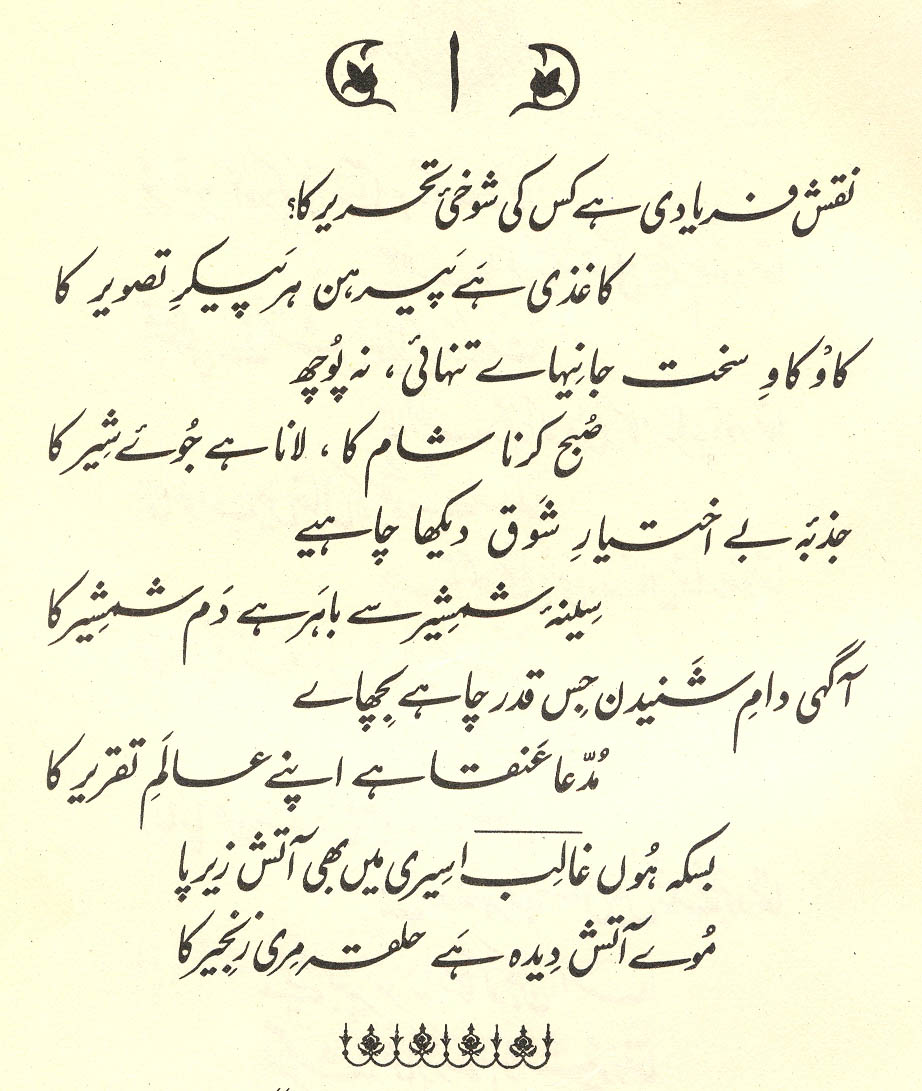
That is, you can report my speech to whatever extent you may desire; it is impossible to arrive at its meaning. Even if the ardor for awareness becomes a hunter and spreads the net of hearing, so what? The meaning of my speech is the Anqa bird, upon which a net can never be flung. In short, my verses are entirely mysteries []. (2)
== Nazm page 2

Urdu text: Vajid 1902 {1}
That is, my speech is entirely a mystery from the Unseen []. It is not popularly comprehensible, such that every Tom, Dick, and Harry would be able to understand it. Accordingly, Mirza Sahib says in one Urdu letter that poetry is a name for theme -composition [ ; though what Ghalib actually wrote was (see 119,7 )], not for rhyme -weighing []. (10)
No matter how much effort the power of understanding makes, it is deficient in understanding the goal and purpose of our speech. Gesturing toward his own 'love of difficulty' [] and 'difficulty of style' [], he says that his poetic speech is very difficult to understand. Perhaps for this reason, growing annoyed, he versifies a thought very similar to this one: 62,2 . (4)
The ʿanqā (the mythical bird in Persian and Urdu literature characterized solely by its unlocatability) has a parallel in the Western tradition: the black swan. The Roman poet Juvenal (first/second c. CE) wrote in despair of finding a wife with all the right qualities that such a woman is “rara avis in terris, nigroque simillima cygno” [in this world a rare bird, very much like a black swan] (Satires 6.165). In his time and for most of the next two millennia, the black swan was presumed by Europeans not to exist. Indeed, “all swans are white” had long been a favorite postulate in philosophy. When black swans were finally discovered in Australia in 1697, many people thought for years afterwards that it was a hoax. (Mar. 2013)
As Faruqi has pointed out (July 2000), to say , 'the meaning is an Anqa', is also an idiomatic way of saying that something is meaningless. Ghalib's Anqa verses do in fact tend to be on the obscure side.
Line two is, in almost a mathematical sense, 'symmetrical': it plays on the Urdu grammatical fact that to say 'A is B' is equally to say 'B is A'. So we can say either that the is an Anqa, or that the Anqa is a -- or, of course, both, since there's no way to choose between them.
It is common to take the in the second line as equivalent to , 'my own'; for examples and discussion of this flexibility in , see 15,12 . But it literally means 'belonging to the subject of the sentence', thus yielding the abstruse (and very post-modern-looking) meaning presented as (2c). Moreover, we must then ask whose intention-- the poet's in composing poetry, or the reader's in seeking to understand it?
The result is an early example from a set of verses that might well be called 'meaning generators', since they're impossible to resolve into one interpretation (or even two, or even three or four). There will be many more of these to come.
I used a free transcreation of this verse as a source for the title of Nets of Awareness . Could there possibly be a better introduction to Ghalib's poetry than this verse?
And here's a salute to our Urdu poetry group: they very much improved (Oct. 2023) my translation of this verse. I had somehow translated as 'intelligence'; they pointed out that 'awareness' was a much better translation, more in accord with my own commitment to maximum literalness.
Here's a provincial Mughal vision of the Anqa:
graphics/mughalanqa.jpg