Verse 31816iirkaa
G1
1
the uncontrolled/uncontrollable passion/attraction of ardor ought to be seen!
2
the breath/life/edge of the sword is outside the sword's breast
'Passion, rage, fury; violent desire'.
'Drawing, attraction; allurement; absorption'.
'Ardour, zeal, eagerness, avidity; alacrity, gaiety, cheerfulness; curiosity'.
is an archaic form of ; GRAMMAR .
'A sword, a scimitar'.
(P) 'Breath, vital air, life; —a moment, an instant; ... —spring, elasticity; vitality, energy, vigour, stamina, spirit, mettle; strength, goodness, virtue (as of medicines, cloth, &c.); —ambition; —cheerfulness, pleasure, recreation; society (as a breathing together); —edge (of a sword); point (of a spear) ...; a draught (of water)'.
(P, H) 'Deceit, fraud, trickery, trick, coaxing, wheedling; —arrogance, pride, haughtiness; boasting'.
(A) 'Blood'.
| References | |
|---|---|
| Arshi, Imtiyaz Ali | Ghazal# 1 |
| Raza, Kalidas Gupta | 140 |
| Nuskhah-e-Hamidiyah | 27-28 |
| Asi, Abdul Bari | 49-50 |
| Gyan Chand | 59-61 |
| Hamid Ali Khan | Open Image |
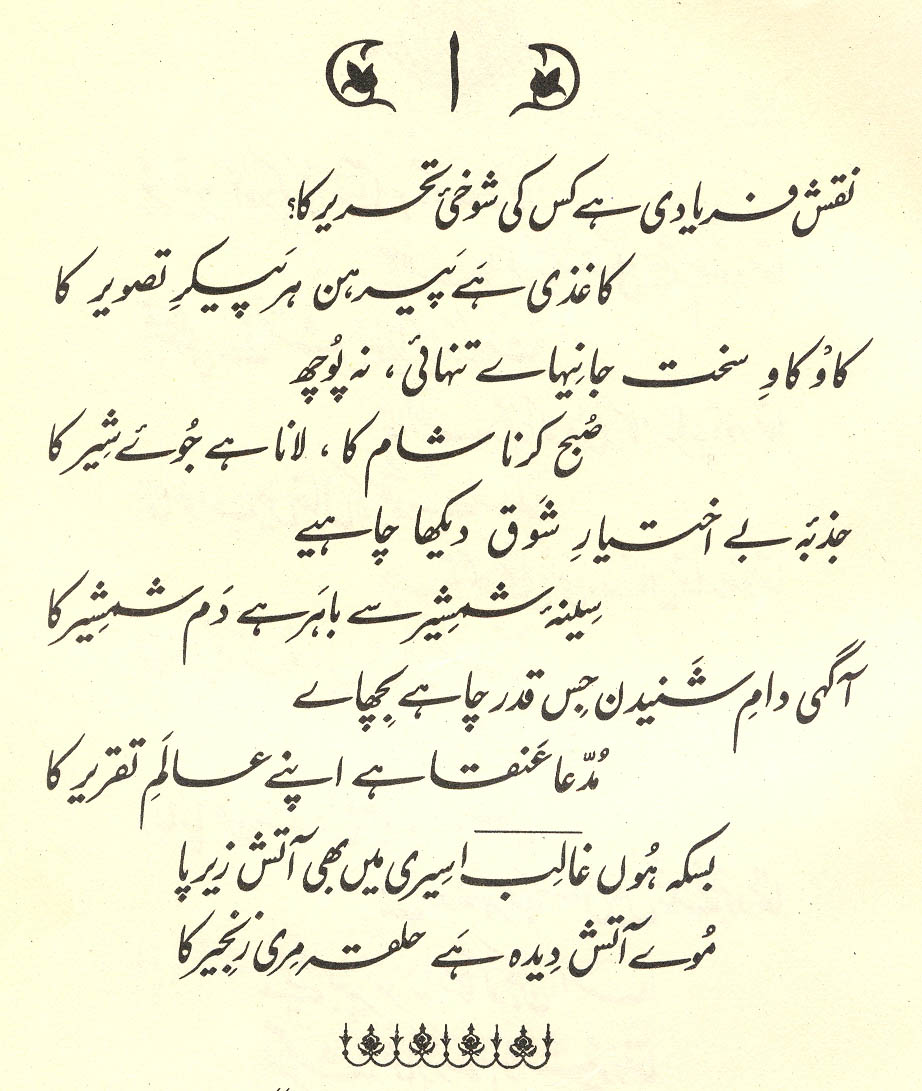
The word has two meanings, 'breath' and 'edge', and here both meanings are related and suitable. He has said 'breast of the sword'-- the meaning is that in my eagerness to be slain, such passion is attracting the sword's that it is drawn out of the sword's breast. (2)
== Nazm page 2

Urdu text: Vajid 1902 {1}
They call the temper and sharpness [] of a sword the of the sword. And this is always on the outer part of the edge. The lover declares the of the sword's being outside the sword to be evidence of the uncontrolled passion of his ardor, and the claim includes a clear proof . Who can doubt that the verse is ? (10)
The edge of a sword faces toward the outside, but the ardent lover, in the extreme ardor for martyrdom, entirely forgets that everyday fact; instead, he thinks that either out of an ardent desire to slay him, or drawn by his ardent desire for martyrdom, the edge of the sword has emerged from the breast of the sword. This verse is based on ' elegance in assigning a cause '. (4)
A SPECIAL DISCUSSION: HOW MUCH IS ENOUGH? The real delight of the verse is the lovely wordplay on , in which two of its meanings-- the edge of a sword, and the breath-- are dead-on perfect. Other verses in which multiple meanings of are exploited include: 22,7 ; 92,3 , which also features a ; and 98,3 . The present verse can also be used as a kind of focal point for a discussion of poetic principle. The question is, how much wordplay, and/or philology, is too much? For , from Arabic, also means 'blood'; and has other Persian- and Hindi-based meanings as well, of 'trickery' and 'arrogance' (see the definitions above). Do those meanings count too? Here are some thoughts on this problem: * FWP *.
The sword's eagerness could be an illusion created by the lover's passion. Or the uncontrolled enthusiasm could be that of the sword itself, which has come to share the lover's passion. Is that why the word has been so conspicuously repeated, to alert us to the fact that plays it two roles? It is both a weapon and a manifestation of 'ardor'; and of course, we can't tell whether the ardor is its own, or the lover's, or even the beloved's-- as Faruqi has suggested (July 2000). Since the first line promises a spectacle, the emotion might even be that of some eager would-be gawker. And no matter who feels the emotion, the word itself carries strong overtones of its root, , with its strongly relevant sense of 'drawing, attraction' (see the definition above).
Another verse in which inanimate things seem to quiver with eagerness: 120,6 .
Note for grammar fans: is an archaic form of what would nowadays be . For other such instances see 94,1 ; 126,11 ; 127,2 ; and many verses of 189 , in which it's often worked into the rhyming elements.
Compare Mir's brilliant use of the sword's wild emotions: M 144,5 .
It was common for the hilt of a sword or dagger to be given the form of a dangerous animal's head (here, a lion):
graphics/shamshir5.jpg
Here's a sword-hilt with * an elephant's head *, here's one with * a snake's head * (but then, here's * a horse's head * and * a peacock's head *). Here's one that depicts both predator and prey:
graphics/shamshir3.jpg
A more systematic look at another :
graphics/shamshir.jpg
"A Lucknow enamelled shamshir, India, early 19th century. With single-edged watered steel blade inscribed near hilt, silver fittings engraved with floral decoration, remains of green and blue enamelling to the quillons and lion head terminal, the hilt of ivory with cross-hatching and scabbard of shagreen - 36 1/4in. (92cm.) long."


