Verse 111854aa;Nkyuu;N ho
G2
1
do you seek to accomplish/'pull out' work/desire through reproaches/accusations, Ghalib?!
2
from your calling her 'unkind', why would she be kind/gracious to you?!
| References | |
|---|---|
| Arshi, Imtiyaz Ali | Ghazal# 127 |
| Raza, Kalidas Gupta | 449-50 |
| Hamid Ali Khan | Open Image |
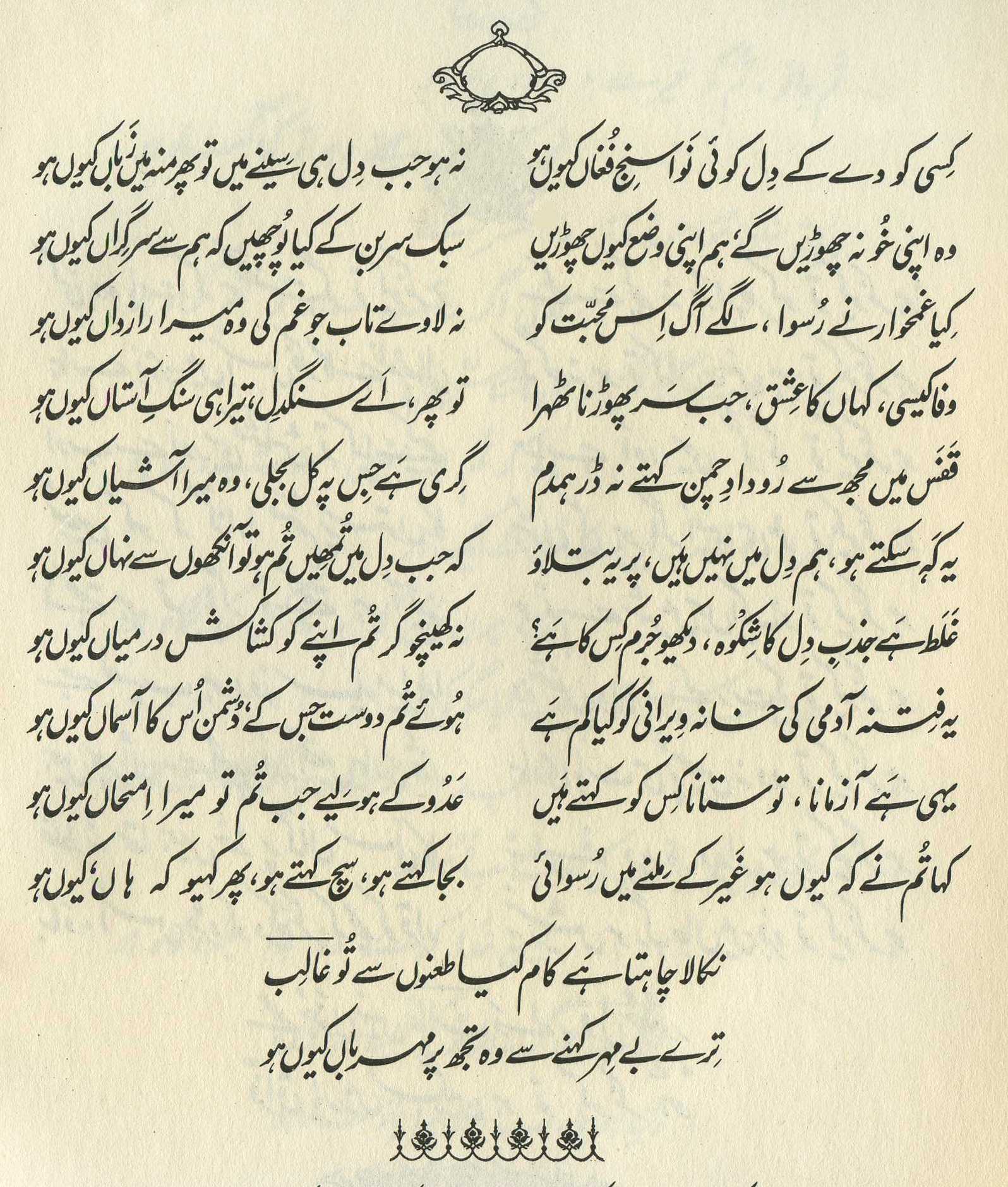
That is, you think that through your repeated reproaches, she would become yours. That will not happen. (137)
== Nazm page 137

Mirza Sahib has written this whole ghazal with adornment. Every single verse is peerless, and the closing-verse is the ultimate jewel.... The excellence of this closing-verse is that he has described the beloved's behavior with a new mischievousness []. The meaning is that she always does the opposite of what she is told to do. And knowing this, he has called her 'unkind', so that with her long-time stubbornness she would become kind. (192)
Reproaches will not get the job done; she's not one to be trapped in your net. (257)
A vintage mushairah verse. The first line is uninterpretably broad and abstract. The first half of the second doesn't make clear what's going on. The punch-word is withheld till the last possible moment, and then it knits the whole thing together. It opposes itself both to the reproaches/accusations in the first line, and to the earlier in the line. And it also connects with the secondary meaning of -- which is 'desire' as well as 'work'.
The lovely, perfectly balanced second line, suggesting the hopelessness of struggle, has an overtone of clear-eyed fatalism. Reproaching her and calling her 'unkind' won't make her kind-- but then, flattering her and calling her 'kind' won't make her kind either. (If it would, the lover would have made use of such a ploy long ago.) The basic truth is that nothing will make her kind.
The speaker-- who may be a friend or well-wisher-- is trying to reason with the lover; or else the lover's rational self is trying gently, compassionately, to reason with his passionate self. The rational self or speaker sees that the lover's passion is pursuing a lost cause-- and even doing so in a counterproductive way. But then, it's not as though the rational self has anything more promising to offer.
Note for grammar fans: In the first line, instead of the usage would nowadays be . For more such examples, see 1,3 .
graphics/quarrel.jpg