Verse 101854aa;Nkyuu;N ho
G2
1
you said, 'Why would there be disgrace in the Other 's meeting me?'
2 a
you speak rightly, you speak truly! Say again, 'Indeed, why would there be?'
2 b
you speak rightly, you speak truly, say it again! For indeed, why would there be?!
'Dishonoured, disgraced, infamous, ignominious; humiliated; open, notorious; accused; one held up to public view, as an example to deter'. (Steingass p.576)
| References | |
|---|---|
| Arshi, Imtiyaz Ali | Ghazal# 127 |
| Raza, Kalidas Gupta | 449-50 |
| Hamid Ali Khan | Open Image |
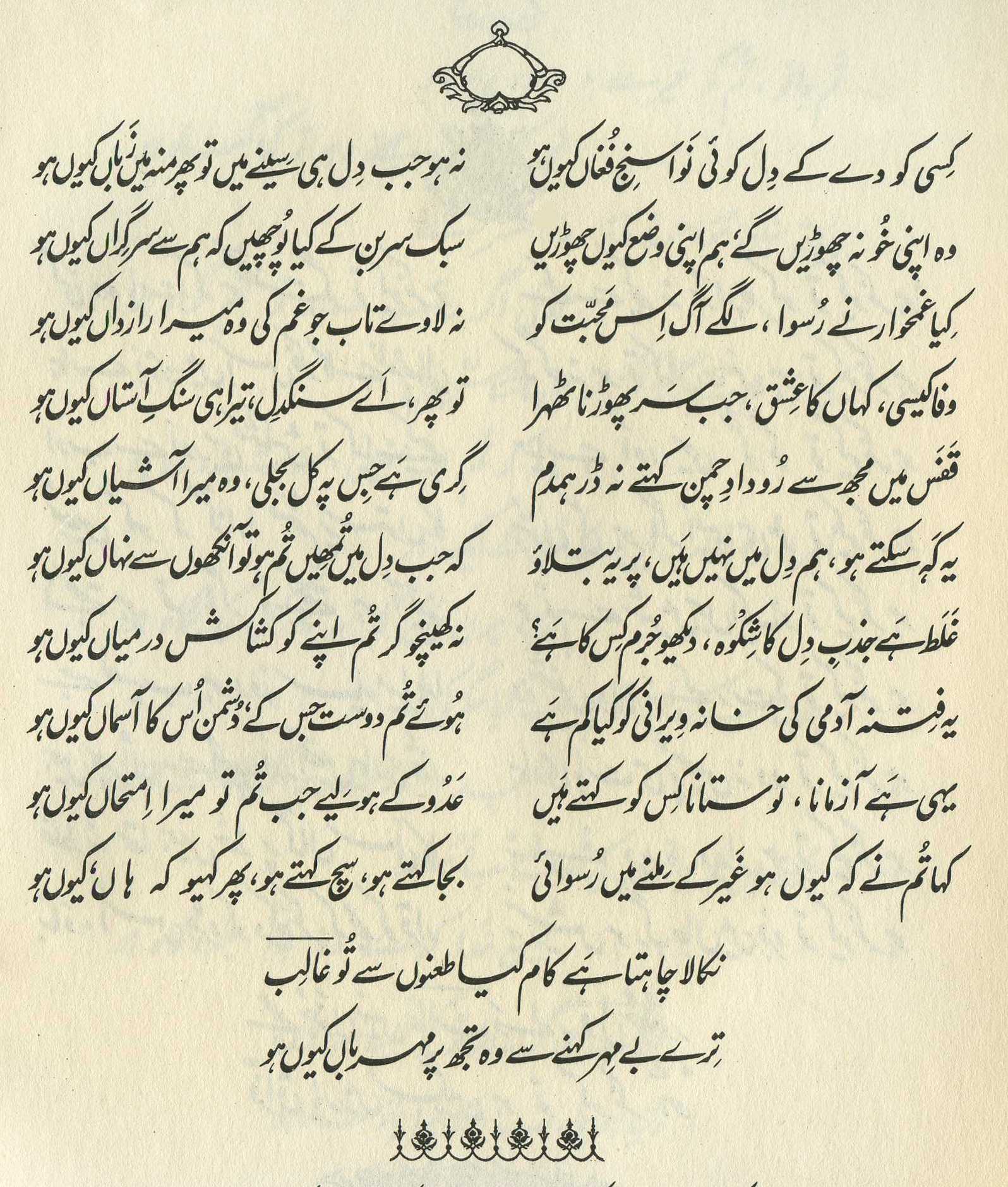
Only out of regard [for the refrain has the author used in this place; otherwise, in such a place they say . Nevertheless, its construction [] has reached the level of enchantment. (137)
== Nazm page 137

He says, when you said, 'Why would there be disgrace and ill-fame in meeting the Other, for what cause?'-- you speak rightly, you speak truly. Then say it a second time: indeed, why would there be disgrace? The meaning is that there will certainly be disgrace. For your sake, if you tell me to, I would say that indeed, meeting the beloved is not a cause of disgrace. (192)
When the lover tries to persuade her, the beloved says, 'Why is there ill-fame in meeting the Rival ?' In response to this he says sarcastically, 'You've spoken very well-- please just say it again! From your lips, this speech is very pleasing.' Precision [] [of structure] sacrifices itself for this verse. (257)
This is surely one of the world's ultimate verse of dialogue. Forms of 'to say' [] occur in it four times, and its colloquial energy and idiomatic phrasing are admired by the commentators. Appropriately, it relies on tone; and as usual, we readers are left to choose much of the tone for ourselves.
The first line is a direct quotation of the beloved's words. Are these words innocent and naive (she doesn't realize how the gossip machine works)? Or are they coy and flirtatious (she is just teasing, pushing the lover's buttons)? Or are they defiant and angry (she declares her willingness to burn her bridges behind her)? As usual, it's left to us to decide for ourselves.
Whatever her tone may be, the lover's own tone is hardly in doubt: he seems to be speaking with heavy, ostentatious sarcasm. He offers her classic phrases of mock praise ('Oh sure, that's great! You're really brilliant!'). And then-- what next? He either encourages her to repeat and even amplify her words (2a); or he adopts her line of reasoning-- and echoes her very words-- himself (2b). Either way, the sarcasm is dripping from his words, and this enjoyable vehemence is what gives such remarkable exclamatory energy to the verse.
Yet the fact that the verse asks a question, and that the surface grammar is completely hospitable to this question, can also lead us to ask the question straightforwardly. Would it in fact be disgraceful if the beloved were to associate with the Other? We know nothing about her circumstances. Perhaps she is a well-placed lady of independent means, and feels able to associate with anyone of her choosing. Or perhaps she's so accustomed to living with scandal-- since her gorgeous beauty attracts and slays lovers by the score-- that she has nothing further to lose (in this context consider 24,7 ).
So might the lover's sarcasm be a last-ditch recourse-- might it be a desperate replacement for the more substantive arguments he would like to offer but cannot find? For after all, the lover himself doesn't exactly occupy any moral high ground: his real reason for trying to discourage her is not any abstract moral concern, but sheer self-interest. (Remember 116,6 , in which he's hoist with his own petard.) As usual, Ghalib leaves us with a set of piquant and fascinating questions-- and, needless to say, no answers.
graphics/why.jpg