Verse 41854aa;Nkyuu;N ho
G2
1
what kind of faithfulness?! what sort of passion?! when head-smashing has been decided upon
2
well then, oh stone-hearted one, why would it be only/emphatically your doorsill-stone?!
'To last, endure; to be ascertained, be proved, be established; to be settled, be agreed upon, be concluded; to be fixed on, be determined, be resolved'.
| References | |
|---|---|
| Arshi, Imtiyaz Ali | Ghazal# 127 |
| Raza, Kalidas Gupta | 449-50 |
| Hamid Ali Khan | Open Image |
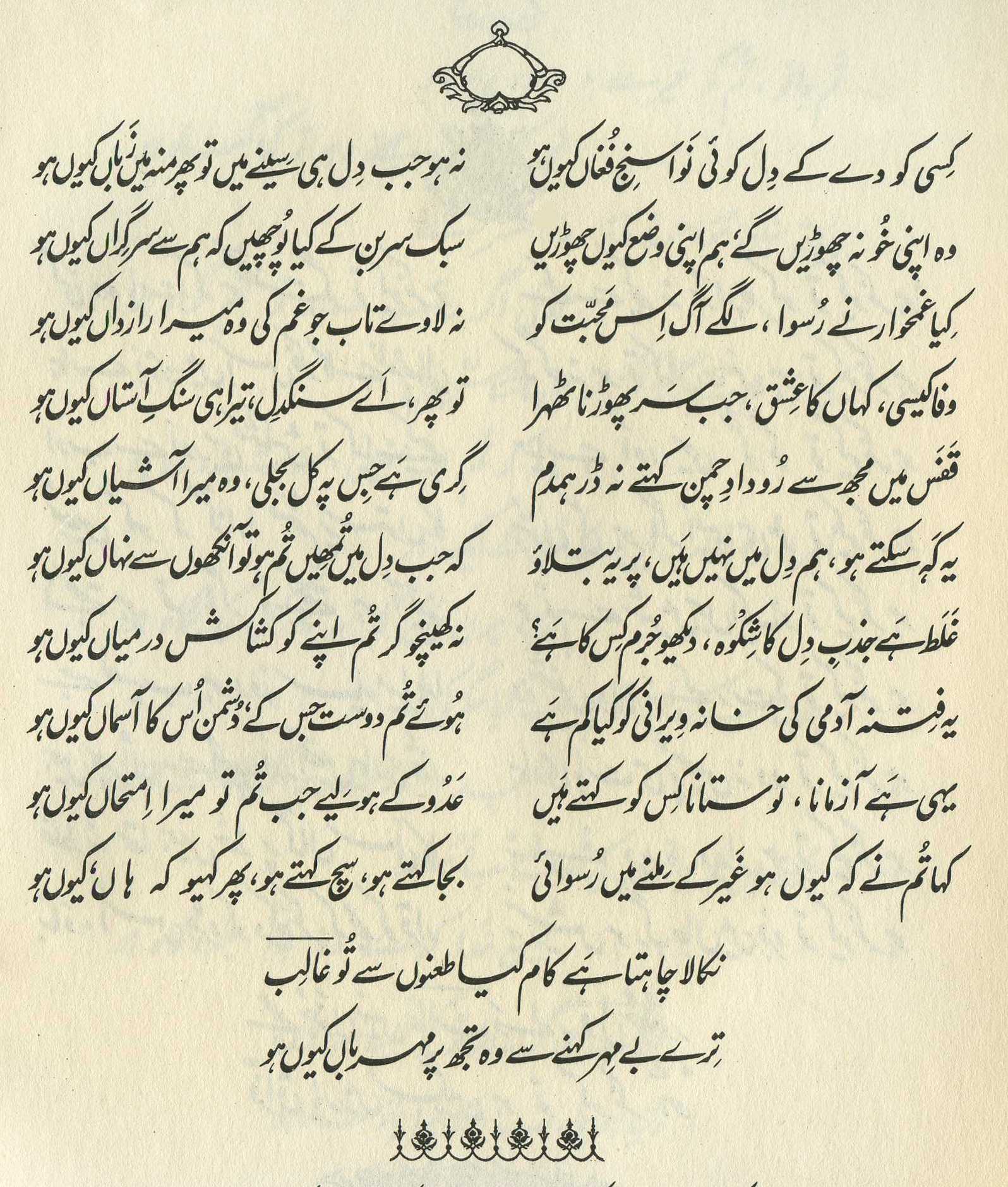
This verse is, in its color and shape [], a royal pearl.
== Nazm page 136

He says, 'What kind of faithfulness, and what passion and love! When I've resolved to bash my head and die, then what do I care about the aforementioned two things? And when I've already resolved in my heart to adopt the scheme of bashing my head, then, oh stony-hearted one, what need do I have of your threshhold-stone? If not that one, then I'll bash my head against some other stone.' They're not words, but sets of jewels. (191)
It's as if the beloved has said, 'You claim to be faithful, so then why complain about cruelty?' The answer to this is [the verse].... Through this, his only purpose is to move the beloved to compassion. (255)
What a brilliant use of speech! The whole verse consists of two short simple questions, and one long complex one. Here are some of the possibilities of the two short ones:
='What kind of faithfulness, what sort of passion', have you ever shown me? (Now you see the result of your cruelty!)
='What kind of faithfulness, what sort of passion', do I owe you? (None at all, after the way you've treated me! Now you see my response.)
='What kind of thing is faithfulness? What is the source of passion?' (I don't understand the nature of these deep emotions, but I know they go far beyond any special loyalty to you!)
Then the second question includes the beautiful, multi-layered wordplay that links the notoriously stony-hearted [] beloved and her 'doorsill-stone' []. There's also the ambiguity inherent in the verb . When something has been 'fixed' or 'settled', it may indeed have been decided or resolved by the person himself; but it may also have been already arranged, decreed, written by the hand of fate-- such that the person cannot 'decide' it, but can only discover or realize it as inescapable.
The implied answer to the second question would seem to be, 'Why, there's no reason at all it should be your doorsill! It won't be, of course-- there are plenty of more convenient, more neutral stones without that unnecessary extra bitterness!' But in the ghazal world, it's very possible that it will be her doorsill after all; the lover, having vented his bitterness, will be back to her door just as surely as the Moth will return to the candle flame.
See 124,5 for a similar treatment of all places versus the one place.
On the translation of as 'has been decided upon', see 38,1 .
graphics/queenscollvrn1873.jpg