Verse 5after 1847aahho
G3
1
when the wine-house has been left/abandoned-- well then, now what restriction/bondage of place?!
2
whether it be a mosque, whether it be a religious school, whether it be some [Sufi] hospice
'To be set free, be liberated, be discharged, be acquitted; to be redeemed (a pledge); to be let go; to get loose; to be loose; to be dishevelled (the hair); to escape (from); to slip (from); to be adrift; to be got rid of, to be separated (from); to be left, be abandoned; to be left out, be omitted; to be left off, be given up, be relinquished'.
'A shackle, fetter, bonds; bondage; confinement, imprisonment; control; restraint; restriction; limit; condition; an obstacle; a bond, compact, treaty, bargain; rule, regulation; article (of agreement); an obligation'.
| References | |
|---|---|
| Arshi, Imtiyaz Ali | Ghazal# 123 |
| Raza, Kalidas Gupta | 399 |
| Hamid Ali Khan | Open Image |
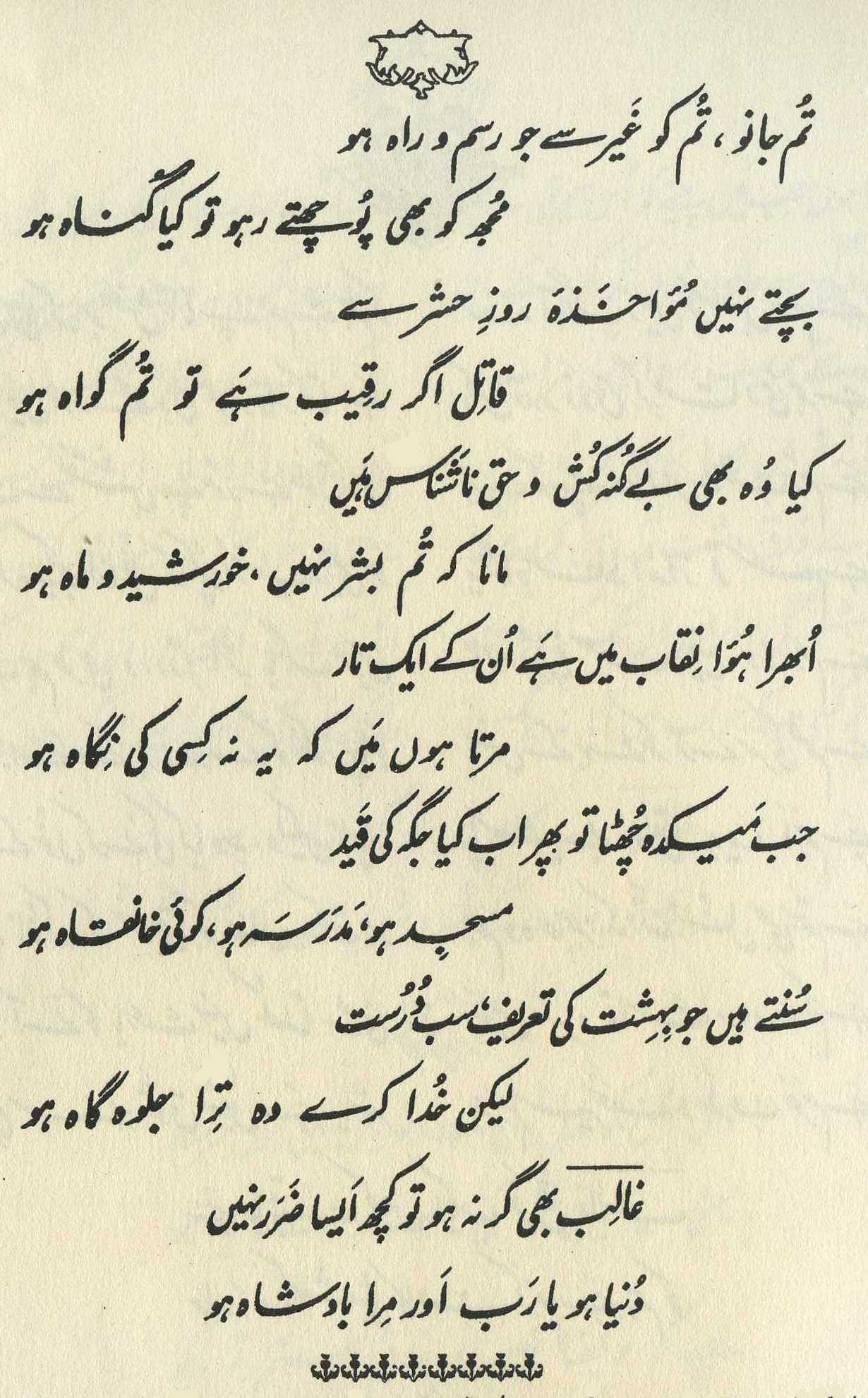
In this verse, by way of refinement he has not mentioned that activity for which he declares mosque and religious school and Sufi hospice to be suitable. The meaning is that when the wine-house, where there was the pleasure of drinking wine with companions, has been left behind, now if we meet in the mosque or encounter each other in the religious school or the sufi hospice, all places are equal. The mosque, etc., have been singled out by way of mischievousness; that is, these places which are absolutely not proper for this activity-- even there, after leaving the wine-house, there’s no rejection of drinking. And not to explicitly mention wine-drinking is the claim of rhetoric [].
==Urdu text: Yadgar-e Ghalib , p. 154
When the place where the pleasure of life was found has been left, then now there's no refusing to go anywhere. This verse is the [choicest] 'produce of the ground ' []. (133)
== Nazm page 133

When one can't remain in the wine-house, then now the mosque, the religious school, the Sufi hospice, are all equal; we'll go wherever you say. This verse is an extremely fine example of rakish witticism []. How glorious and splendid a thing is the wine-house, and how commonplace the mosque, etc., look! (251)
The commentators have done a helpful job on this one. Bekhud Mohani is right to point out the casual tone of the second line-- how the names of the possible places are tossed off, carelessly and thoughtlessly, in no particular order, with the added touch of 'some' [] to add a sense of supreme indifference. Compared to the wine-house, all these other (virtuously Islamic) places are of no importance at all. (For a similarly casual treatment of the Ka'bah, see 163,7 .) And what is the use the speaker has made, or plans to make, of any of these places? As so often, it's left entirely up to us to decide.
Has the wine-house been left behind under some kind of duress, as the commentators assume, so that the speaker's indifference is that of a man with nothing left to lose? It's perfectly possible, and it makes a wonderful reading.
But it's equally possible that the speaker's (literal or metaphorical) intoxication has now reached such a level that it's independent of the wine-house. He no longer needs wine, he's drunk enough; perhaps he is now so mystically exalted that he will never need to drink again. Now he's free of all ties to particular places. The wine-house was his last allegiance, and now that too has been transcended, so he exults in his radical detachment and autonomy. He's gone beyond even the wine-house! (Compare 5,3 , in which the speaker has gone 'even beyond non-being', and is now free from the inconveniences of that state.)
There's also a nice affinity between and (see the definitions above); I think Syed Zulkifil for pointing this out (Jan. 2011).
On the translation of as 'has been left', see 38,1 .
graphics/sitaram1814.jpg