Verse 2after 1847aahho
G3
1
you/people don't escape from the reckoning/reproach of Judgment Day
2
if the Rival is the murderer, then you are a witness/proof
'Calling to account, taking satisfaction (from); retaliating; punishing, chastising; punishment; impeachment; accountability; --amends, damages; --reprehension, blame'.
'A witness, an evidence; testimony, proof'.
'One who bears witness, a witness, deponent; ... a sweetheart, a beloved object; a handsome man; a beautiful woman; a female friend'.
| References | |
|---|---|
| Arshi, Imtiyaz Ali | Ghazal# 123 |
| Raza, Kalidas Gupta | 399 |
| Hamid Ali Khan | Open Image |
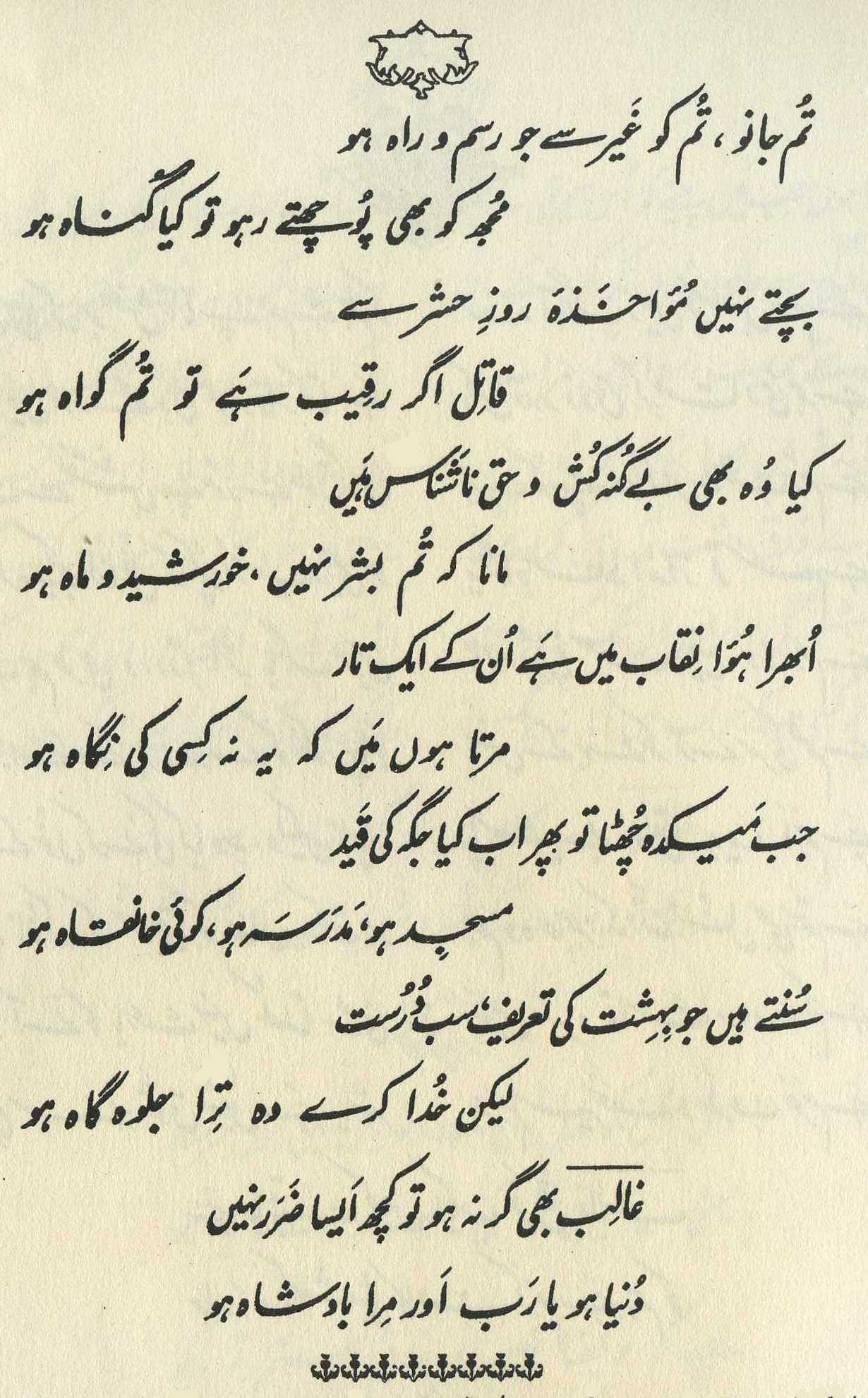
That is, you don't escape; that is, my murderer. The meaning is that if you're a witness, you'll be seized, even if you escape blame for the murder. (133)
== Nazm page 133

From the inquiry of the Day of Judgment neither can you escape, nor can the Rival. If the Rival is charged as a murderer, then you will be a witness. Because you know very well that I am slain by him. (250)
In truth, the theme -generatingness of this verse is dependent on the law of witness and punishment. According to this law, the witness to a crime is considered to be a participant in the crime if he keeps the crime secret.... According to this law, the beloved, who has beheld the scene of slaughter with her own eyes, but has wanted to keep the crime secret, deserves to be charged.
If the question be raised as to where in the verse is there mention of keeping the crime hidden, then the reply will be that if the crime is not hidden, then the verse's premise itself is at an end. The point is that the Rival (or the Rival conspiring with the beloved) has contrived the lover's murder, or brought about this result, and only these two know about it. If everybody would know about this, then where's the meaningfulness in making only the beloved a participant ('if the Rival is the murderer, then you're a witness')? If there were many witnesses, then accusing the beloved alone would be frivolous.
== (1989: 232) 2006: 253-54
In classic mushairah -verse style, the first line is such a broad, sententious generalization that it's virtually uninterpretable. The omitted subject of its masculine plural verb can be 'they' (including the unspecified 'people in general'); or the polite 'you' [], or the familiar 'you' []; or 'we', or 'we' used colloquially in place of 'I'. Nobody can possibly tell until (after, under mushairah performance conditions, a suitably tantalizing delay) we're allowed to hear the second line.
Then, of course, we learn that the beloved will be part of the murder case-- as an accomplice (she permitted, or even encouraged, him to do the deed), or as a piece of the evidence (her beauty and cruelty motivated the murder), or both. When she is called to give testimony, her part in the whole affair will be brought out in open court, and how will she escape at least blame and reproach, if not criminal charges?
Hovering invisibly but enjoyably over the verse is the word (see the definition above)-- a word that literally means 'witness' but has also become an epithet for the beloved (since the beautiful beloved is a 'witness to ' or 'proof of' of God's creative power; see for example 71,10 ).
The word too deserves some credit-- it is a ' fresh word ' that occurs only this once in the divan . It sounds properly judicial and ominous; and it's so long that fitting it nicely into the line would have required care. Yet there it is, solidly ensconced right in the middle of the first line, with its absolutely perfect range of meanings (see the definition above).
Still, it's an unexciting verse-- it's the kind that doesn't lose much in a prose paraphrase.
graphics/justice.jpg