Verse 101821aaz
G8
In this meter the first long syllable may be replaced by a short; and the next-to-last long syllable may be replaced by two shorts.
1
Asad ullah Khan became finished [off]
2
ah, alas!-- that reprobate/rake, a pursuer of beautiful ones!
'To be completed, finished, or concluded; to come to an end, to cease; to die'.
'A sceptic; a knave, rogue; a lewd fellow, reprobate, drunkard, debauchee, blackguard, profligate, libertine, rake'.
'Playing, player; --(in comp.) a suffix denoting an 'agent,' 'doer,' 'one who has to do with,' 'fancier,' &c.'.
| References | |
|---|---|
| Arshi, Imtiyaz Ali | Ghazal# 69 |
| Raza, Kalidas Gupta | 332-33 |
| Nuskhah-e-Hamidiyah | 113-114 |
| Hamid Ali Khan | Open Image |
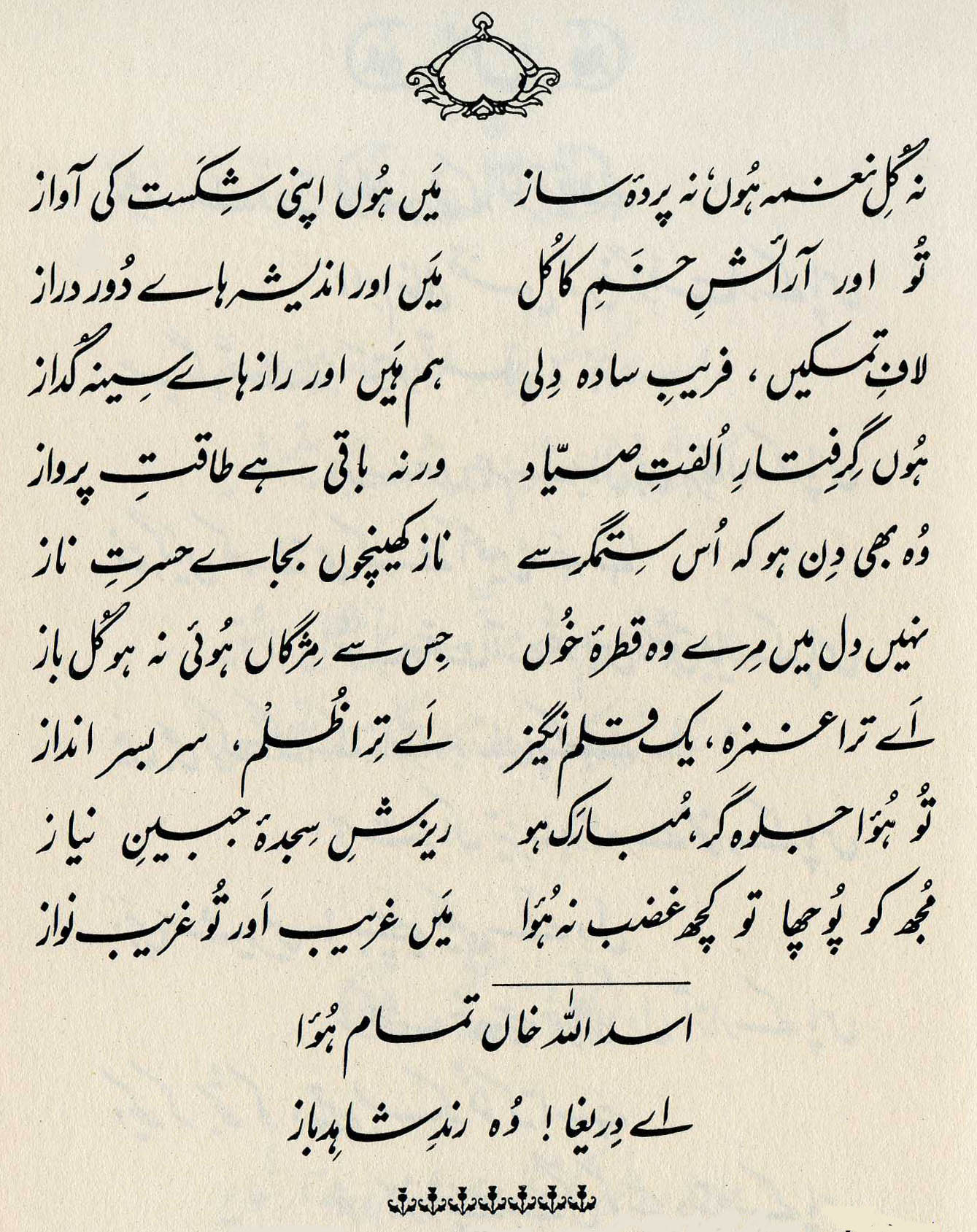
In the second line there's the tone of lament [], and it's of the type of . (74)
== Nazm page 74

Asadullah Khan has died. Alas, that reprobate, that pursuer of beautiful ones! From it's clear that the person who is saying this is well acquainted with Asadullah Khan and his worship of beautiful women. (155)
means 'worshipper of beauty' []. means 'rash/heedless wine-drinker' []. After mentioning two flaws, to express regret at his death, and to say 'ah, alas!' is not without pleasure. (157)
Here, the greatness, venerableness, and loftiness of rank that are apparent in 'Asadullah Khan' are not present in 'Asad' alone. [For another such example, see 158,9 .] (249)
ABOUT : The word is the most untranslatable kind of epithet, the kind that is full of complex cultural meaning within a particular social setting. If the word 'rake' (as in 'rakish' []), were still in circulation, instead of so archaic-feeling, that would be the one reasonably satisfactory translation. But alas, 'rake' is no longer really available, and what else is there? An amalgam of carelessness, carefreeness, wine-drinking, winehouse-visiting, roguishness, devil-may-careness, cap-askewness, the pursuit of beautiful beloveds-- all this is the flavor. It can no doubt be a reproach (which is how Platts censoriously presents it), but it should also have overtones of rueful, affectionate tolerance and even romantic semi-admiration ('the beautiful and the damned' kind of thing). Other examples: 133,3 ; 189,2 .
If we put the verse's three comments together, they do the job nicely. The speaker apparently knows the dead man well; he refers to him by his full, dignified title; he speaks of what are (ostensibly at least) his flaws of character; he expresses what feels like sincere sorrow at his death. In a closing-verse , it's piquant to appear to 'close out' the poet as well.
Note for nit-pickers: Is the poet's use of his full name to be considered a use of his pen-name 'Asad', which is included within it? I don't know, but it would seem logical. Other such cases: 129,7x ; 158,9 .
This verse is discussed by Faruqi in comparison to a similar verse of Mir's, in an essay that is part of the Mir site.
graphics/ghalibpainting.jpg