Verse 81821aaz
G8
In this meter the first long syllable may be replaced by a short; and the next-to-last long syllable may be replaced by two shorts.
1
you became {glory/appearance}-doing-- may [it/you] be blessed/happy/auspicious!
2
a pouring-out of the prostration of the forehead of supplication/longing!
'Doer; maker; worker, workman (used as a suffix'.
'Blessed; happy, fortunate, auspicious; august; sacred, holy; -- intj. Welcome! well! hail! all hail! blessings (on you)!; congratulations (to you)!'
'Pouring out, scattering; flowing in small quantities, running; a running at the nose'.
'Petition, supplication, prayer; --inclination, wish, eager desire, longing; need, necessity; indigence, poverty'.
| References | |
|---|---|
| Arshi, Imtiyaz Ali | Ghazal# 69 |
| Raza, Kalidas Gupta | 332-33 |
| Nuskhah-e-Hamidiyah | 113-114 |
| Hamid Ali Khan | Open Image |
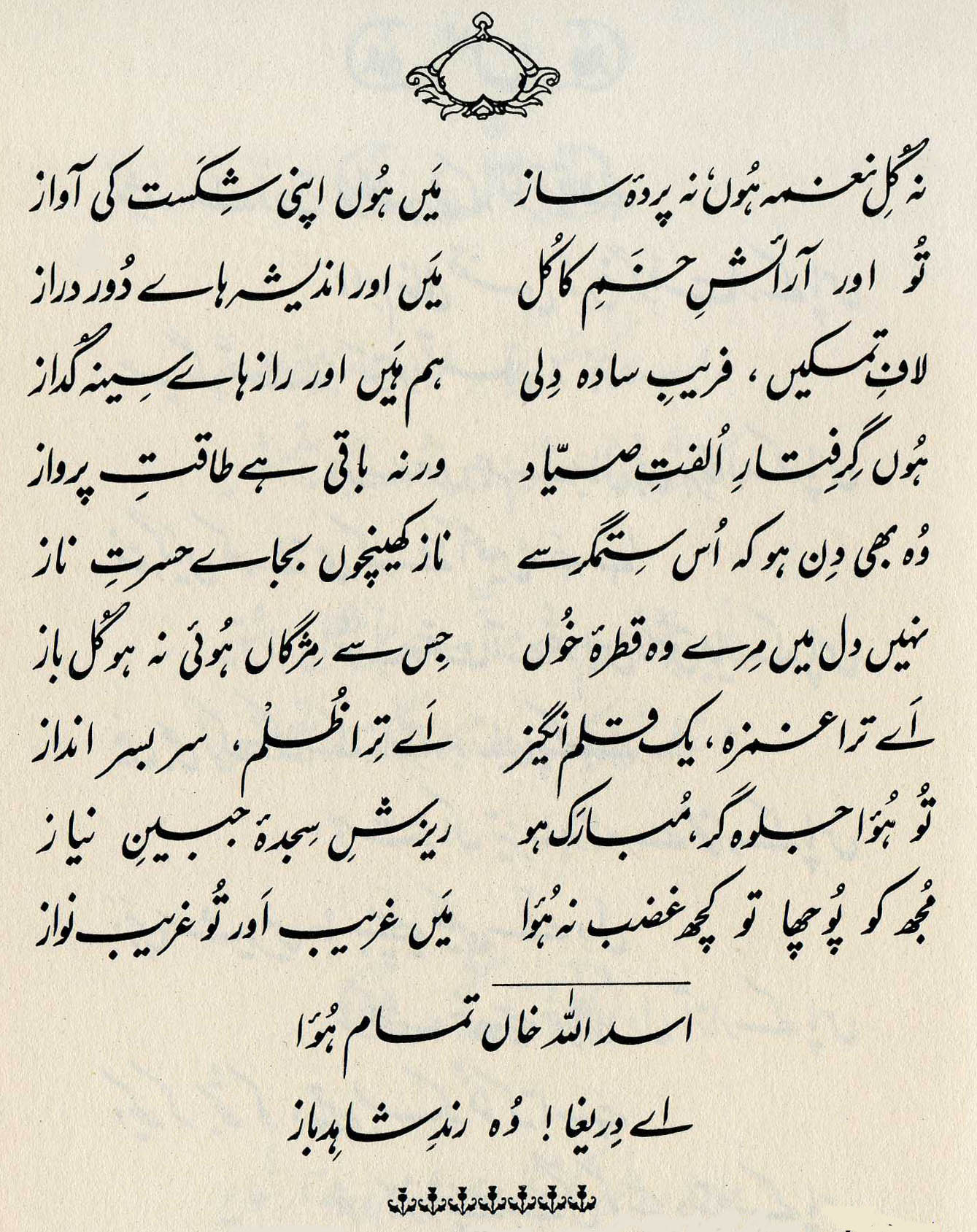
You came; now may my prostrating myself be enjoyable/auspicious for you. (72)
== Nazm page 72

Oh beloved, your sidelong glance is the essence of airs and graces; and not only that, but your tyranny is completely coquetry. You showed your glory/appearance-- may the prostration of the people of humility be auspicious. (145)
To do prostration [] is also called 'pouring out of prostration' []. This verse ought to be considered, along with the previous one, a verse-set []. After mentioning in the first verse the beloved's two opposite qualities and addressing her, he says, you gave me a sight of you. Now may you enjoy the prostrations of our forehead of supplication/longing. (156)
In this verse, part of the pleasure is in the ways that can be read; it is positioned at what I call a 'midpoint'.
The commentators prefer to read , 'May the pouring out of prostrations be blessed/happy/auspicious for you-- or, colloquially, you're welcome to them!' As the commentators say, you've manifested yourself, so may you enjoy your reward.
Alternatively, the reading could be, -- 'May your showing of your glory/appearance be blessed/happy/auspicious! (For you? For me?) I offer the appropriate prostration to show gratitude and humility.'
For a similarly complex use of , see 77,3 .
The verse's real achievement, though, is a kind of sarcastic tone that's hard to capture in translation. It's something like, 'Oh, you've appeared in all your glory! Wonderful! I grovel before you and abase myself to the floor in humility, of course!' The only sign of the sarcasm is the hyperbolic excess of humility. In this verse, the whole second line is taken up with profuse groveling. Not just a bow, but prostrations-- and not just any prostrations, but ones requiring a string of fancy Persian nouns joined by no fewer than three (compulsory) constructions. The tone of voice is surely what Ghalib is creating for us here. We're not required to read it sarcastically, but we're strongly invited to.
If there's any doubt about the tone, take a look at the next verse, 71,9 , in which the sarcasm becomes even more explicit. Josh actually asserts that these two are a verse-set , while Bekhud Mohani (154) and Nazm [ 71,9 ] consider them at least informally to be a pair.
graphics/prostration.jpg