Verse 11821aaz
G8
In this meter the first long syllable may be replaced by a short; and the next-to-last long syllable may be replaced by two shorts.
1
I am neither the flower/rose of sound/melody nor the tone/frets of a [musical] instrument/harmony
2
I am the sound of my own breaking
'A soft, sweet voice; --a musical sound or tone; --melody; song; modulation; trill, shake'.
'A musical tone or mode; a note of the gamut; the frets of a guitar, &c'.
'Ornament; concord, harmony; a musical instrument'.
'Breaking, breakage, fracture; a breach; defeat, rout; deficiency, loss, damage'.
'Sound, noise; voice, tone; whisper; echo; shout, call, cry; report, fame'.
| References | |
|---|---|
| Arshi, Imtiyaz Ali | Ghazal# 69 |
| Raza, Kalidas Gupta | 332-33 |
| Nuskhah-e-Hamidiyah | 113-114 |
| Hamid Ali Khan | Open Image |
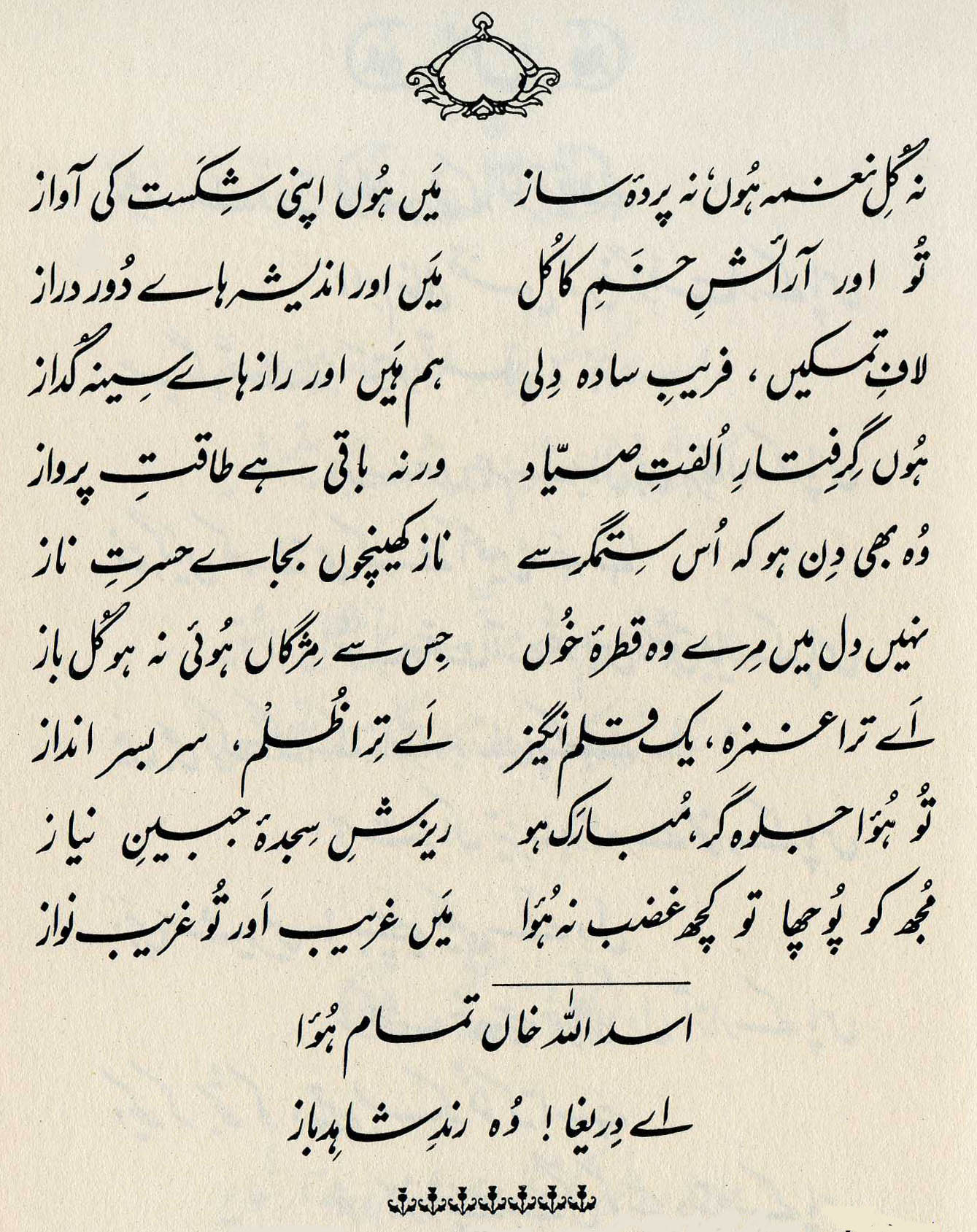
That is, I have no connectiion with joy or music, I am entirely made of pain and in my own difficulty. (71)
== Nazm page 71

My existence is no musical instrument from which melodies would emerge and turn to flowers. My voice is the sound of the breaking of my heart, as if my existence had become the musical instrument of my pain. (155)
= [ = 'The note of the nightingale; warbling; --sound; --fame, rumour; --glad tidings' (Platts p.911)]. (192)
means a joyous/pleasing melody []....
In this verse Ghalib has made a philosophical statement, that my existence is not made by anyone, nor is it anyone's fault; rather, in itself it is a proof of its own negation. That is, my existence is saying with the tongue of its condition, 'in truth, I have no existence.' (457)
: the song blossoming forth; a beautiful thing as well as something with inherent growth. Progression. Maturity.
: the source of music; the source of beauty. Any damage to it would be lamented, and any pressure on it would produce pleasant sounds of music.
I am neither the first nor the latter. I am the sound of my own defeat and breaking apart. Neither the event nor its source is of much consequence. (7)
[The commentators have no clear idea of the meaning of , nor does it appear in Urdu or Persian dictionaries. The earliest citation seems to be a verse by Mir Hasan (1736/7-1786).] This verse of Mir Hasan's given below is from 'Sihr ul-bayan', ed. Rashid Hasan Khan (New Delhi: Anjuman Taraqqi-e Urdu, 2000), p. 233:
(verse 1522)
... Five verses later he has again written :
(verse 1528).
.... Mir Hasan has called , the flowers and leaves of the tree under which Najm un-Nisa has seated herself and is playing the .... Later, he has called these very flowers and leaves -- that is, , such that compared to their flourishingness the flowers of the desert seemed to be thorns. That is, the effect of Najm un-Nisa's vina [] on the tree was that its fresh roses entered a state of bliss and gradually fell to the ground.... Thus it's clearly apparent that Mir Hasan is the initiator of this construction. But he has used it in a different meaning from that of Ghalib's verse; and this usage is his own: he had not obtained any warrant from a dictionary or other poets' work....
If we investigate in dictionaries, then we find that one meaning of is the best of something, a select part of it. Accordingly, the meaning of (in Ghalib's verse) will be 'the spirit of melody, its perfume, its best part'. This meaning seems better than all the meanings discussed so far....
The conclusion of the discussion is: (1) is not a musical term, and is not any fixed construction, either in Ghalib's verse or in Mir Hasan's. (2) Ghalib and Mir Hasan have used with different meanings. (3) In the verse of Ghalib's under discussion, the meaning of is 'the spirit of melody, its perfume, its best part'.
== 2006: 102-04
This is one of only a handful of ghazals from which Faruqi has selected every single verse as superior.
I was sure that would be a technical musical term of some kind, as it ought to be for reasons of Ghalibian affinity-creation and parallelism with . I was counting on the commentators to know what exactly it meant, and was surprised that not one of them seemed to have any well-grounded notion. After much questioning of musical experts, it turned out that the best information came from S. R. Faruqi (Feb. 2003); now the information he searched out and gave me has also been incorporated into the new edition of his commentary (see above).
The phrase caught on, though whether because of Ghalib's popularity or that of Mir Hasan's masnavi is impossible to tell. Yashowanto Narayan Ghosh points out that went on not only to become the title of Firaq Gorakhpuri's divan , but also to feature in this verse by Ziya Jalandhari:
As Faruqi shows, we can document the fact that Ghalib didn't just make up the phrase himself; instead (and characteristically, in a case like this), he used a pre-existing phrase, one from the most famous and popular masnavi in Urdu-- a phrase that would probably have been recognizable to his audience, and would thus have added to the pleasure of the verse.
There's another use of in 294x,5 ; commenting on it, Gyan Chand says (p. 217) that means 'the best part' of a melody. And in 261x,1 there's a that according to Gyan Chand means 'the best of' the message. (Only in 424x,6 with its does he take a more specific tack.) In English too we have the archaic phrase 'the flower of' to mean 'the best of', 'the supreme example of'.
I am not, the speaker says, the 'flower of melody', not am I a string or fret of an instrument. Instead, I'm something unfamiliar, shocking, discordant. 'I am the sound of my own breaking'-- some of the effect even comes across in translation. Chishti's idea that this should be taken as a serious philosophical statement is not persuasive. The image is striking, it's arresting, it's provoking; and in Urdu, it also sounds beautiful. It has a sense of what might be called -- turbulence, bitterness, strong emotion. In a background of related imagery, what more does a two-line verse need to offer? This is a very famous verse, one that people often memorize and recite.
In 13,1 we see the of a invoked in another context: as part of a mystery, an interplay between the meaning of as concealment and as stringed instrument. For further comparison: on suffering and music, 196,1 ; on complaint and music, 319x,7 .
For an indication that might not be only a negative experience, see: 214,8 . And finally, here's a cleverly ambiguous use of the whole Persian infinitive, : 37,5x .
Compare Mir 's depiction of himself as his own sunset: M 328,7 .
graphics/strings.jpg