Verse 5x1816urdagaa;Nkaa
G12
1
entirely a 'whole-mirror'-possessor of brokenness/breakingness--
2
I am the desire/intention of those with a 'whole-worldful' of dejection
'To break (trans. and intrans.); to defeat (an enemy); to turn away the face; to be rough and severe; to torture; to disturb; to be disturbed, agitated, angry; to eat, chew; to be broken, split, opened; to be covered with shame; to fold, to bend, to curl; to restrain; to suppress, to keep back (as tears, &c.)'. (Steingass p.753)
'Desire, inclination, will; intention, purpose, resolve, determination; aim, object, end, end in view; plan, design; meaning, purport'.
'Frozen, frigid, benumbed; withered, faded; dispirited, dejected, low-spirited, melancholy'.
| References | |
|---|---|
| Arshi, Imtiyaz Ali | Ghazal# 17 |
| Raza, Kalidas Gupta | 157 |
| Nuskhah-e-Hamidiyah | 61-62 |
| Asi, Abdul Bari | 64-65 |
| Gyan Chand | 97-98 |
| Hamid Ali Khan | Open Image |
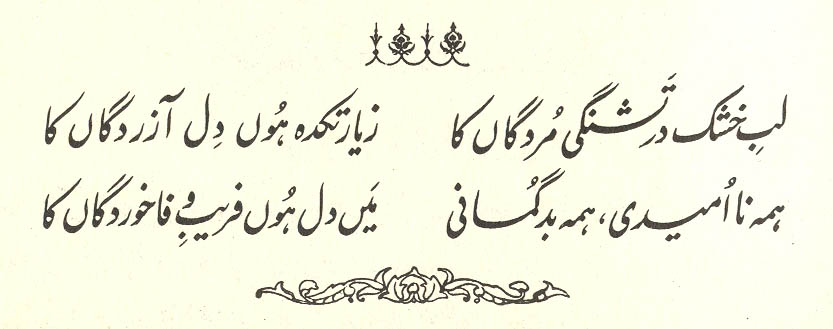
From head to foot I am a mirror-possessor of brokenness. So to speak, I am the desire/intention of those people who are wholly dejected and oppressed.
== Asi, p. 65
Here, by is meant those people who have become dejected by not succeeding in their purposes-- when they form a desire/intention of something, they see nothing but failure upon failure in every direction. Ghalib gives himself as a simile for this failed desire/intention. The result is that 'I am the embodiment of failure and nonachievement'.
= the dejected-hearted ones from the whole world. = I am ready to break, since the verb goes with desire/intention and purpose, as wordplay with it he has called a failed desire/intention a 'mirror', and himself a 'mirror-holder'.
== Zamin, p. 61
Those people who are entirely dejected-- their power of desire/will becomes very weak. If they form a desire/intention to do some task, then because of dejection and despair, after some time they abandon that desire/intention. I too am the image of just this kind of mental defeat and sorrow. In another place he has said, [the second line of] 71,1 .
== Gyan Chand, p. 98
For background see S. R. Faruqi's choices . This verse is NOT one of his choices. I found it interesting and have added it myself. For more on Ghalib's unpublished verses, see the discussion in 4,8x .
On this ghazal as a kind of unlabeled verse-sequence , see 37,1 . On the macaronic structure of this ghazal, with its Persian first lines and Urdu second lines, see 37,2 .
On the idiomatic possibilities of expressions like and , see 11,1 . In this verse seems to be used both in this special (Persian) idiomatic sense, and also more literally ('I am the possessor of a single mirror').
The Persian infinitive can mean either 'to break' or 'to be broken' (see the definition above). Thus if the speaker is 'entirely a "whole-mirror"-possessor' of this state, what he experiences (or perhaps 'reflects') might be either 'brokenness' or 'breakingness'.
In the second line, the speaker declares himself to be an -- a desire, intention, resolve (see the definition above). And this desire/intention is one formed by 'those with/of a "whole-worldful" of dejection'. This may mean, as Gyan Chand maintains, that the speaker has a very weak, futile desire/intention, since he 'mirrors' or reflects the 'brokenness' characteristic of people who are despairing and dejected.
Yet it's also possible that the desire or intention that the speaker 'mirrors' is that of 'breakingness', since it's one formed by people radically disaffected with the world. Perhaps they cherish a dream of destroying the world, or themselves, or their connection with the world. Even if they're too melancholy to even try to achieve this intention, it's just the sort of longing that the state of the desperate lover might well embody or reflect.
Gyan Chand is right to suggest for comparison 71,1 ; but consider also the complex 214,8 .
graphics/brokenmirror.jpg