Verse 6x1816urdagaa;Nkaa
G12
1
in appearance-- formality/courtesy; in inwardness/meaning-- grief/regret
2
Asad , I am the smile of the withered/blighted ones
'With, for, from, in, or by him, or it'.
'Form, fashion, figure, shape, semblance, guise; appearance, aspect; face, countenance'.
'Taking (anything) upon oneself gratuitously or without being required to do it, gratuitousness; taking much pains personally (in any matter); pains, attention, industry, perseverance; trouble, inconvenience; elaborate preparation (for); profusion, extravagance; careful observance of etiquette, ceremony, formality; dissimulation, insincerity'.
'Meaning, intended sense, intent, signification; indication, import, drift, acceptation; intrinsic quality; --spirituality; --substance, essence; reality; the interior or hidden part (of anything)'.
'Grieving, lamenting, pining, brooding over trouble or affliction; grief, regret, repentance'.
'Withered, faded, pallid, drooping, blighted, decayed; frozen, numbed'.
| References | |
|---|---|
| Arshi, Imtiyaz Ali | Ghazal# 17 |
| Raza, Kalidas Gupta | 157 |
| Nuskhah-e-Hamidiyah | 61-62 |
| Asi, Abdul Bari | 64-65 |
| Gyan Chand | 97-98 |
| Hamid Ali Khan | Open Image |
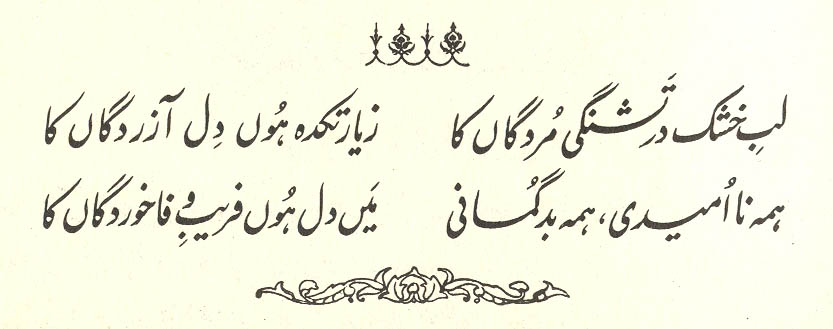
Apparently I am full of formality/courtesy, but in reality I am an embodiment of grief/regret. I am the smile of withered/blighted people-- if sometimes out of formality/courtesy they smile/laugh, then in that smile/laughter too is hidden a whole world of pain.
== Asi, p. 65
The way dejected people, for the sake of their companions, would even smile-- that smile will be artificial. It will look like a smile/laugh, but it will be the same as a thousand tear-sheddings.
== Zamin, p. 61
I am like the smile of withered/blighted and dejected people-- which when it appears outwardly is with formality/courtesy. Inwardly, it is chiefly sorrow and grieving. I too am outwardly happy and joyous, but in reality I've been extinguished [like a candle].
== Gyan Chand, p. 98
For background see S. R. Faruqi's choices . For more on Ghalib's unpublished verses, see the discussion in 4,8x .
On this ghazal as a kind of unlabeled verse-sequence , see 37,1 . On the macaronic structure of this ghazal, with its Persian first lines and Urdu second lines, see 37,2 .
The first line sets up a major contrast between an outward appearance and an inward meaning-- both unmoored from any owner. Then the second line announces that the speaker is 'the smile of the withered/blighted ones'. We are surely meant to think of the 'smile' (the usual metaphor for bloomingness) of withered roses, which may retain their shape for a time but are in fact dried out and will fall apart and lose their petals at a touch; or else that of blighted, decayed, or even frozen flowers, which still show a lingering outer color or facade but have no vitality inside them. This is what the 'smile' of the withered/blighted ones is like-- and this is what, somehow, the speaker 'is'.
The word is especially well chosen, since it can mean 'aspect' and exterior appearance (so that it can be elegantly opposed to the inwardness or essential reality of in philosophical discourse); but it also of course means 'face', so that it resonates equally well with 'smile' (see the definitions above).
Note for meter fans: Although nowadays in Urdu we usually see , the pronunciation is still ta-as-suf (short-long-long), as of course Ghalib scans it here. The reason is that the is to be considered as only a 'chair' for a . In Ghalib's day, the was still written. This is just one of those little tidbits of Arabic grammar that we inherit. Compare .
graphics/sadsmile.jpg