Verse 91821aaz
G8
In this meter the first long syllable may be replaced by a short; and the next-to-last long syllable may be replaced by two shorts.
1
if you would ask about me, then nothing [so] awful would occur
2
I-- poor; and you-- a 'Protector of the Poor'
'Anger, passion, wrath, rage, fury, vengeance; wrong, impropriety, injustice, oppression, outrage; violence, force, compulsion; --a curse, calamity, affliction, woe, a fearful thing, an awful event'.
'Foreign, alien; strange, wonderful; rare, unusual, extraordinary; --poor, destitute; meek, mild, humble, lowly'.
| References | |
|---|---|
| Arshi, Imtiyaz Ali | Ghazal# 69 |
| Raza, Kalidas Gupta | 332-33 |
| Nuskhah-e-Hamidiyah | 113-114 |
| Hamid Ali Khan | Open Image |
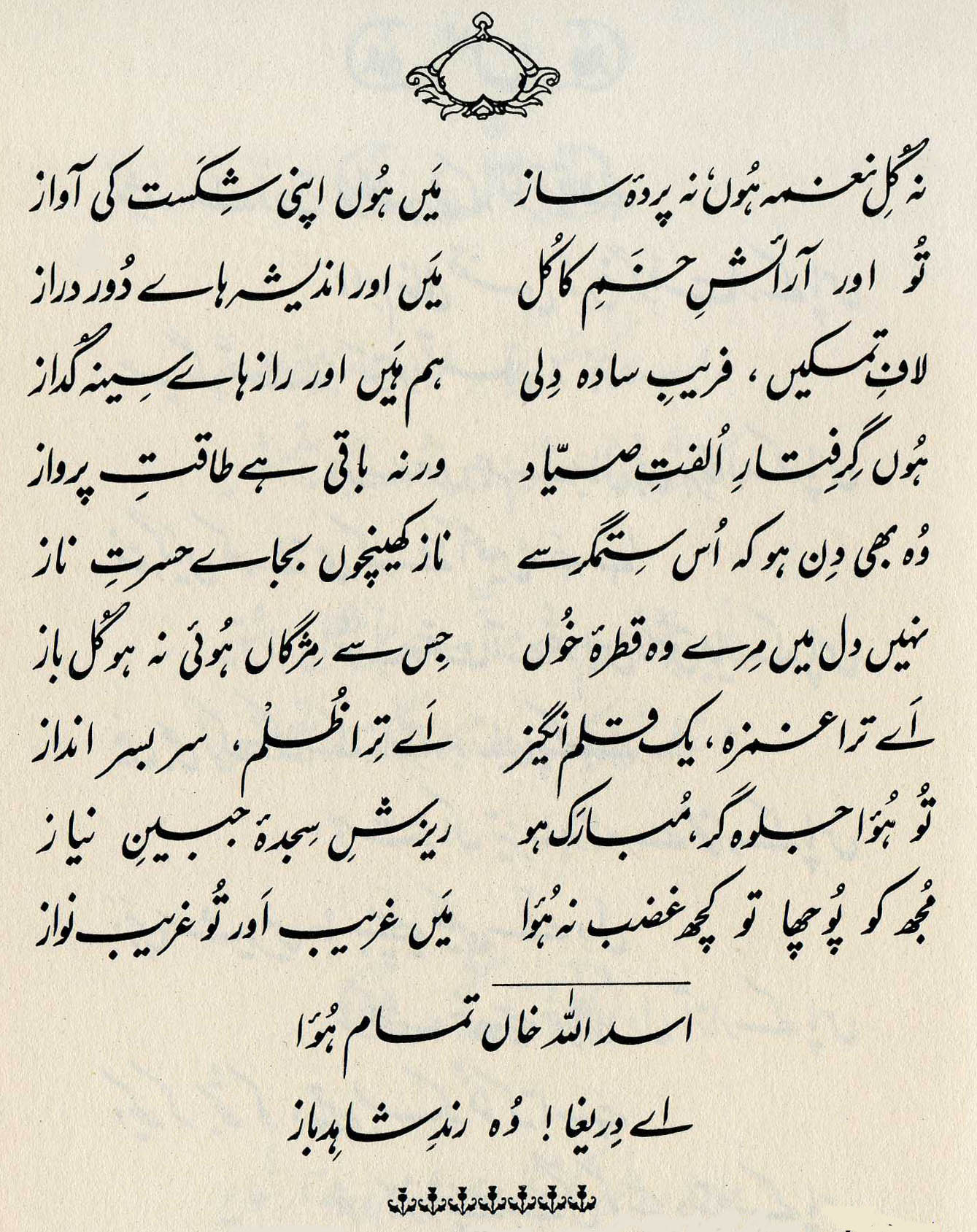
In this verse, is replete with meanings. If instead of this phrase he had said [any other form of words], then the words would simply have expressed a meaning, it would not be an invention [].... Only the word [is such] that a whiff of complaint comes from it, and it conveys the information that his heart is in a complaint-filled state....
In both these verses [this and the previous one, 71,8 ] there is exactly the same excess/extremity []. And both verses are in a mode of thankfulness, and the claim of a mode of thankfulness is that when giving thanks, to prolong the expression of gratitude is attractive. And for this reason a line in which there's hyperbole [] goes even beyond the claims of the mode-- in comparison to the proportionate line, that is, the hyperbolic line is eloquent [], and the proportionate line non-eloquent. From the comparison of both these verses, the conclusion is that in the mode of hyperbole, proportionateness [] reduces poetic beauty []. (73-74)
== Nazm page 73 ; Nazm page 74


In this verse, the phrase has given rise to a strange, pleasurable meaning. Connoisseurs of language [] use this [phrase] on an occasion of thankfulness, sarcastically []. The meaning of the rest of the verse is clear. (119)
Asking about me is not contrary to your glory. And I am entitled to it. This also emerges: that I am grieved at your not asking up till now, and I have a complaint about it too. You should have asked, because I am poor and you are a 'protector of the poor.' (155)
This one is the second half of a sort of quasi- verse-set ; for more on this, see 71,8 . The commentators have spoken of the untranslatable colloquial charm of ; I've been searching for counterpart English phrases, but not with much success. 'It wouldn't do any harm'; 'Nothing so awful would happen'; 'It wouldn't be the end of the world'. There's a sarcastic, hyperbolic quality that works most enjoyably in the context. Compare the similar sarcasm in 124,1 .
More possible to convey in English is the pleasure of the second line. 'Protector of the Poor' is a formal title appropriate to a king or saint, and is especially used for Khvajah Mu'in ud-Din Chishti, whose dargah (pictured below) is in Ajmer. Undoubtedly the lover is poor []-- and also of course 'strange, wonderful unique' (see the definition above). And to call the beloved 'Protector of the Poor' is a deft touch, mischievously converting a religious claim on a saint into a claim for attention from one's beloved. It evokes 162,9 , in which the cry of a wandering ascetic is similarly approp riated into a sort of flirtatious, erotic suggestion.
Needless to say, such an epithet as 'Protector of the Poor' is also a notable invitation to sarcasm, and thus works well with the previous verse. Nazm praises the hyperbolic quality of the second lines of both verses, linking the sarcastic over-the-topness of the humble prostrations with the similar quality of a saintly epithet like 'Protector of the Poor'.
Here's my long-ago attempt at a translation (1985) .
For more 'you and I' verses, see 71,2 .
Note for grammar fans: Here's an intriguingly doubled example of the perfect used in place of the subjunctive (on this see 35,9 ). The literal grammar of the first line is '[When] you asked about me, then nothing so awful occurred'. That's a possible reading, but much less piquant than the one generally adopted by the commentators. For the colloquial reading makes it a proposed action, and one rendered doubly dubious by the use of two subjunctives ('If you would ask about me, then nothing so awful would occur'). This kind of hypotheticalness, to the max, is far more suggestive, multivalent, and amusing.
Compare a somewhat similar, though more enigmatic, verse of Mir 's: M 1076,4 . And there's Mir's use of the same construction in M 775,5 .
graphics/gharibnavaz.jpg