Verse 41821aaz
G8
In this meter the first long syllable may be replaced by a short; and the next-to-last long syllable may be replaced by two shorts.
1
I am captured/captivated by love/affection of/for the Hunter
2 a
otherwise, strength for flight remains (and can be used)
2 b
otherwise, strength for flight would remain (while now it does not)
'Taken, seized, arrested, captured; involved (in), entangled; liable; stricken, smitten (with love, &c.), captivated; --one who is taken, &c.; a captive, a prisoner'.
'Familiarity, intimacy; attachment, affection, friendship'.
| References | |
|---|---|
| Arshi, Imtiyaz Ali | Ghazal# 69 |
| Raza, Kalidas Gupta | 332-33 |
| Nuskhah-e-Hamidiyah | 113-114 |
| Hamid Ali Khan | Open Image |
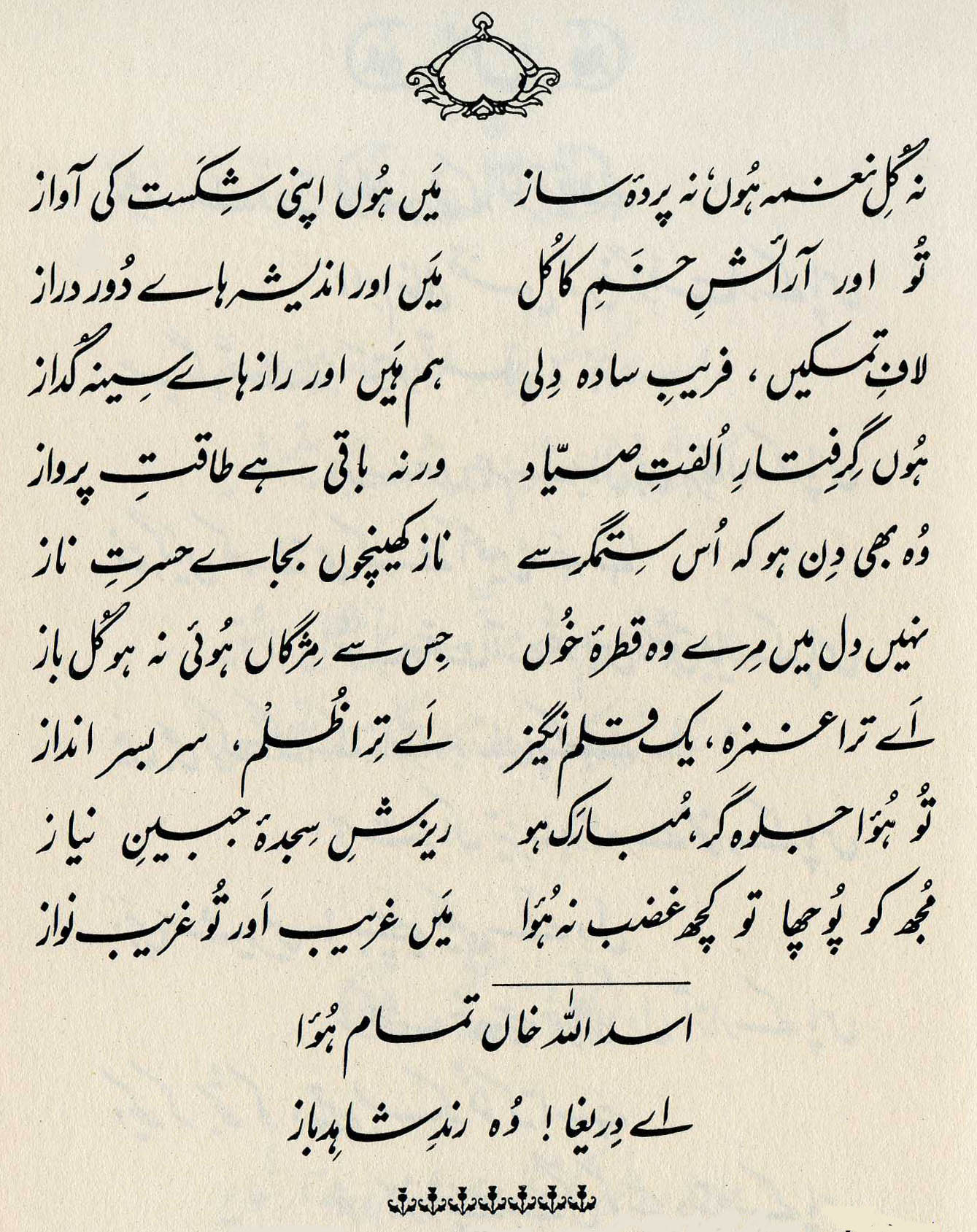
Worldly relationships have imprisoned me; otherwise, if it's up to the heart, then I can free myself. (72)
== Nazm page 72

The thing that prevents me from getting out of the path of the beloved is not the compulsion of the heart; rather, my beloved herself loves me. (154)
That is, I have the strength to fly out of the trap, but the love I've come to feel for the Hunter doesn't permit me to do it. The meaning is that the Hunter releases us, but we can't release the Hunter. By the Hunter is meant worldly relationships. (155)
The Hunter and his/her prey [] are part of the landscape of the ghazal universe, like the Executioner and his/her victim. The Hunter seems usually to be the beloved; the Executioner seems usually to be the beloved's agent. Here, the Hunter is out trapping birds, and the lover is a bird, for he speaks of the power of 'flight' []. (This can be confusing in English, but in Urdu it's clearly flight as in 'to fly' with wings rather than flight in the sense of 'to flee' from something.) For more verses in which the lover speaks as a bird, see 126,5 .
This verse is another example of the dual valence of , which is hard to translate. It can have either an indicative or a contrafactual sense: 'I'm staying out of choice; otherwise, I can fly away whenever I want' (2a); versus 'I'm staying because I'm helplessly mesmerized; otherwise, I could have used my power of flight and escaped' (2b). For more on this, see 15,12 .
The contrafactual sense of suggests an interpretive possibility that the commentators ignore: that of the lover's self-deception. Does the lover really still have the power of flight, or do we think he doth protest too much? Is he not perhaps just whistling in the dark, trying to tell himself that it's really his own choice to be captured? The lover has no choice, and never has had since the moment when he first set eyes on the beloved, and we know this and he knows it too. For the perfect verse to illustrate the empty bravado of his claim, see 230,7 : the real pledge of faithfulness is not fancy verbal claims of love-as-choice, but more like 'a hand trapped under a stone'.
In 72,1 , however, we see the lover preparing to live up to his boast: he is a wild bird, eagerly preparing to fly into the Hunter's net.
Compare Mir 's bird, with his different rationalization for his 'choice' not to fly: M 256,3 .
graphics/hunter.jpg