Verse 11821aarke paas
G5
In this meter the first long syllable may be replaced by a short; and the next-to-last long syllable may be replaced by two shorts.
1
good tidings, oh Relish for/of Captivity! for there is in view
2
an empty net near the cage of the captured bird
'Glad tidings, good news'.
| References | |
|---|---|
| Arshi, Imtiyaz Ali | Ghazal# 72 |
| Raza, Kalidas Gupta | 357 |
| Asi, Abdul Bari | 131-132 |
| Gyan Chand | 227 |
| Hamid Ali Khan | Open Image |
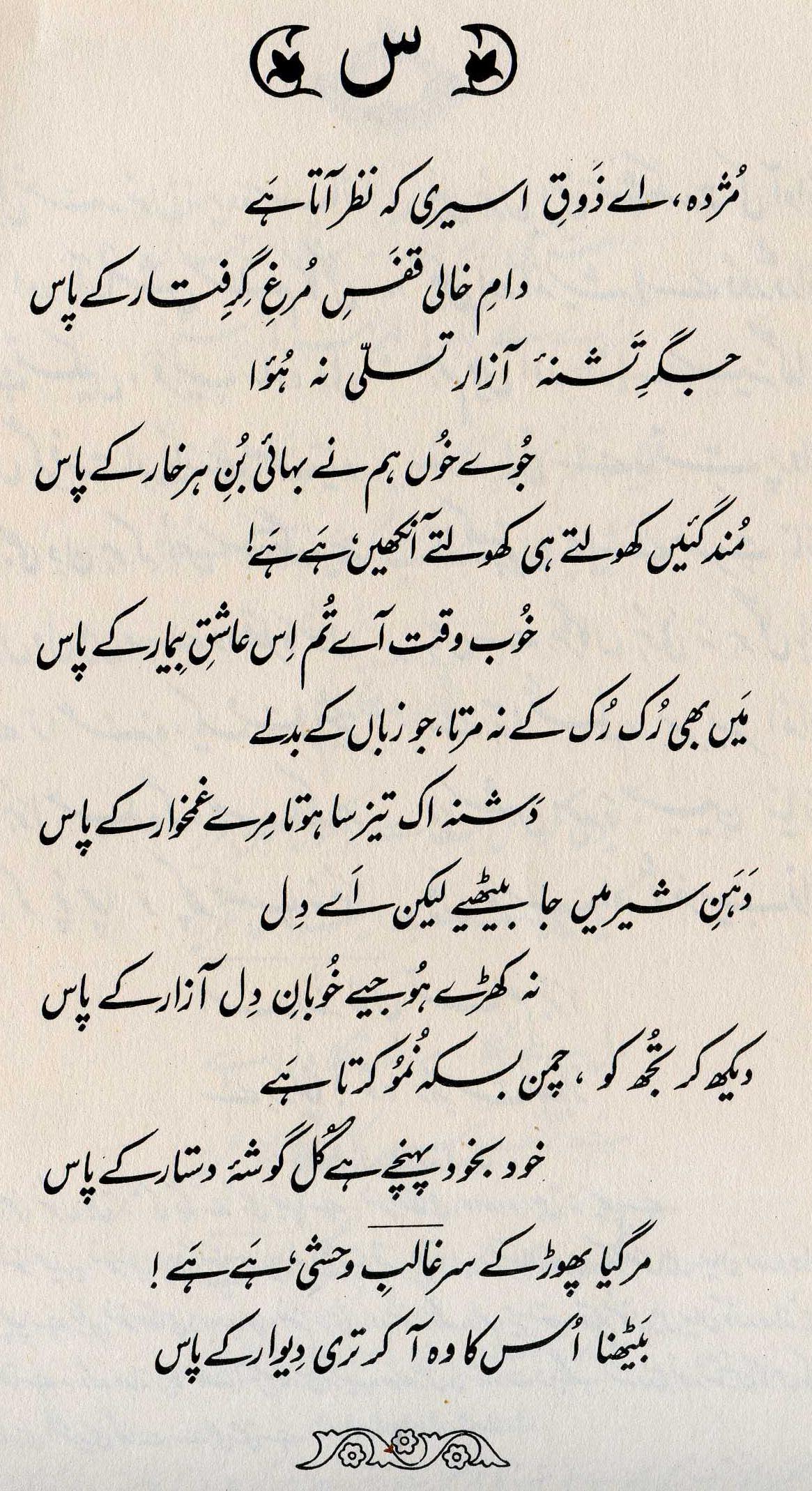
It's a well-known method for hunting, that people spread a net and place a caged bird there, so that when they see it and hear its voice, wild birds would come down. (74)
== Nazm page 74

The beloved, even while her lovers are present, has arranged her curls. From that it can be seen that she intends to ensnare new lovers. Now one ought not to miss out-- this is the time! If this time is missed, then it will be necessary to wait for some time. (155)
The captive bird's cage has been placed there, and the net too is empty. There's not even any other bird trapped in it. Accordingly, this is a good time for your becoming captive-- if you are captured, then you're captured-- you'll become near to the Hunter . (235)
In the divan of Navab Ilahi Bakhsh Khan Ma'ruf Dihlavi (d.1242/1826), which to my knowledge had been edited by about 1820, there's a ghazal in this ground (published divan: 58). In Gul-e Ra'na [] too five verses of it have been anthologized. (209)
The divan form of this ghazal has no opening-verse . The original opening-verse was 72,8x .
Far from being deceived by the caged decoy bird and the concealed net nearby, the wild bird is eagerly taking stock of an excellent chance to be captured, and thus to receive the undivided attention of the beloved in her guise as bird-catcher or Hunter . This verse follows perfectly from the logic of 71,4 : there the lover claims to be have been captured only by love of/for the Hunter, while here we see him preparing to launch himself into captivity out of a (semi-personified) 'relish of/for captivity'.
It's so piquant, that second line. Good news-- I see one! there's an empty one, right next to that occupied one! The speaker is looking eagerly for a space-- just the way someone might search for a parking space, or a table in a crowded restaurant, or a seat in a movie theater. Or, in this case, an empty snare right next to an occupied one. Quick, rush in and grab it, before somebody else does! The lover, already hopelessly ensnared by passion and the 'relish' for his own imprisonment, only seems to have a choice. The 'trap' is hardly necessary in his case-- and it wholly fails to deceive him. Rather, to the wild bird it's hardly a trap at all, but an offering, an enticement, into which he will fly with open eyes.
This is one of the verses in which the lover speaks as a bird; for others, see 126,5 .
graphics/birdcages.jpg