Verse 41821aarke paas
G5
In this meter the first long syllable may be replaced by a short; and the next-to-last long syllable may be replaced by two shorts.
1
even/also I would not have died slowly/haltingly, if instead of a tongue
2
my sympathizer had had a single/particular/unique/excellent sharp-ish dagger
' 'Devouring sorrow'; afflicted, sorrowful, sad; — commiserating, pitying, condoling, sympathetic; one who commiserates, or condoles, or sympathizes (with), a consoler, comforter; a sympathetic or intimate friend'.
| References | |
|---|---|
| Arshi, Imtiyaz Ali | Ghazal# 72 |
| Raza, Kalidas Gupta | 357 |
| Asi, Abdul Bari | 131-132 |
| Gyan Chand | 227 |
| Hamid Ali Khan | Open Image |
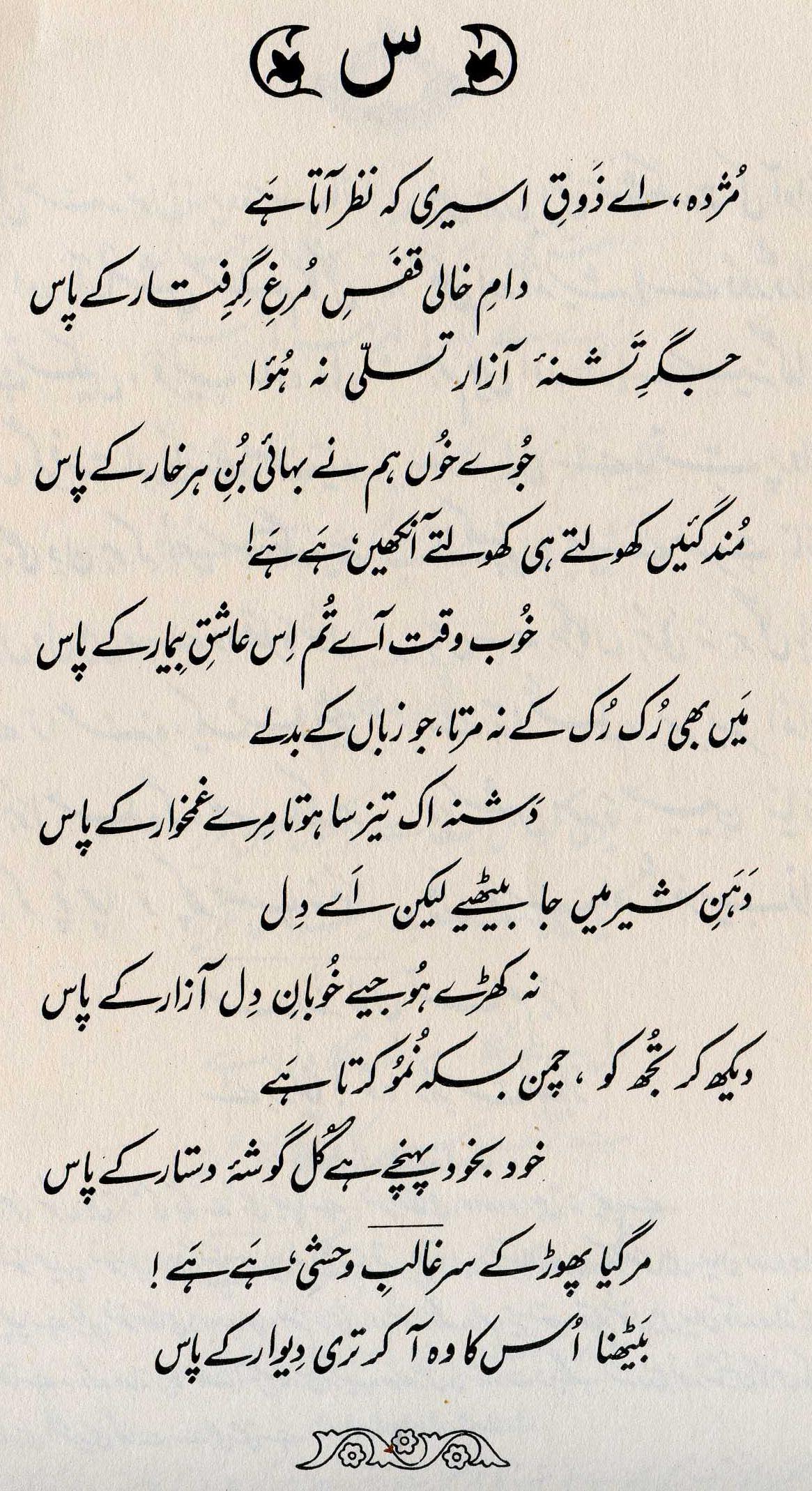
== Nazm page 75

He says, the sympathizer's taunts and reproaches and admonitions murdered me like a dull dagger. I would have given up my life so quickly, if he had had, instead of that tongue, a sharp dagger. (120)
'I would not have died slowly and haltingly' [] means that the effect of his blame on my heart was such that I can't remain alive, I will die. But I will die sobbing and writhing in pain. (156)
The commentators seem to assume that the speaker's 'sympathizer' []-- literally 'grief-eater', to go with the 'tongue'-- doesn't want to kill him, but merely seeks to correct his ways with scoldings and reproaches; he or she thus kills the speaker slowly and cruelly-- but apparently involuntarily, and only in the process of trying to reform him.
But consider 2,1 , in which the 'sympathizer' [] brings presents that are actually lethal-- like wounds, and diamonds (to swallow). Yet Asad is congratulated on this sympathizer's visit; the double meaning of is also exploited, and in directions that favor the sympathizer. We are reminded that killing the lover may be doing him the supreme kindness (by removing him from his worldly despair, and/or uniting him with his divine Beloved).
The description of the ideal weapon is worth noticing, because of all the 'stress-shifting' it provides.. If only the sympathizer's weapon had been --single, instead of the diffuse tiny pinpricks of language); and/or some 'particular' one; and/or a 'unique' or 'excellent' one. And if only it had been (sharpish, instead of the cruelly slow 'blunt instruments' of words). And if only it had been a (a purpose-built killing-machine, not a jury-rigged one put together from miscellaneous bits and pieces). Think of the second line of 20,8 -- why would the lover have minded dying, if it had once [] (not many times, and not never) actually happened?
So we are left with several open (and, as usual, unclosable) questions. Who is the sympathizer? (The beloved? a genuine friend? a hostile fake 'friend'?) What are the sympathizer's intentions, to kill or to cure? Does the lover know and/or share the sympathizer's plans? And what of he little monosyllable 'even/also' [], with its suggestion that other people have had quick, clean deaths, and the speaker could have been among them? Who are these other people (ordinary people? other lovers of the past?)
Ultimately, in the lover's paradoxical situation no one can tell killing from curing. He is more than ready to die, and his sympathizer is sympathetically (?) helping him. But how clumsy he/she is, and how long it takes! The speaker is impatient, longing to get it over with-- perhaps it's not the pain at all that bothers him, but simply the delay. (Or perhaps he even relishes the prolonged pleasure/pain, as he seems to do in 20,4 ?)
graphics/khanjar.jpg