Verse 71821aarke paas
G5
In this meter the first long syllable may be replaced by a short; and the next-to-last long syllable may be replaced by two shorts.
1
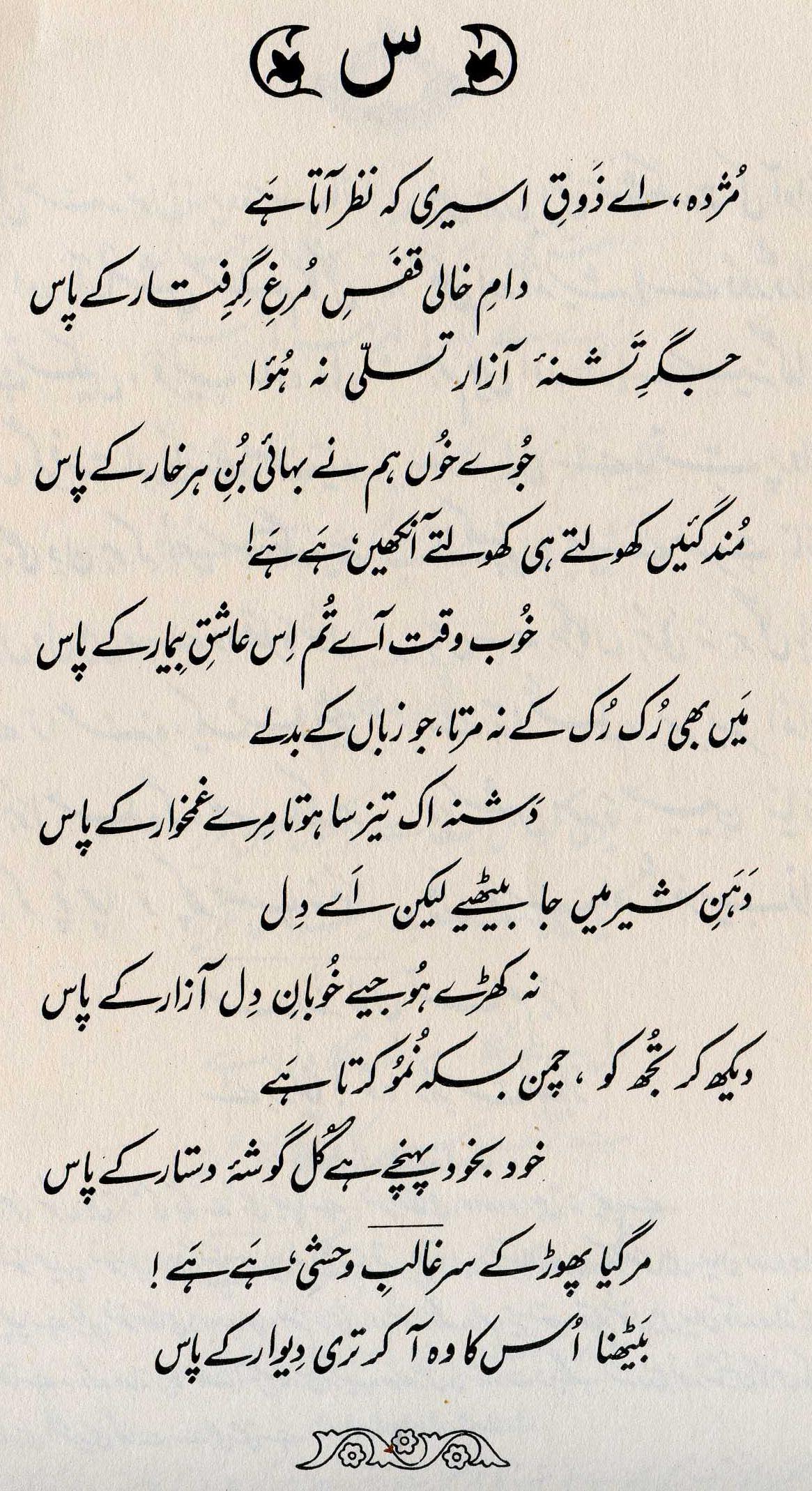
he died, having burst open his head, the wild/mad Ghalib-- alas
2
[for] that coming and sitting beside your wall, of his!
'To break, crack, split, burst open, break open, break to pieces, to shatter'.
'Wild, untamed; shy; unsociable; --uncultivated; uncivilized, barbarous; savage; untractable; fierce, ferocious; brutish; cruel'.
| References | |
|---|---|
| Arshi, Imtiyaz Ali | Ghazal# 72 |
| Raza, Kalidas Gupta | 357 |
| Asi, Abdul Bari | 131-132 |
| Gyan Chand | 227 |
| Hamid Ali Khan | Open Image |
It has been mentioned above [in 62,6 ] that there's more pleasure in than in informative speech []. That is, dwells in the heart/soul []; for this reason the practiced [] poet converts informative speech into . In this verse the author, rejecting the aspect of informative speech, has made the verse extremely eloquent []....
The gesture of 'that' [] in the [second] line is a further excellence.... it points out that the beloved who is being addressed is not unfamiliar with this event of which the speaker reminds her.
And the words 'having come' [] prove that that madman's custom was that at those times when he hoped to see the beloved's face, or hear her voice, he used to come every day and sit down. If were not in the second line, then the meaning would have emerged that only his sitting there would be remembered, and the beauty of the verse would be lessened. (75)
== Nazm page 75

What a peerless closing-verse he has written. (121)
In the second line, the words 'comes to mind' [] are omitted . This omission has given rise to a great deal of beauty in this line, and has doubled the glory of this closing-verse . (158)
Compare 60,12 . (204, 210)
This verse is in fact, as Arshi points out, almost a twin of 60,12 .
Nazm does a good job on this verse. The shift from information to sorrow, the intimacy of recollection between the speaker (some confidant?) and the addressee (the beloved), do indeed carry such a colloquial ease. And the recollection is of Ghalib's 'coming and sitting beside' the beloved's wall, as though that in itself were a death sentence-- to be even near her wall is to be haunted by her to the point of madness. Eventually the mad lover will smash his head (to end its wild anguish) against her wall. For that wall itself is both a barrier that blocks the way, and the closest to her that the poor crazed lover can come.
graphics/haveliwall.jpg