Verse 21821aarke paas
G5
In this meter the first long syllable may be replaced by a short; and the next-to-last long syllable may be replaced by two shorts.
1
the torment-thirsting liver was not consoled/satisfied
2
we caused a stream of blood to flow near the root of every thorn
'Sickness, disorder, disease, infirmity; trouble, affliction; injury, outrage'.
''Being diverted (from) the remembrance (of)'; consolation, comfort, solace; assurance; contentment, satisfaction'.
| References | |
|---|---|
| Arshi, Imtiyaz Ali | Ghazal# 72 |
| Raza, Kalidas Gupta | 357 |
| Asi, Abdul Bari | 131-132 |
| Gyan Chand | 227 |
| Hamid Ali Khan | Open Image |
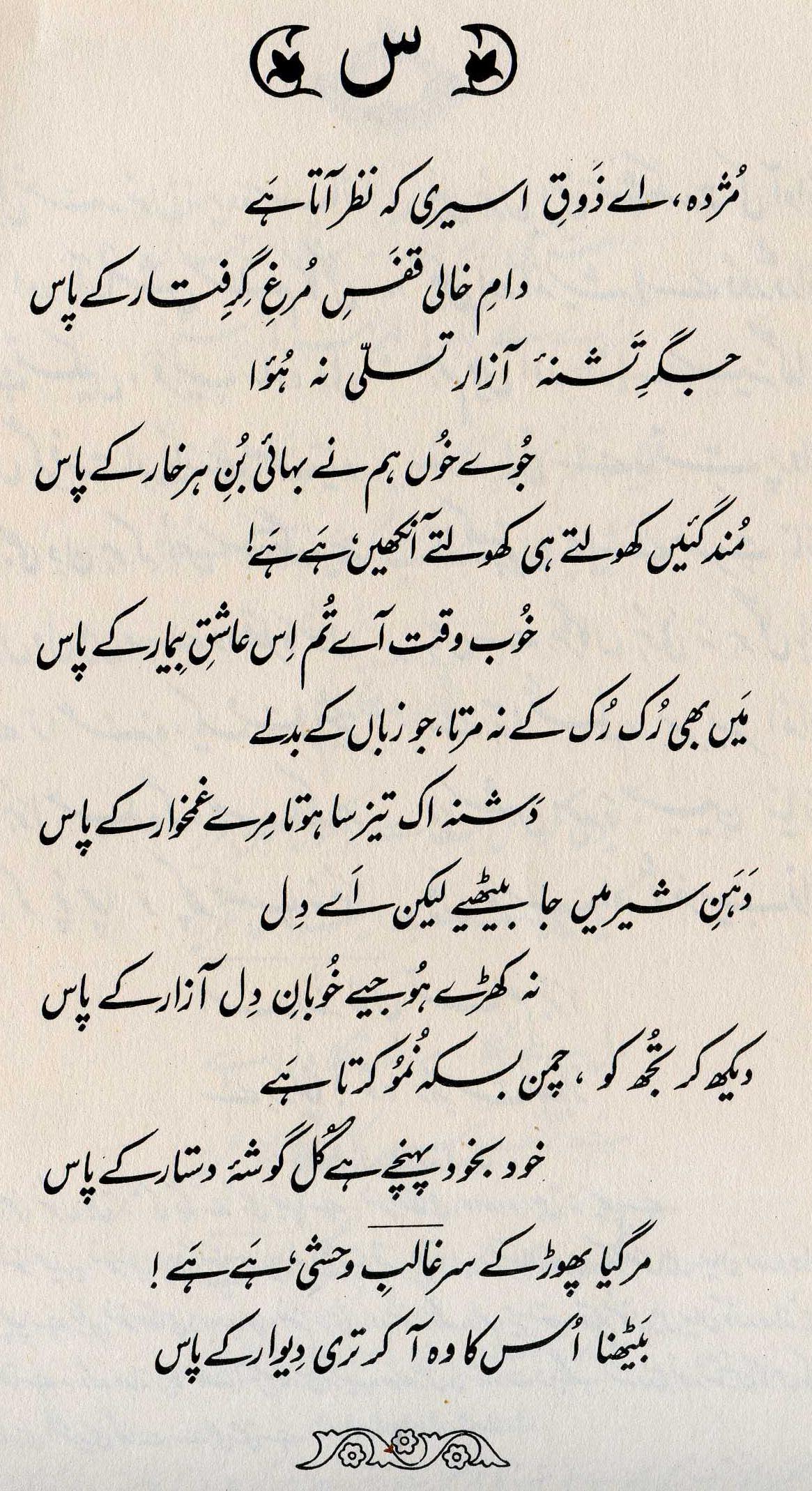
That is, my liver, which is thirsty for torment, and which gets pleasure from blister-footedness and desert-wandering, is even now not satisfied. From the soles of my feet, there flowed streams of blood near every single thorn. But my liver was not satisfied after enduring [even] that much suffering. (74)
== Nazm page 74

Rivers of blood flowed from our foot-soles onto every single thorn, but the torture-seeking heart was still not satisfied. That is, while searching for a path, many great difficulties had been encountered, but we were not defeated. (155)
is an idiom of the language, and its meaning is 'did not become a finder of satisfaction' []. (157)
All [the commentators] agree that these rivers of blood flowed from the foot-soles when they were pierced by thorns during desert-wandering; but Asi writes that because of the thorns that are lodged in the foot-soles, a stream of blood flowed from the foot-soles and from the feeling of pain in them. (196)
This verse is one of the 'liver' ones; for more on the role of the liver, see 30,2 . It's also a candidate for the quality that I call grotesquerie; for more on this concept, see 39,3 .
Here, as so often, are two independent 'A,B' statements. If we read line one as logically prior, we have a solicitous lover who notices his liver's dissatisfaction, wishes to satiate his liver's urge for torment, and thus saturates the root of every thorn with streams of blood. If we read line two as logically prior, we have a lover who has already saturated the root of every thorn with a stream of blood, but the result is that after all that, the liver's urge for torment is still not appeased. Needless to say, both readings could apply to the same situation, in a classic back-and-forth ('more! more! I'm still not satisfied!') way.
There is a missing physical link in the verse: how do the streams of blood get from the liver to the thorn-roots? Most of the commentators supply as an intervening link the soles of the lover's feet; this of course makes sense, since the lover is often imagined to be wandering barefoot in the desert. Asi considers that the thorns are not just stepped on but are lodged deeply in the soles of the feet themselves, which is convenient in explaining how the 'roots' of the thorns get bathed in blood. Nazm alludes to the blistered feet that we have noticed before, in verses that are potential candidates for my category of grotesquerie [ 39,3 ]. But here we don't actually have blisters.
Instead, we have whole streams of blood, and they're directed toward the root of each thorn. This reminds me of 214,6 , in which 'fragments of the liver' are used to make the thorns literally bloom, so that the lover practices 'gardening in the desert'. In the present verse it's hard to tell whether these 'streams of blood' poured out on the thorn-roots are (or are meant by the lover to be) fertilizing in this way, but it's at least a possibility.
Perhaps it wasn't enough for the lover to merely walk with bloodied feet over the thorns, leaving scattered blood-drops on the tips. Perhaps the restless liver insisted on offering more-- it was not content merely to suffer pain in the ordinary course of walking, but wanted to intensify and systematize the process. As is so often the case, the verse doesn't give us all the information we want; it leaves us to arrange and rearrange in our minds the lover and the liver, satisfaction and torment, the thorn-roots and all those streams of blood.
Note for grammar fans: Only Josh picks up the question of the grammar of the first line. For after all, doesn't mean 'satisfied, comforted' as the line seems to push it to mean; rather, it means 'satisfaction, comfort'; and it's a feminine noun. Josh solves the problem by simply declaring it to be an idiomatic expression. I've been told by educated modern speakers too that can be used idiomatically to mean 'consoled, satisfied'.
graphics/bloodythorn.jpg