Verse 61821aakare ko))ii
G3
1
from a fragment of the liver, the vein of every thorn is a rose-branch
2
how long/much would anyone do gardening of the desert?!
'How many? how long? by how much?'.
| References | |
|---|---|
| Arshi, Imtiyaz Ali | Ghazal# 169 |
| Raza, Kalidas Gupta | 347 |
| Nuskhah-e-Hamidiyah | 255-257 |
| Asi, Abdul Bari | 262-263 |
| Gyan Chand | 383-384 |
| Hamid Ali Khan | Open Image |
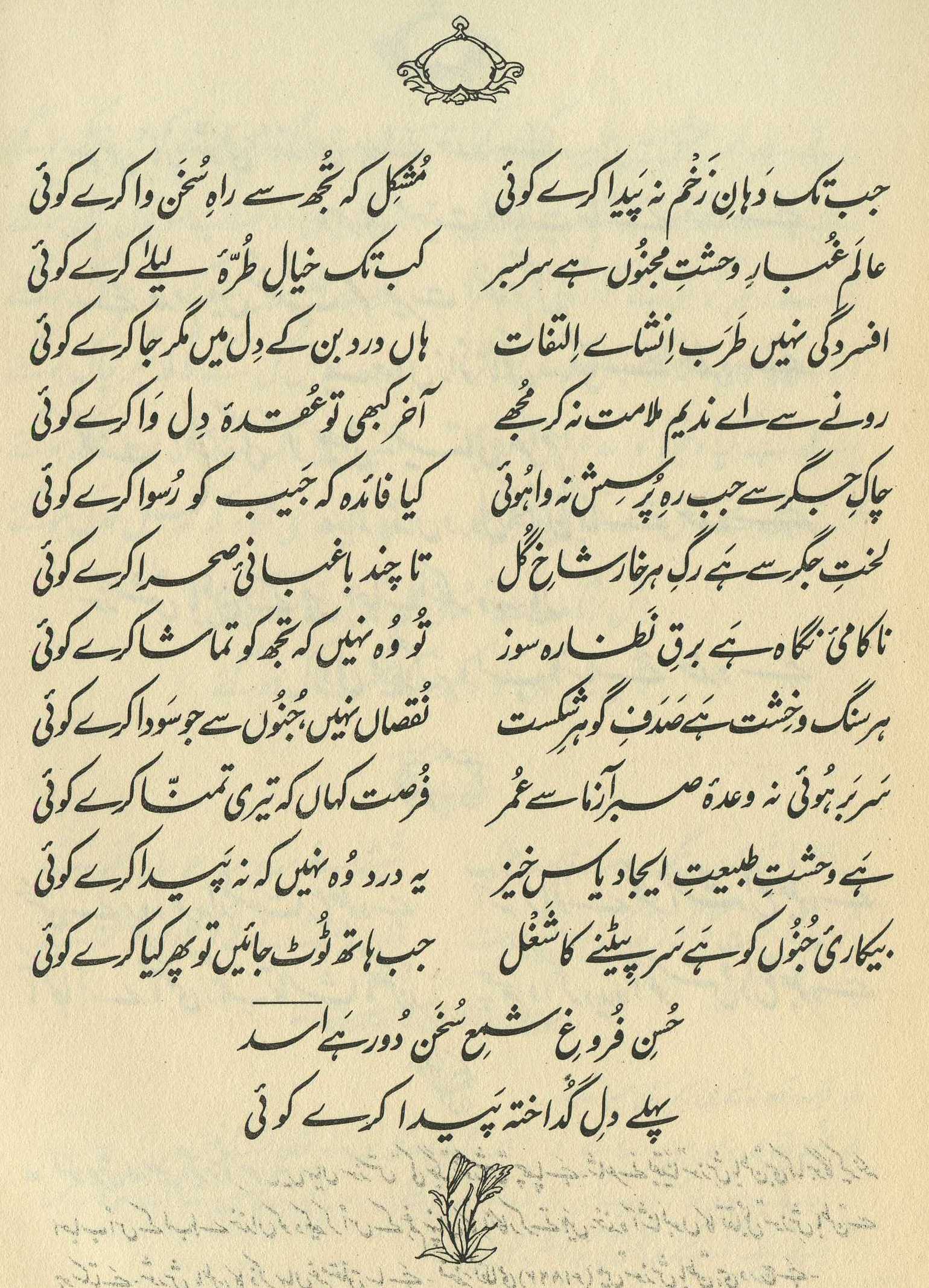
In desert-wandering, the fragments of my liver that emerged through my tears-- through them, every single thorn has become a rose-branch. Now what remains to be done in the adornment of the desert, that anyone would continue to do gardening? (242-43)
== Nazm page 242 ; Nazm page 243


He says, 'In the state of desert-wandering, the fragments of my liver dripped from my eyes in tears, and from then every single thorn in the wilderness became a rose-branch. Now what thing remains in the adornment of the desert, that anyone would become a gardener and keep increasing the decoration of the wilderness?' (301)
That is, weeping and weeping blood in the desert, we've made the desert into a garden. Now how long would we weep, and to what extent would we remain lying in the desert? Our shedding of blood has had no result. (435-36)
The rhetorical structure of this verse at once recalls 214,2 . Both verses have the same extravagant, over-the-top first line, with its depiction of some altogether extraordinary situation in the world. Then in the second line there's an exclamation, with no single clear way of connecting it to the first line. Thus the possible relationships between the lines, and readings of the verse, are manifold:
='I've already done such a lot of successful gardening in the desert-- the work is mostly over now, and it's boring; how long am I supposed to keep it up?'
='I've wasted such a lot of blood and energy and liver-fragments, 'gardening' in the desert, and without achieving any truly worthwhile results (or the results I wanted?); so maybe it's time for me to quit.'
='It's not possible to 'garden in the desert' for very long, because my blood-producing liver-fragments are so potent that pretty soon the whole desertful of thorns turns into a garden and isn't a desert any more.'
='One single fragment of my blood-producing liver suffices to turn every thorn in the desert into a rose-branch-- there isn't even time for me to start 'gardening' at all!'
='My passionate desert-wandering and suffering have already given the thorny desert a bloody radiance-- what's the need to bring in a 'gardener' to do any 'gardening'?'
The use of 'I' is just for convenience, since the verse is careful not to tell us who is speaking, who is providing the liver-fragment(s), or who might be doing the gardening. The answers to these questions that we choose will of course greatly affect the interpretation of the verse.
What's really most irresistible about both this verse and {214,2} is the tone of the second line-- that petulant tone, that colloquial way of expressing a sense of grievance, of sulking, of being pettish ('If you don't show up, how long am I supposed to wait?!'). Of course there are other tones in which to read the line, but this one surely has to make the reader smile every time.
In recitation, the first line always seems clunky to me-- choppy, full of consonants, full of short phrases, hard to memorize, hard to recite fluently. But then-- ah, the delight of that second line!
Compare 239x,4 , in which the lover's restless passion endows every stone-vein in the mountains with a fluttering pulse.
Compare Mir 's verse about the power of the lover's blood to turn the desert into a garden: M 1056,4 .
graphics/thornvein.jpg