Verse 31821aakare ko))ii
G3
1
melancholy/bleakness is not a joy-composition of kindness/regard
2 a
indeed, but/perhaps having become pain, someone might make a place in the heart
2 b
indeed, but/perhaps having become pain, it might make some place in the heart
'Frozenness; frigidity, coldness; numbness; dejection, melancholy, lowness or depression of spirits'.
tarab>> : 'Emotion, joyous excitement, joy, mirth, cheerfulness, hilarity'.
'[inf. n. iv of 'to grow, spring up,' &c ]. Writing, composition; the belle-lettres; elegance of style; style, diction'.
'Regard, attention, countenance; respect, consideration, courtesy, civility, kindness; (in Rhetoric) An apostrophe'.
| References | |
|---|---|
| Arshi, Imtiyaz Ali | Ghazal# 169 |
| Raza, Kalidas Gupta | 347 |
| Nuskhah-e-Hamidiyah | 255-257 |
| Asi, Abdul Bari | 262-263 |
| Gyan Chand | 383-384 |
| Hamid Ali Khan | Open Image |
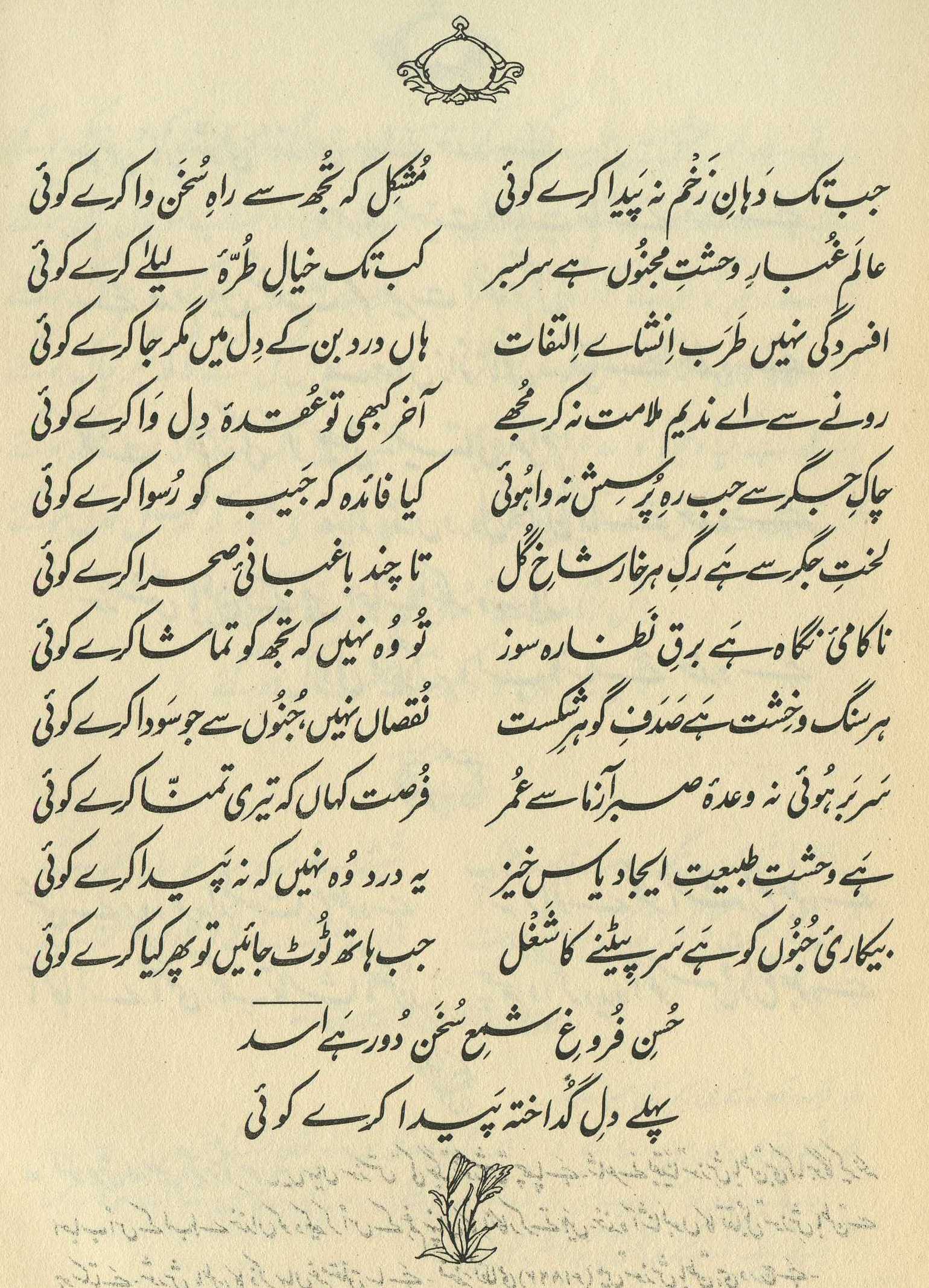
He says, my melancholy is not such that I could be made happy by anyone's kindness; that is, through anyone's kindness my depression of spirits would not vanish.... In short, my melancholy is such that in my heart there's no room for anything except pain. Another aspect is that in sorrowfulness and depression I don't obtain the joy of the kindness of the beloved. Indeed, if someone would create the pain of passion, then there would be room in her heart.
In the phrase both words are Arabic, and the construction is Persian. That is, 'happiness-creating', because means 'creating'; and this is an extremely novel construction. Such finickiness [] is not part of Ghalib's style. It wouldn't be strange if he had said [and there was some scribal error]; or rather, it's safe to say that that very thing would have occurred. (242)
== Nazm page 242

Melancholy of temperament is not such a thing that the beloved could turn it into happiness by casting a glance of kindness on her lover. Indeed, for the lover it's proper that he would become pain from head to foot; at that time the beloved can show kindness toward him. The meaning is that seeing the lover's melancholy, the beloved considers that this person is a lustful one who has become downcast at heart through the harshness of passion. Because of this view, she shows carelessness and inattention. Indeed, if the lover, having become pain from head to foot, would come before the beloved, then the beloved would regard him with a look of kindness. (300-01)
As long as melancholy is left, the beloved's kindness doesn't create a wave of joy in anyone's heart. If someone wants to create space in his heart, then let him become pain from head to foot. That is, the beloved shows kindness to the 'people of pain'-- what else? (434)
The first line is an entirely abstract and quite multivalent assertion; the second line is full of doubts and uncertainties and multiple possibilities of its own. So, this being Ghalib, is anybody surprised?
In normal Urdu usage is a literary term (see the definition above); to make it mean something like 'creating' as the commentators do, we have to go back and re-engineer it from its Arabic root. And even if we do that, we have no grounds for categorically ruling out its normal meaning. The compound , 'joy-composition' or 'joy-style', is so vague and/or strange that we can't assign any one meaning to it. The uninterpretably broad and confusing first line of course works very well in the 'first line, [delay], first line, second line' mushairah performance style.
Moreover, the means that if it's a 'joy-{composition/style} of kindness', an 'A of B', then it might be an 'A that is produced by B'; or it could also be an 'A that is identical to B', or else an 'A that belongs or pertains to B'. And can mean 'respect' or 'civility' in a general sense (see the definition above); it doesn't have to refer to something that only the beloved can bestow on the lover. A structure like 'X is not an A of B' has a range of possibilities in any case, and this one, with its undecideable compound in the 'A' position, has even more than usual.
If we turn to the second line for help, we find a new set of complexities. The initial is mildly concessive, something like 'indeed' or 'to be sure' or 'no doubt'. But then what's the subject? The most obvious candidate is 'someone' []-- 'someone' might, having become pain, make a place in the heart; this is how the grammar works in the other verses of this ghazal. But the could also be an adjective modifying 'place': some unstated subject, most plausibly 'melancholy', might make 'some place' for itself in the heart.
And of course, we don't have any way of knowing whose the heart is. Might the lover be making space in his own heart for melancholy? Might he be making space in the beloved's heart for himself? Might the melancholy be making space for its own self in the heart of one or the other? Might the verse be quite universal, so that the space would be made in some archetypal human heart?
The ambiguity of , as either 'but' or 'perhaps', opens further possibilities, in suggesting two different logical relationship of the two lines.
There's also an enjoyable bit of rhetorical wordplay: is of course a literary term, and has a secondary meaning of 'apostrophe'-- not the punctuation mark, but the rhetorical kind that occurs when a speaker or writer breaks off and addresses an imaginary person or abstract quality or idea. So for that matter, why couldn't we take the phrase in the first line to mean 'melancholy is not a joy-style of apostrophizing'? We could, of course. With so many other possibilities, why not one more?
In short, this is the kind of verse that lives at the center of a penumbra of possible meanings; only with some kind of fuzzy logic can it be read at all. Surely Ghalib meant for us to be both vexed and haunted by it, and to enjoy its moody obscurity.
graphics/heartpain.jpg